First, as noted in previous posts, we are developing a for-profit partner that will pursue some of our work in Washington D.C. and eventually beyond. Specifically, that partner will use advertising-funded napkins distributed in restaurants, bars, cafes and other eateries in Washington D.C. to help inform and engage the public. You can learn more about this Napkin Education Initiative on our Metro D.C. page. We expect the initiative to launch in November or December.
Second, we have also been hard at work creating the content for our new Metro D.C. Weekly Learn. This new, free and local educational initiative will offer via email interesting facts and perspectives on the politics, economics, demographics and history of the Washington D.C. metro area. We expect to start disseminating the Weekly Learn in early October, so sign up now!
Third, we have just moved the Learning Life website to a new server to allow us more control. In this transition, we’re taking the opportunity to make a few changes to the homepage. Please be patient with us as we work to improve the homepage as well as reconnect our quizzes and photos on many of our pages.
Fourth, we are pleased to have a new fall intern, Shuo Wang (she goes by Gladys). A graduate student in information systems technology at George Washington University’s School of Business, Gladys brings considerable technical skills she is putting to use helping with the server transition, the Learning Life homepage changes, and soon, the development of our for-profit partner’s own website. Look for a profile of Gladys in an upcoming issue of our monthly newsletter.
Fifth and finally, we are pleased to announce several new educational releases on our website:
Thanks to Learning Life volunteer Craig Gusmann for his excellent work researching and writing the above three new releases, and to Craig and Georgetown student Ehvyn McDaniels for drafting our latest profile, this one on summer intern, Nick Burton.
Stay tuned for more news in next month’s newsletter!
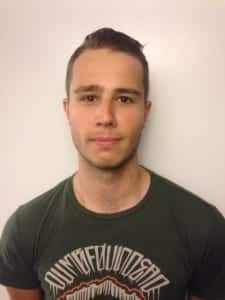
Special thanks to Learning Life intern Ehvyn McDaniels and volunteer Craig Gusmann for helping to draft Nick’s profile.
Virginia native Nick Burton enjoys a good challenge, especially if that challenge involves writing, sports, the internet, or business.
A graduate of W.T. Woodson High School in Fairfax, Virginia, and Potomac State College of West Virginia, Nick served as the editor of The Pasquino, Potomac State’s student newspaper. While the majority of the articles he wrote focused on-campus news, Nick also covered broader issues, like the future of Apple, and the potential for world war in Syria.
This past summer, Nick helped Learning Life with a variety of work including increasing our following on our social media pages, researching funding sources, and gathering facts on varied topics from financial literacy to Washington D.C history, to violence against women worldwide.
Nick recently took the time to answer some further questions about him.
Where were you born? Fairfax, Virginia
What’s your current occupation? I’m a student at Ohio University
What are your hobbies? I love sports. I love to root for all of the D.C. area sports teams – the Nationals, Redskins, and Capitals. I also like to play around with social media and website development in my spare time, honing my entrepreneur skills. I once created a website called “Rap Game Versace Flame” where I posted daily videos, links, and articles on hip hop culture.
Where would your dream vacation happen? Hawaii!
Are there talents or skills you wish you had, or hope to learn? I want to develop the ability to dunk a basketball.
What do you want to become in life? A business owner and millionaire. This fall, I’ve started as a freshman at Ohio University. I am majoring in business, and hope to use what I learn to become an entrepreneur. I am interested in anything from online marketplaces to restaurant chains. I find the idea of being my own boss and paving my own path extremely appealing.
Why did you choose to intern with Learning Life? I chose to intern with Learning Life because working with a developing nonprofit can be a very fun and exciting experience. I also really wanted to do something that had some meaning to it, rather than just sitting in a cubicle doing paperwork that has barely any impact. With Learning Life, I got to help teach people in a unique way.
We at Learning Life thank Nick for his help this past summer, and wish him the best in his pursuits at Ohio University and beyond!
To learn more about interning or volunteering with Learning Life, contact us at email@learninglife.info.
5 FACTS ON FOOD & GENETIC ENGINEERING
Human beings have used selective breeding techniques on plants and animals for thousands of years. Genetic engineering (GE, also known as GM or genetic modification), however, is a much more recent phenomenon, and has stirred considerable controversy over its use in the food supply.
Advocates argue that GE can boost food production for the world’s growing population, and improve the qualities of food, like hardiness, flavor, nutrition, appearance. Opponents charge that, among other things, GE plays with nature, is unsafe, and threatens the diversity of the world’s food supply as well as the livelihood of farmers worldwide who cannot afford to pay for GE crops.
In light of this controversy, Learning Life offers the following five facts about GE’s origins, forms, and use in the food supply.
1) 1973
The year the first genetically modified organism (GMO) was created. That GMO was a microbe. The next year, scientists produced the first GE animals: mice. Source
2) 1994
The year the first genetically modified organism (GMO) — a microbe used to make many cheeses — was introduced into the food supply. Source
3) 17 million farmers, 28 countries
The number of farmers and countries producing GE crops as of 2012. The 170 million hectares of land in use to produce these crops is more than 12 percent of the world’s arable land. Source
4) 88%
The percentage of corn planted in 2012 in the United States that was genetically engineered in some way, according to the U.S. Department of Agriculture. That same year, 94% of cotton and 93% of soybeans were genetically engineered in the USA. Source
5) Zero
The number of GM animals approved by the U.S. Food & Drug Administration (FDA) as meat for food. Currently, GM animals are used for research and medical purposes as well as to produce milk or other products. FDA guidelines state that “developers of GE animals of any species traditionally consumed as food must notify the agency that they are developing such animals, and cannot introduce them into the food supply without prior investigation from FDA.” Source
Live, or Do Business in the Washington D.C. Area?
As I noted in the blog post, “Toward a Local Learning Infrastructure,” last month, Learning Life is pleased to announce two local initiatives launching in the coming weeks: a Weekly Learn, and a Napkin Education Initiative. This post offers more details about these two new projects.
Learning Life’s mission is to inform and empower more people by spreading knowledge on everyday surfaces, like napkins, placemats and posters as well as phones, tables and computers. In pursuit of this mission and developing a local learning infrastructure, we are launching this September a free “Weekly Learn” where Learning Life is based in the Washington D.C. metro area. Once a week, subscribers will receive an email containing a brief, interesting fact or set of facts about the history, economy, politics, people and/or organizations that shape and define the D.C. metro area. It’s a new, free and easy way for D.C. area residents to learn more about their metro community.
The second developing project, the Napkin Education Initiative (NEI), will start spreading informative napkins in metro D.C. eateries in the coming months. The NEI builds on the pilot public education project Learning Life conducted last December with D.C.’s Newseum, a private museum devoted to learning about news and journalism. For last December’s project, Learning Life volunteers conducted street theater and distributed 10,000 interactive napkins (see the adjoining napkin graphic) in restaurants in several commercial centers of Washington D.C. The napkins invited readers to learn about President John F. Kennedy, in light of the 50th anniversary of his assassination in November 2013, by taking a JFK quiz at Learning Life, after which quiz takers could get a discount to the Newseum’s JFK exhibits. You can learn more about this JFK project by watching the short video we produced about the project and Learning Life’s approach.
Following on Learning Life’s JFK project, the NEI will offer selected nonprofits in metro D.C. the opportunity to promote their volunteer opportunities and low-cost or free services free on paper beverage napkins to be distributed in D.C. area restaurants, bars, cafes and other eateries. The NEI will be run through our soon-to-be-formed partner organization, Signia Surfaces LLC. Signia Surfaces will design, print and distribute the napkins on a monthly basis. Each napkin will feature the nonprofit information on one side, and advertising on the other. The advertising will provide companies, nonprofits and governments a new and innovative way to get their message out – on napkins in eateries – while simultaneously helping to promote local nonprofits and inform community residents.
If you live or do business in the D.C. metro area, you can sign up for our free Metro D.C. Weekly Learn, and find out more about the NEI here. Interested napkin advertisers and metro D.C. nonprofits seeking free promotion are encouraged to contact us at email@learninglife.info. Stay tuned for more information about these projects in our next monthly newsletter!

 Second, we have also been hard at work creating the content for our new Metro D.C. Weekly Learn. This new, free and local educational initiative will offer via email interesting facts and perspectives on the politics, economics, demographics and history of the Washington D.C. metro area. We expect to start disseminating the Weekly Learn in early October, so sign up now!