As of September 1, 2019, Learning Life’s Citizen Diplomacy Initiative is called the Family Diplomacy Initiative (FDI) to more accurately represent the family form of citizen diplomacy we are developing. To learn more about FDI, click here.
The Coming International Community of Families
On this third anniversary of Learning Life’s Family Diplomacy Initiative (FDI), we are excited to report that we have been busy this summer preparing for the Initiative’s significant scale up, and name change.
Following the tragic terrorist attacks in Paris, France in November 2015, and in keeping with Learning Life’s mission to spread learning beyond school walls in innovative ways, FDI was established to develop a novel approach to tackling the world’s vicious cycle of terrorism and xenophobia. As a caring-focused institution widely valued across cultures, we believe the family constitutes a potentially powerful force for promoting mutual empathy and a more caring world. Hence, for the last three years we have been developing FDI, first testing small-scale projects, and soon scaling up online.
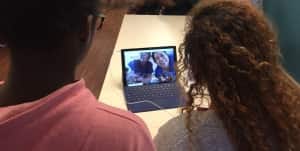
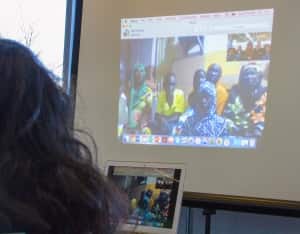
Three years ago, on August 27, 2016, Learning Life held its first live international family-to-family video dialogue between two American families in Washington DC and one Senegalese family in Dakar, the capital of Senegal. In December 2017, we completed our first project, which engaged lower-income families in Washington DC, Dakar, Senegal, and Jerash, Jordan in taking and sharing photos of their respective communities online, ultimately producing a comparative community photo album. In April this year, we completed a second project involving lower-income families in Washington DC, San Salvador, El Salvador, and Dakar, Senegal in learning about each other’s food cultures as well as nutrition. That project, done in collaboration with Georgetown University School of Medicine, yielded two research projects comparing food cultures, plus a second project report issued July 1 documenting the progress our families made in their knowledge, interest and warmth toward the peoples with whom they communicated.
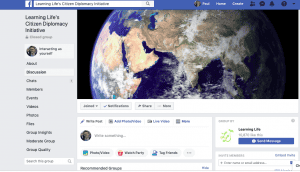
Since May, we have been gathering a large list of relevant organizations in six countries — Argentina, El Salvador, USA, Senegal, France and Australia — in preparation for expanding our Facebook group. Our purpose is to develop an international community of families learning about the world through educational content we provide, and importantly, through sharing photos, videos, and information about their lives. Between September and December this year, our goal is to at least quintuple the number of members of our Facebook group, primarily from those six countries. We chose those six countries given their relative political stability, geographic dispersion, prior Learning Life connections (in the case of the USA, El Salvador and Senegal), and the major languages they speak: Spanish, French or English. We anticipate including families that speak other languages in the future, but for now families do not have to come from these six countries to join; they just should be able to read and write in English, French or Spanish.
This Facebook group expansion will substantially scale up international engagement with FDI, from two dozen to thousands of families by 2020, all with an eye to advancing a family form of diplomacy in the long-term. “Getting larger numbers of families worldwide to share and learn from each other in a supportive online community is the next big step in the evolution of our Family Diplomacy Initiative. We’re excited to see what happens!” said Learning Life’s Founder, Paul Lachelier.
If you would like to join our Facebook community of families, click here and request to join. We will connect you promptly. If you would like to learn more about the thinking behind family diplomacy, and/or our broader project to help democratize diplomacy, click here and here, respectively.
Democracy Dinners Begin
In light of mounting concerns about the condition of democracy at local, national and international levels, Learning Life launched its first Democracy Dinners in June in Washington DC, with more planned in August and beyond.
The Presidency of Donald Trump has raised numerous concerns about democracy. Some of these issues are relatively new, like the proliferation of “fake news” and the influence of Russia on public opinion, American elections and high-level government officials, including the President. Some are longstanding, though now resurgent or more apparent, such as white supremacy movements, Congressional and activist polarization, executive overreach, government corruption, and distrust of the press.
But there are also worries about democracy at local and international levels. At the local level, citizen participation in American school, city and county elections and governance remains lackluster. Middle and upper class citizens as well as developers and other businesses tend to dominate decision-making, usually in their favor. Abroad, more authoritarian leaders have been elected in a number of countries in recent years, including Turkey, Brazil, Italy, and the Philippines, and movements hostile to immigrants, minorities, press freedom, and other elements of diverse democracies are growing.
Given all these and other concerns about democracy, fortunately there are already organizations, new and longstanding, working to bring Americans together across political and social divides, including Bridge Alliance, Better Angels, Make America Dinner Again, Courageous Collaborations, and the Bipartisan Policy Center. Yet clearly more can be done given the wide variety of current threats to democracy.
As the capital of the United States, Washington DC — where Learning Life is based — is home to many influential organizations and individuals who work for pay or free on a wide range of democracy issues local to global, including voting rights, voter mobilization, campaign finance reform, economic democracy, empowering the marginalized, government transparency and accountability, democratization, citizen diplomacy, citizen education, civic engagement, criminal justice, human rights, civil liberties, and more. However, infrequently do people in this broad democracy sector have the opportunity to talk to each other across their specialty silos about their work, and the complexities, challenges and possibilities of/for democracy.
In June, Learning Life launched its first Democracy Dinners in Washington DC with an eye to bringing together democracy activists, academics and professionals across these specialty silos. In contrast with the lectures, panel discussions, and networking events so common in Washington DC and other communities, Learning Life’s Democracy Dinners are purposefully smaller and more participatory, in keeping with the spirit of democracy. Four to six participants are invited to meet at a restaurant in DC, they introduce themselves, talk about their own work and discussion questions about democracy, then pay their own food bills. “The purpose of the Dinners is to encourage activists, academics and professionals to meet and talk about their work, enrich their understanding of democracy’s facets, developments and problems, and foster collaboration when and where participants want it,” Learning Life’s Director, Paul Lachelier, explains.
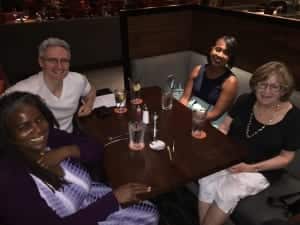
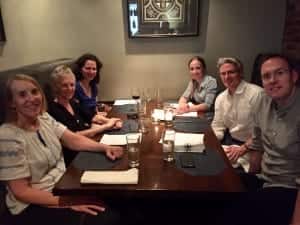
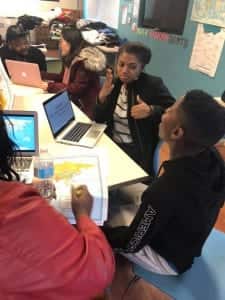
The first two Dinners, on June 23 and 24, involved four and six participants, respectively, including Lachelier who facilitates the conversations. Participants included public affairs and political science professors from American University and the University of Maryland-College Park, a sociologist, a rural policy expert, a grassroots media trainer, a federal defense and human rights lawyer, a National Democratic Institute employee, and a nonprofit leader advancing global education in DC. The conversation ranged widely from race, segregation and gentrification in Washington DC, to LGBTQ rights and human dignity policy in international governance. Photos of the first two Dinners’ participants are featured in this post.
The next Democracy Dinners are scheduled to take place on August 4 and 6.
Learn more about Learning Life’s Democracy Dinners here. If you live in metro DC and would like to be added to the Democracy Dinners invitation list, please email us at email@learninglife.infowith your resume, Linkedin profile page, or personal website. We do not guarantee that everyone will get on the list, but if a person lives in metro DC and works or has experience in the democracy field, they will be added to the invitation list.
Food Culture Project Results Are In!
Learning Life is pleased to release the results of our international food culture and nutrition project engaging families in the United States, El Salvador and Senegal. The project, part of our flagship program, the Family Diplomacy Initiative(FDI), ran from January to May 2019, and yielded significant improvements in participants’ knowledge of nutrition and food culture. The project also increased participants’ warmth toward those foreigners with whom they interacted, their openness to cultural differences, and interest in engaging with the world — encouraging counters to the resurgent nationalism and xenophobia in a number of nations.
Context
Since August 2016, through FDI, Learning Life has engaged lower-income families in different countries in learning together online with an eye to developing a family form of diplomacy in the long term. In August 2017, we completed a community photo project which engaged eight lower-income families (7 parents, 1 grandparent, 16 children) in Washington DC, USA, San Salvador, El Salvador, and Dakar, Senegal. The family participants took photos of their respective communities to share and discuss online to learn about community differences and social change, culminating in an international photo album and a project report published in the professional journal, Childhood Education.
In 2018, Learning Life collaborated with the Georgetown University School of Medicine’s Community Health Division on two qualitative studies that compared the food culture of lower-income families in Washington DC, USA, San Salvador, El Salvador, and Dakar, Senegal. Those studies showed that richer is not necessarily better: while the Salvadorans and Senegalese families live in poorer countries, their diets tend to be healthier, containing more home-cooked meals made with whole foods (click here and here for details on these studies).
In October 2018 to May 2019, we carried out our second project, which, following on the above-mentioned 2018 studies, focused on improving participants knowledge of food culture and nutrition. In addition, participants answered questions about their interest in world affairs plus their tolerance for cultural differences and feelings of national superiority in the same survey completed before and after the project. Eight families participated: six in Washington DC, one in San Salvador and one in Senegal. Three of these eight families also participated in the 2017 community photo project. The eight families engaged a total of six parents, two grandparents and sixteen children for a total of 24 participants, of whom 2 were Salvadoran, 3 were Senegalese, and 19 were American.
Per Learning Life’s FDI selection criteria, all the families were lower-income (household annual income below their nation’s median), had parents with less than a bachelor’s degree, and had minimal engagement with the world, as measured by their number of flights abroad, and contact with people living abroad besides Learning Life staff and volunteers. We set these criteria in order to focus our efforts on those families least likely to be connected to the wider world, in line with our interest in democratizing diplomacy — in essence, widening the circle of participation in world affairs — in the long-term.
Project Details
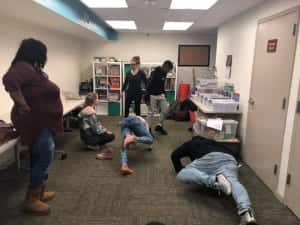
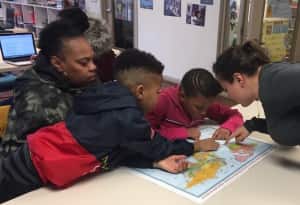
Learning Life’s international food culture and nutrition project engaged the 24 participants in interactive “fundays.” For the families participating in Washington DC, the fundays took place at the Arbor View Community Center in southeast Washington DC, and combined “Move Your Mind” learning units (MMs) focused on geography, food culture and nutrition, with “Move Your Body” exercise units (MBs) oriented to challenging the children with five exercises testing their physical balance, flexibility, strength and endurance. The MM-MB combination was intended to help keep the children engaged, and to underscore the importance of good health in keeping with the project’s focus on nutrition. The families moved from MMs to MBs in 20 minute increments as Learning Life volunteers coached them along the way.
In San Salvador and Dakar, the families connected with Learning Life volunteers in metro Washington DC from their homes via Facebook video to carry out the MMs only at the same or different times. For all participants, the MMs were essential to developing the knowledge they were tested on in the pre- and post-surveys. All families had access via Google docs to the MM learning slides, in English, French and Spanish, at all times during the project period.
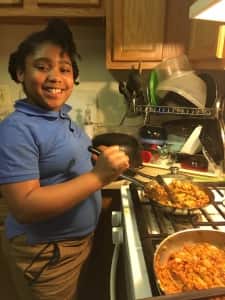
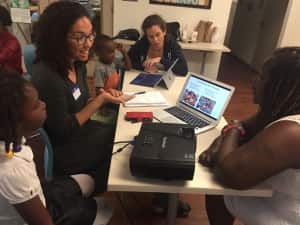
In addition, from October 2018 to May 2019, many of the participants in Washington DC experienced one or more Learning Life cook-eat-learn sessions or CELS. The CELS — held conveniently at the families’ homes, and led by medical students from Georgetown University and A.T. Still University, with guidance from Learning Life Director Paul Lachelier and Dr. Kim Bullock of the Georgetown University Medical Center’s Community Health Division — involved American participants in making then eating healthy Senegalese and Salvadoran meals for hands-on, project-focused learning about foreign foods, meal preparation, and nutrition.
The project offered prizes worth $100, $150 and $200 to the three top scorers among the participating children in the USA, El Salvador and Senegal. All the children received 10 points per funday they attended, plus 10 additional points if a parent or other family adult attended, for a total of up to 100 points over five fundays from February-April 2019. (There were a total of 6 fundays on February 10, 24, March 10, 24, April 7, 28, 2019, but the February 10 funday was not counted to give all families a chance to acclimate to the rigors of the fundays.) The children also received up to 96 points for improvement in their food culture and nutrition knowledge from their pre-survey to their post-survey. The children were thus not competing with each other but rather themselves to see how much they could grow their knowledge.
Research Method
All twenty-four project participants completed pre- and post-surveys to allow us to gauge whether our project fundays had some impact on their interest in world affairs, tolerance for cultural differences, sense of national superiority, and knowledge of food culture and nutrition. Trained Learning Life staff and volunteers completed the surveys with each family participant whether face-to-face or online via Facebook. Learning Life uses the online survey platform, kwiksurveys.com, for all our surveys.
For purposes of evaluating participants’ performance and apportioning points for prizes, two volunteer raters scored the participants’ answers to the survey’s six knowledge questions. Respondents were not given points for their answers to the questions concerning their interest in world affairs and attitudes toward cultural differences and national superiority because we did not want to penalize or reward participants for opinions to which they are entitled. The two raters gave a grade of A, B, C, D, F or 0 for each answer to the knowledge questions. Where the raters disagreed on the grade, a third rater was brought in to read the answer and determine which of the two conflicting grades would stand. The names of all survey respondents were removed to help control bias in the raters’ grading. Respondents received up to 26 points for their answer to the food culture question, and 14 points for each of five nutrition questions. The grades and points were assigned as follows:
Nutrition questions: A=14 points, B=11, C=8, D=5, F=2, No answer=0
In addition, Learning Life staff kept track of attendance and behavior (five points were deducted from 10 attendance points per funday if a child was substantially distracted, disengaged or combative) at each funday to help determine the distribution of points for project prizes.
Survey Results
The results are broken down below by interest in international affairs, tolerance for cultural differences and sense of national superiority, and last but not least, knowledge of food culture and nutrition.
Interest in international affairs
We asked one survey question to gauge interest in international affairs:
“How interested are you in the following, on a scale from 1 to 5 (1 is least interested, 5 is most interested). Again, there are no right or wrong answers. Just answer quickly the way you feel.”
Pre: 3.54/ Post: 3.71 News about international issues and events
Pre: 4.13 / Post: 4.29 Learning about foreign countries and cultures
Pre: 4.0 / Post: 4.38 Talking with families in other countries
Pre: 3.92 / Post: 4.33 Collaborating on projects with families in other countries
Thus, respondents on average reported more interest in all four of the above in the post-survey. The average for all four statements was 3.9 in the pre-survey versus 4.18 in the post-survey, representing a 7% increase in interest in learning about international affairs and engaging with foreigners.
Tolerance for differences and nationalism
We asked two questions here, the first to measure change in tolerance for cultural differences and sense of national superiority, the second to measure warmth or coldness toward different social groups — the so-called “feeling thermometer question.” Here are the results for the first question:
“Please indicate how much you agree or disagree with each statement below, on a scale from strongly disagree to strongly agree. There are no right or wrong answers. Just answer quickly the way you feel.”
Pre: 2.25 / Post: 1.92 “People who look and act differently from me make me uncomfortable.”
Pre: 2.92 / Post: 2.52 “I prefer to live in a community of people who are like me than people who are unlike me.”
Pre: 2.21 / Post: 2.18 “Foreigners who come to live in my country more often cause trouble than do good.”
Pre: 3.33 / Post: 2.96 “My country is probably the best country on Earth.”
Pre: 3.17 / Post: 3.0 “Most people would be happier if they lived as we do in my country.
Note that in this question, the lower the number, the more tolerant and less nationalistic the respondents are. Thus, on all five, respondents on average responded with more tolerance and less sense of national superiority in the post-survey. The overall average for all five statements was 2.78 in the pre-survey versus 2.52 in the post-survey, or a 9% decrease in nationalism and intolerance of cultural difference.
Here are the results for the feeling thermometer question:
“Now how would you rate your feeling toward each group below on a scale from 0 to 100? 0 means you feel the coldest or least favorable to the group, 100 means you feel the warmest or most favorable to the group, 50% means you feel neutral (nothing one way or the other) toward the group.”
Pre: 77.8% / Post: 80.6% People from your country
Pre: 53.1% / Post: 51.5% Russians
Pre: 59.4% / Post: 58.3% Europeans
Pre: 68.0% / Post: 69.9% Chinese
Pre: 70.5% / Post: 81.5% Senegalese, Salvadorans, or Americans [that is, the people participants interacted with]
Pre: 66.2% / Post: 68.7% Refugees
Pre: 82.1% / Post: 63.6% Legal immigrants
Pre: 43.8% / Post: 40.0% Illegal immigrants
Pre: 77.0% / Post: 82.2% All people on Earth
Pre: 80.5% / Post: 79.7% Muslims
Pre: 90.4% / Post: 85.6% Christians
For six of the above eleven social groups, respondents feelings grew colder, and for the other five groups — feelings grew warmer. However, for all but two of the social groups, the changes in feelings were relatively marginal — a change of 5.2% or less. For legal immigrants, the drop of 18.5 points from the pre- to post-survey is much more significant, and may unfortunately reflect the wider diffusion of anti-immigrant sentiments in this historical period since our food project did not discuss immigration, legal or illegal. The bright light, however, is the 11% increase in warmth for those foreigners the project participants learned about and/or interacted with. This coheres with considerable research that shows that more learning about and interaction with foreigners can improve perceptions of them.
Knowledge of food culture and nutrition
88% of participants (21 of 24) improved their knowledge of food culture, nutrition and health from the pre-survey to the post-survey.
23% average score improvement for the 24 participants, or 22 out of 96 maximum points participants could score on the survey’s six knowledge questions. For each question, the average percentage improvement, the actual wording of the question, the question’s correct answer, and the maximum points a participant could gain for the question are as follows:
Question 1 (food culture): 29% improvement. The question: “What have you learned about the food culture of the foreign people you engaged in this project? How is it the same or different from your food culture?” Answer: On this question, there was no precisely correct answer we were looking for since respondents could answer in any number of ways depending on which foreign families they interacted with and the different things they learned about foreign food cultures in interaction with our volunteers and learning activities over the course of the project. (26 max points)
Question 2 (nutrition): 21% improvement. The question: “What is nutrition?” Answer: Nutrition is the study of how your diet affects your health. (14 max points)
Question 3 (nutrition): 6% improvement. The question: “Complete the sentence: The foods I eat affect my…” Answer: Mood, energy, sleep, bowel movements, immunity, weight, skin, hair, nails, etc. (14 max points)
Question 4 (nutrition): 22% improvement. The question: “What are processed foods versus whole foods? Which is better for people, and why?” Answer: Whole foods are generally, though not always, healthier. Processed foods are foods that have been changed in some way. Food companies process foods to make food products that are cheaper, tastier, and more eye-catching. Not all food processing is bad. For example, grapes need to be dried to make raisins or fermented to make wine. Grains need to be milled to make bread and cereal. However, processing is not so good for human health when it strips whole foods (unprocessed foods) of their natural ingredients. For instance, wheat is stripped of much of its fiber to make white bread. Processing is also not so good for human health if it adds extra fat, sugar or salt to foods, or creates food products (like soda, cookies, candy, chips) that have a lot of fat, sugar and/or salt, but few other nutrients. (14 max points)
Question 5 (nutrition): 15% improvement. The question: “A diet high in salt, sugar and saturated fat contributes to what common health problems?” Answer: Heart disease, cancer, stroke, diabetes, obesity, high blood pressure, osteoporosis. (14 max points)
Question 6 (health): 9% improvement. The question: “What can anyone do to have a healthier life now and in the future?” Answer: Eat more whole foods, including fruits, vegetables and whole grains. Drink water rather than soda, juice, iced tea, and other sweet drinks. Eat more beans, and less meat. Walk and exercise more. Sleep at least eight hours per night. Engage positively with your family, friends and community. Help other people. Don’t smoke or do drugs. Don’t drink alcohol excessively. (14 max points)
Participant Feedback
In the post-survey, we asked some additional questions to garner feedback on the project and Learning Life more generally. Here is what we found:
“Overall, how interested are you in continuing to participate in Learning Life?”
4% (1 participant) definitely not interested
0% (0 participants) somewhat uninterested
8% (2 participants) neutral (neither interested nor uninterested)
33% (8 participants) somewhat interested
54% (13 participants) definitely interested
“On a scale from 1 to 5 (1=very bad, 2=bad, 3=fair, 4=good, 5=excellent), how would you rate:”
4.58 average out of 5: Learning Life volunteers and staff
4.63 average out of 5: This food culture project
4.75 average out of 5: Our Citizen Diplomacy Initiative
Here are some of the comments participants wrote when asked what they liked most about their engagement with Learning Life:
“I like how you go to different families, you don’t care about their racial background, you help them learn how to eat healthy and give them opportunities.”
“Learning about the world, continents — it helps me in school because in reading class we do science stuff about Earth.”
“The dialogues between families struck me, the fact that I got to know other families via Learning Life without traveling, just staying in place. Also the fact that it’s not a meeting between individuals but between families because this brings together families. Normally, each has their own phone, but when it’s time for the dialogue, everyone focuses on one telephone and the dialogue.”
Acknowledgements
Learning Life would like to thank the eight families who participated in this project in Washington DC, San Salvador and Dakar. We would also like to thank the many volunteers who helped make this project possible, including Marvin Fan, Suzanne Lachelier, Anna Dezenzo, Vanessa Dos Santos, Yiran Su, Bingying Zhao, Meli Ordonez, Yesica Sorto-Argueta, Cullan Riser, Siyu Wan, Rayna Weiser, Jie Yuan, Derrick Costa, Janae Washington, Naya Frazier, Bridget Doyle, Chloe Weidenbaum, Nikita Deshpande, George Peng, Dahlia Fateen, Amna Nawaz, Claire Kaplan, Matt Statz, Bryan Chan, and Natalie Rice. Thanks also to our organizational partners, FUSALMO in San Salvador, El Salvador, the Collectif pour la Promotion des Groupes Vulnerablesin Dakar, Senegal, and in the United States, A.T. Still University and the Georgetown University School of Medicine’s Community Health Division. Last but not least, thanks to Learning Life’s Founder and Director, Paul Lachelier, who led the project from design to implementation, research, write-up and dissemination.
What Comes Next
Going forward, Learning Life’s Family Diplomacy Initiative is scaling up as an online community on Facebook. Starting this fall, we will be inviting families in El Salvador, Argentina, Senegal, France, Australia and the USA to join our Facebook group to learn, connect and share with families in these Spanish, French and English-speaking countries. We chose these countries given their geographic dispersion in the world, and that they speak French, Spanish or English, which are the languages we at Learning Life most commonly use.
Learning Life will soon be posting weekly dispatches to the group that contain engaging stories, photos and videos intended to stimulate interest in and knowledge of the world as well as tolerance for cultural differences. Further, starting later this year, we aim to periodically invite families in the Facebook group to share written answers and photos in answer to questions we pose to spur sharing and learning among families in these six countries. This next exciting phase in the development of Learning Life’s flagship program, FDI, will thus engage many hundreds if not thousands of families worldwide in our developing family diplomacy. If you and your family are not currently part of our Facebook group, we invite you to join here.