Learning Life’s student interns this fall 2019 are, among other things, supporting our Family Diplomacy Initiative (FDI), planning for the World Affairs Pipeline, and world learning excursions with our children in Washington DC. Amber Spalek, interviewed below, started interning with Learning Life in May, and happily for us, decided to continue interning this fall.
Where were you born and raised?
I was born and raised in Richmond, Virginia.
What school do you attend, and what is your year and major there?
I’m a sophomore at George Mason University studying Global Affairs.
What do you like to do in your free time?
I enjoy learning languages and reading in my free time. I really like non-fiction books about politics and linguistics. I’m especially interested in the history of languages, and sociolinguistics. Currently, I’m learning Mandarin and Cambodian, but I have dabbled in a number of languages.
Is there a life experience you have had that has particularly shaped you thus far? If so, what is it, and how has it shaped you?
The most influential life experience I’ve had was studying abroad in China in summer of 2017, the summer after my junior year. It was the first time that I was fully immersed in another culture, and it changed the way that I view the world. It was the first time that I understood what it is to be an American, and how what we do as Americans influences how other people view us. For instance, American media is so not reflective of the diversity of America, so many Chinese people have the impression that the United States is largely white.
What are your career plans?
I plan to work in international education with a focus on exchange programs.
Why did you choose to intern with Learning Life?
I chose to intern with Learning Life because I am passionate about citizen diplomacy and making international exchange experiences accessible to everyone.
What is the most beautiful place you have seen on Earth, and why is it so beautiful?
The most beautiful place I’ve seen is the Church of the Savior on Spilled Blood in St. Petersburg, Russia. The walls are covered in vividly-colored paintings and gold leaf. It’s a surreal experience being inside of the Church because the walls are so intricately designed, and it’s crazy to think that they were all hand-painted!
Five Reasons Why Diplomacy Should Involve Families
Our world is becoming more complex and interdependent as more people, goods, services and interactions flow across national borders. This changing global reality has triggered xenophobic, sometimes violent reactions that have been validated and amplified by political activists and opportunistic leaders. Diplomacy is rightly upheld as an important response to the mounting tensions within and between some countries, but diplomacy should not be left strictly to professionals. The internet and smart phones open exciting possibilities for citizens to be involved in diplomacy to help promote peace, prosperity and justice, but success and our global future depend in part on fresh approaches. This is the second in a series of posts intended to develop family diplomacy as a new form of citizen diplomacy for a more caring world. Read the first post here.
Thanks to Learning Life intern Marley Henschen for her assistance in the research for this post.
Diplomacy can be simply defined as the management of international relations. Yet the adjective “diplomatic” — that is, dealing with people tactfully — suggests diplomacy is a broader social art or ethic especially needed in our divided world. Given international divides sometimes erupt into violence, why would one want to get families involved? Here are five reasons.
1. Value:
The search for common ground is one of the staple practices of diplomacy, and if there is one institution which people across the world commonly cherish it is probably the family. According to the World Values Survey, when asked to rank family, work, religion, friends, leisure and politics in importance in their lives, the vast majority of people in nations poor to rich throughout the world rank family far above all other aspects of their lives (Inglehart 2018). Indeed, strong majorities of people in 29 countries worldwide — from 75% in India to 99% in Colombia — believe that “more emphasis on family would be a good thing” (Social Trends Institute). Similarly, a 2019 Pew Research Center survey of people in 27 countries found that 58% overall believe family ties have weakened over the last two decades, and majorities in all the countries think those ties should be strengthened (Pew 2019).
2. Impact:
Families are impacted by most international forces and trends, from war and terrorism, to trade and immigration, to climate change and disease transmission. Because families are widely valued and vulnerable to so many international forces and trends, advocates and policymakers frequently call for the protection and support of families, but rarely for their political empowerment. Individual citizens in liberal democratic societies are free to, and in some cases expected to participate in the decisions that affect their lives (at least by voting for their government representatives). In corporatist countries like Germany, Ireland, Sweden and Norway, groups like business associations and labor unions — not just individuals — have a say in government decisions that affect them. Families, like businesses and labor unions, are impacted by government decisions, and have distinct interests and associations representing them on various issues. So, why shouldn’t families also have a seat at the decision-making table, at local to global levels, including international diplomacy?
3. Empowerment:
Involving families in diplomacy can also empower kids, parents and grandparents as global citizens by nurturing valuable experiences, contacts and skills as well as a larger sense of purpose and significance. For these and other reasons, there is considerable interest in the United Nations to include youth in decision-making (see, for example, the 2009 UN Convention on the Rights of the Child, General Comment #12). Yet far less thought is given to involving kids as members of families, including parents, grandparents and guardians. Of course, not all families speak with the same voice, nor do their members speak with equal status, and some voices — especially those of women and children — are often routinely stifled or subordinated within families. But not all families need be engaged in diplomacy. Families that demonstrate interest in diplomacy can be selected from all classes and countries, and should model not only interest, but tolerance and equality so that all people can see men, women and children unafraid to participate. Further, parents, grandparents and children can form distinct groups that meet separately then together to develop then share their respective concerns about, aspirations for, and interests in world affairs.
4. Responsibility:
For most of human history, most kids in hunter-gatherer then settled agricultural societies spent most of their time at work, rest or play with their families and larger kinship groups. With the proliferation of factories and schools in the 1800s, more kids spent more time segregated from their parents. In the most modern societies marked by rapid change, commercialism and individualism, families now spend a minority of their waking time interacting, and seem increasingly strange to each other because rapid change sharpens generational differences, individualism nurtures a desire to lead separate lives based on interests rather than kinship, and commercialism turns families’ attention toward products (screens, games, shows, clothes, music bands, etc.) rather than each other.
There is ample evidence that youth who spend more time alone or in groups of youth unsupervised by parents or other responsible adults are more likely to get injured, do worse in school, and develop behavioral problems, including risky behaviors like consuming alcohol, cigarettes and drugs (Warr 1993, Pettit et al. 1997, Kerrebrock & Lewit 1999, Mott et al. 1999, Colwell et al. 2001, Updegraff et al. 2006, Keijsers et al. 2012). There is no turning back to hunter-gatherer or agricultural societies to bring families back together, nor should we want to return to those harsh, precarious eras. But if modern people still value families, and family supervision encourages kids to act more responsibly, then involving families — not just youth — in government and diplomacy can be a modern vehicle for bringing families together, and for socializing kids as responsible global citizens.
5. Care:
The preceding three reasons deal more with how families would benefit from their involvement in diplomacy. This fifth and last reason points to a benefit for families and diplomacy alike. That is, involving families in diplomacy can promote a culture of care in and beyond the family. Families play a distinct if not unique role as a care-giving institution. Families can look very different — large, small, multigenerational, bi- or multi-national, inter-racial, straight, gay, with one, two or more parents, with adopted kids, etc. — but they all tend to have the same fundamental purpose or aspiration: to care for each other. Publicly elevating (e.g., highlighting, rewarding, publicizing) family care-giving, by making families part of government and diplomacy, has the potential to inspire more caring not only among families, but also in government policy and practice.
In these fractious times, caring families could be a potent force for a more peaceful world.
Colwell, Malinda J., Gregory S. Pettit, Darrell Meece, John E. Bates, and Kenneth A. Dodge. 2001. “Cumulative Risk and Continuity in Nonparental Care from Infancy to Early Adolescence.” Merrill-Palmer Quarterly 47(2): 207–34.
Inglehart, Ronald. 2018. Cultural Evolution: People’s Motivations Are Changing, and Reshaping the World. Cambridge: Cambridge University Press.
Keijsers, Loes, Susan Branje, Skyler T. Hawk, Seth J. Schwartz, Wim Meeus, Tom Frijns, Hans M. Koot, and Pol van Lier. 2012. “Forbidden Friends as Forbidden Fruit: Parental Supervision of Friendships, Contact With Deviant Peers, and Adolescent Delinquency.” Child Development 83(2): 651–666.
Kerrebrock, Nancy, and Eugene M. Lewit. 1999. “Children in Self-Care.” Future of Children 9(2): 151–60.
Mott, Joshua A., Paul A. Crowe, Jean Richardson, and Brian Flay. 1999. “After-School Supervision and Adolescent Cigarette Smoking: Contributions of the Setting and Intensity of After-School SelfCare.” Journal of Behavioral Medicine 22(1): 35–58.
Pettit, Gregory S., Robert D. Laird, John E. Bates, and Kenneth A. Dodge. 1997. “Patterns of AfterSchool Care in Middle Childhood: Risk Factors and Developmental Outcomes.” Merrill-Palmer Quarterly 43(3): 515–38.
Updegraff, Kimberly A., Susan M. McHale, Shawna M. Thayer, and Shawn D. Whiteman. 2006. “The Nature and Correlates of Mexican-American Adolescents’ Time with Parents and Peers.” Child Development 77(5): 1470–1486.
Warr, Mark. 1993. “Parents, Peers, and Delinquency.” Social Forces 72(1): 247–264.
CDI is now FDI
As of September 1, 2019, Learning Life’s Citizen Diplomacy Initiative is called the Family Diplomacy Initiative (FDI) to more accurately represent the family form of citizen diplomacy we are developing. To learn more about FDI, click here.
The Coming International Community of Families
On this third anniversary of Learning Life’s Family Diplomacy Initiative (FDI), we are excited to report that we have been busy this summer preparing for the Initiative’s significant scale up, and name change.
Following the tragic terrorist attacks in Paris, France in November 2015, and in keeping with Learning Life’s mission to spread learning beyond school walls in innovative ways, FDI was established to develop a novel approach to tackling the world’s vicious cycle of terrorism and xenophobia. As a caring-focused institution widely valued across cultures, we believe the family constitutes a potentially powerful force for promoting mutual empathy and a more caring world. Hence, for the last three years we have been developing FDI, first testing small-scale projects, and soon scaling up online.
Three years ago, on August 27, 2016, Learning Life held its first live international family-to-family video dialogue between two American families in Washington DC and one Senegalese family in Dakar, the capital of Senegal. In December 2017, we completed our first project, which engaged lower-income families in Washington DC, Dakar, Senegal, and Jerash, Jordan in taking and sharing photos of their respective communities online, ultimately producing a comparative community photo album. In April this year, we completed a second project involving lower-income families in Washington DC, San Salvador, El Salvador, and Dakar, Senegal in learning about each other’s food cultures as well as nutrition. That project, done in collaboration with Georgetown University School of Medicine, yielded two research projects comparing food cultures, plus a second project report issued July 1 documenting the progress our families made in their knowledge, interest and warmth toward the peoples with whom they communicated.
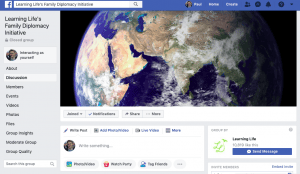
Since May, we have been gathering a large list of relevant organizations in six countries — Argentina, El Salvador, USA, Senegal, France and Australia — in preparation for expanding our Facebook group. Our purpose is to develop an international community of families learning about the world through educational content we provide, and importantly, through sharing photos, videos, and information about their lives. Between September and December this year, our goal is to at least quintuple the number of members of our Facebook group, primarily from those six countries. We chose those six countries given their relative political stability, geographic dispersion, prior Learning Life connections (in the case of the USA, El Salvador and Senegal), and the major languages they speak: Spanish, French or English. We anticipate including families that speak other languages in the future, but for now families do not have to come from these six countries to join; they just should be able to read and write in English, French or Spanish.
This Facebook group expansion will substantially scale up international engagement with FDI, from two dozen to thousands of families by 2020, all with an eye to advancing a family form of diplomacy in the long-term. “Getting larger numbers of families worldwide to share and learn from each other in a supportive online community is the next big step in the evolution of our Family Diplomacy Initiative. We’re excited to see what happens!” said Learning Life’s Founder, Paul Lachelier.
If you would like to join our Facebook community of families, click here and request to join. We will connect you promptly. If you would like to learn more about the thinking behind family diplomacy, and/or our broader project to help democratize diplomacy, click here and here, respectively.


 What school do you attend, and what is your year and major there?
 Why did you choose to intern with Learning Life?