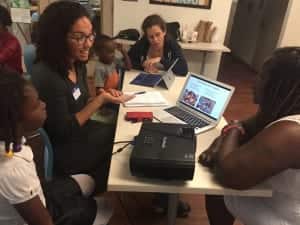
Learning Life is happy to report that we completed our food culture project today!
Launched in January 2018, the project engaged fifteen lower-income families in Washington DC, USA, San Salvador, El Salvador, and Dakar, Senegal in learning from each other and our project curriculum about food culture and nutrition.
The food project follows on Learning Life’s first international project, completed in 2017, which involved lower-income families in the USA, Senegal and Jordan in learning about community through photos they took, shared and discussed, culminating in a photo album featuring selected photos from their different vantage points in the world. Click here for results of that project.
This second international project, part of Learning Life’s Family Diplomacy Initiative(FDI), was completed in collaboration with the Georgetown University School of Medicine’s Community Health Division. That collaboration has thus far resulted in three research conference presentations about the food cultures of some of Learning Life’s families in the USA, El Salvador and Senegal, based on interviews, field observations, and surveys we conducted with them. You can learn more about that research here and here.
By June, we will issue a project report based on pre- and post-project surveys with a subset of eight of the fifteen Learning Life families engaged. The report will detail the project’s impact on the participating families’ interest in international affairs, tolerance for difference, and knowledge of food culture and nutrition. Stay tuned for the report! Also, in the coming months, FDI will be scaling up to engage more families, starting in Spanish, French and English-speaking countries, in world learning from each other plus educational content we provide via Learning Life’s CDI Facebook Group.
Mentor-Mentee Spotlight: Jadyn & Denis
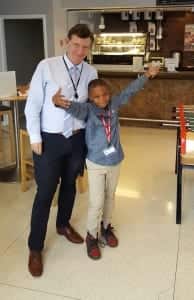
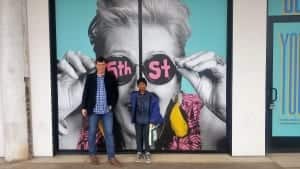
Mentoring can change lives. Learning Life’s mentoring program is different from a typical mentoring program in two ways. First, we mentor Learning Life’s kids wherever their families live in the world. Second, our mentors, all based in the United States, focus on opening our kids to the world through conversation, discussing videos, articles, photos or other content, and in Washington DC, where our mentors can meet face-to-face with their local mentees, through visits to museums, libraries, embassies, cultural festivals, foreign restaurants and other venues. Denis Chazelle has been mentoring Jadyn Walker since September 2018. Learn more about each of them below. Learn more about our mentoring program here.
Mentee: Jadyn Walker
Where were you born and where have you lived so far?
I was born in Washington, DC, and have lived here all my life.
Where do you go to school, and what grade are you in?
I go to school at Friendship Chamberlain Elementary School. I am in fourth grade.
What is/are your favorite subject(s) in school?
My favorite subjects in school is math and social studies.
What are your hobbies?
I like to play on the playground and play drums.
What do you like about your mentor?
He takes me to a lot of places, and he’s really nice.
What’s one rewarding experience you’ve had thus far with your mentor, and what made it rewarding?
Going with him to his house to play board games and learn about the world.
Mentor: Denis Chazelle
Where were you born and raised?
I was born and raised in Troyes, the historic capital of the Champagne region of France.
What’s your current and/or past line of work?
I am the Executive Director of the French-American Chamber of Commerce in Washington DC. In the past, I have been a teacher at the French International School and then an entrepreneur: co-owner of an indoor soccer facility, owner of a computer training company with 4 different centers, and an IT (information technology) consultant.
What are your hobbies?
I enjoy mountain biking throughout the world. I have done long distance races such as the Tour Divide, going from the Mexican border to Banff, Canada, the French Divide going from the Belgian border to the Spanish one, and I have crossed the French Alps three times. I also enjoy watching professional basketball (the NBA), dining at new restaurants in DC, and I’m a bit of a political junkie (lots of CNN and MSNBC).
Why did you choose to volunteer with Learning Life?
I think it fits my skills and international background. I like kids, and I think it’s important to give back and to help those who may not have the same opportunities I have had. Learning Life teaches kids by exposing them to the world, and I can help do that a little bit.
What do you like about your mentee?
Jadyn is smart, curious, very friendly, and eager and quick to learn. He’s also fun to be with, and I can spend time with him without feeling like I’m baby-sitting him. It’s enjoyable.
What’s one rewarding experience you’ve had thus far with your mentee, and what made it rewarding?
I think our visit to the French Embassy in Washington DC, where I have my office, was special. Jadyn was very quick to make friends with everyone he met there, from the Chef, to the server at the Cafe, to the guards at the gate, to the Embassy Police, to the IT specialist, to military attaches and even to the General, with whom he had lunch!
Seven Ways of Being in the World
Given globalization — in short, countries’ growing economic, political and environmental interconnection driven in part by advancements in communications and transport — it behooves those interested in the wider world to consider the ways that people live in or engage with the world. Why? Because some of those ways are good, some are problematic, and all together reveal sharp inequalities. I see seven ways that people cross (or do not cross) national borders and live in the world, for better or worse.
It is worth stressing that the following seven ways describe not types of people but ways of being, that some (usually more privileged) individuals can shift from one way to another sometimes in the same week or day, and over a lifetime any person may engage with the world in more than one of these ways. Also, my definitions of these seven ways are overall more encompassing and in many cases different than those of other organizations, like the United Nations and Amnesty International. Further, I do not provide estimates on the numbers of people engaged in these seven ways of being in the world since others provide estimates, these numbers change constantly, and my purpose here is to paint a bigger picture.
1. The disengaged: It is probably best to start with the largest group, who are not engaged with the world outside their country much if at all. Whether due to ideology, geographic isolation, institutional disconnection, insufficient resources, or some combination thereof, the disengaged know little about the world and have traveled little if at all outside their country. Because the world outside their country, or even their community, is far and foreign in their minds, some (not all) of the disengaged are wary of foreigners and of traveling abroad.
2. Non-exploited workers: These workers move out of their native country, with or without their family, to find or take work in other countries. They typically have had relatively privileged upbringings, have more education and social status, have legal right to work in a foreign country, and make more money from their work. They may be government foreign affairs officers, transnational business executives and employees, or nonprofit workers. Like exploited workers, non-exploited workers more commonly live and work in richer countries, where there are more economic opportunities, and life is more stable and prosperous.
3. Exploited workers: Like non-exploited workers, exploited workers leave their native country to find or take work, with or often without their families. However, they tend to have unprivileged upbringings, less education and social status, may not have the legal right to work, and take jobs that do not pay well by the host country’s standards. Furthermore, their employers or managers often overwork or otherwise abuse them (yell at them, hit them, sexually harass or assault them, expose them to dangerous working conditions, etc.) yet the workers voluntarily endure the exploitation because they are able to work and earn more money than they would in their home communities. Many work in construction, farms, factories, or domestic service. Many exploited workers do not see their families for long periods of time, yet they receive enough in wages to send home money (“remittances”), which can constitute a significant portion of their families’ and countries’ income.
4. Slaves: Millions of people in the world are enslaved, despite the fact that laws in most countries prohibit slavery. Unlike exploited workers, slaves do not voluntarily submit to their exploitation; they work and are confined against their will, often in their own countries. Most are poor, and come from poorer and highly unequal countries. Some get tricked with promises of better lives and trafficked into richer countries, where they commonly do sex, factory, farm and/or domestic work.
5. Refugees: Unlike exploited workers who leave their home country for better economic opportunities, refugees flee their country due to war, persecution or natural disaster. More conflict, authoritarian government and climate change usually mean more refugees. Some refugees are legally accepted in foreign countries. Others — called “asylum seekers” if they’re escaping war or persecution — are not, and live insecure lives as they seek legal permission to live in the country they fled to, working whatever undocumented jobs they can find to make ends meet.
6. Vacationers: As incomes rise across the world, more people have the disposable income to be able to travel abroad. The standard vacationer visits a foreign country to consume its food, sites and experiences, and to have a good time. Some travel companies create all-inclusive resorts so that vacationers never have to leave the resort to see the country and people around it. Vacationers understandably tend to flock to politically and economically more stable countries, but all countries welcome foreign vacationers with open arms because they have more money than most of the world’s people, and they usually spend more money on vacation than they do at home.
7. Global citizens: Global citizens are typically as privileged as vacationers, but unlike vacationers they travel abroad primarily to learn and/or volunteer rather than consume and have a good time. Whether they take classes, volunteer as teachers, community developers or religious missioners, they tend to engage more deeply than vacationers with the people of the foreign countries they live in or visit. As more people across the world get more income and education, global citizens, like vacationers, will likely become more common (assuming relative peace and economic stability among nations). Among these seven ways of being, global citizens may also be the best grassroots agents for nurturing goodwill among nations.
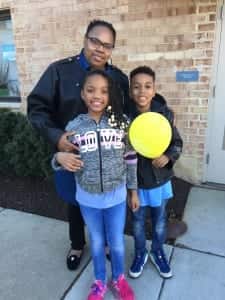
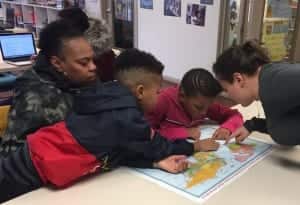
Learning Life is pleased to present this latest spotlight on families involved in our Citizen Diplomacy Initiative (CDI). The Saunders Family, featured in the adjoining photograph, recently joined CDI, and have been participating in our fundays, which start with a food tasting to encourage learning and adventurousness with world foods, then follow with a series of world learning and physical fitness challenges. Below, each participating Family member — the grandmother, Carol, granddaughter, Aubrey, and grandson, Deon — tell us more about themselves and what they like about Learning Life.
Carol Saunders
Where were you born and raised?
I was born and raised in Washington DC. I have lived in DC all of my life, except for one year in Columbus, Georgia in 2012.
What’s your current and/or past line of work?
I am currently disabled, but volunteer a lot. I previously worked as a nursing assistant, medical assistant, and in retail sales for Goodwill Thrift Store.
Is there a life experience you have had that has particularly shaped you thus far? If so, what is it, and how has it shaped you?
The day I was able to help someone. It had to be about 2004. I was home and disabled. I had to figure out a way to keep myself busy, not go into depression, and help other people. So, I decided to give back by volunteering. I started with my grandkids, helping with food, security, counseling at their school for after-school events. Then I started helping seniors. Four years ago I started volunteering at Arbor View Community Center, helping seniors to find and get things, like housing, food, transportation, counseling, medical care, etc. The volunteering helped me come out of depression and feel better about myself as I helped others feel better.
What do you like most about Learning Life?
I like the exposure that Learning Life gives kids to different cultures and countries. I like the volunteers that Learning Life has. They’re good people.
What’s one experience you’ve had with Learning Life that has been particularly meaningful to you?
Sitting down with a volunteer to learn about other countries. It helped me to help my grandkids. Sitting there together learning along with my grandkids was a plus.
Aubrey Saunders
Where were you born, and how old are you now?
I was born in Washington DC in 2011. I am seven years old.
What grade are you in, and what’s your favorite class in school?
I am in first grade. My favorite classes are reading and art.
What do you like to do in your free time?
I like to play with Slime, and I really love to do arts, like painting and drawing.
What would you like to be when you grow up?
I want to be a teacher for little kids.
What do you like most about Learning Life?
I like the [funday world food] tastings, the computer work learning about the world, and the [fitness challenge] exercises.
Deon Saunders
Where were you born, and how old are you now?
I was born in 2010 in Washington DC. I am eight years old.
What grade are you in, and what’s your favorite class in school?
I am in third grade. My favorite class is gym.
What do you like to do in your free time?
I like to play dodgeball, basketball and football.
What would you like to be when you grow up?
[Smiles.] That’s hard…I would like to be a dirt bike rider or a banker.
What do you like most about Learning Life?
I like the [funday fitness challenge] exercising, and the [world tasting] foods we eat, like mangoes and peanuts.


 Learning Life is happy to report that we completed our food culture project today!