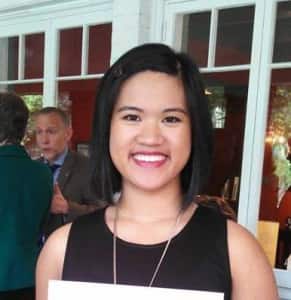
Michelle Vergara grew up in Florida, studied behavioral economics at Stetson University, then moved to Washington D.C., whereupon she began volunteering with Learning Life in the summer of 2014. Michelle and Learning Life founder, Paul Lachelier, overlapped at Stetson University over two years, but never met there. Nonetheless, Paul and the rest of the Learning Life team are very happy to have Michelle on board as she ably helps us with planning, analysis and marketing. Michelle kindly took a little time out of her schedule to answer the following questions about her.
Thanks to Learning Life writer, Craig Gusmann, for help with editing Michelle’s profile.
Where were you born?
Manila, Philippines
What did you want to be when you were a child?
I was an avid reader as a child, so I wanted to be a creative writer with the dreams of one day writing the novels that I loved reading. As I grew older (and more disenchanted) I realized I also wanted to make enough money to eat everyday and so I pivoted my ambitions to be a journalist.
What is your current occupation?
I’m a Sales and Marketing Associate at the Advisory Board Company.
What are your hobbies?
I like reading, museum-hopping, attending the finest and cheapest comedy shows and concerts that DC has to offer.
Do you have any secret talents?
In college, my main mode of transportation was via longboard. I used to be a huge longboard fan until I broke my wrist my freshman year. The longboard traffic also increased as frat boys also picked it up, and so I just avoided it altogether.
What talents or skills do you wish you had or hope to someday learn?
Bartending and making craft cocktails
What is your fondest childhood memory?
My favorite childhood memory was having sleepovers at my friend’s house. Her dad is an architect and her house was designed to have lofts and spiral staircases leading to multiple levels of the house. I was young, so I never really knew how big it was, but her house seemed like an endless adventure to me.
What is your dream vacation?
A jaunt across countries in Southeast Asia like Cambodia, Vietnam, and Thailand. And then a pit stop in Hawaii.
Are there any other interesting tidbits about yourself you would like to share?
I graduated from Stetson University (same university where Paul worked as a sociology prof), where I graduated magna cum laude with a BA in Behavioral Economics. I was the commencement speaker for the class of 2014, and while I can’t remember what I talked about to save my life, I’m sure there’s a video of me floating around somewhere. I currently live in Rosslyn, down the street from the Iwo Jima Memorial and the Netherlands Carilion. The first time I was in DC was a field trip my junior year in high school and I absolutely fell in love with the place. I loved the Metro system and how everyone was running all the time. I came back for a semester program at American University and I can proudly say that I now live and work in the DMV full-time.
What do you want to become in life?
I’m at the inevitable crossroads in my 20’s where I don’t really know what I want to be in life and I’m just trusting myself and the universe to know it when I see it. Right now, I work at the Advisory Board Company where I’m looking to work either as a business analyst or dedicated advisor in the higher education field. But in the long-term, I would like go back to school for an advanced degree in economics or business.
Why did you choose to volunteer with Learning Life?
I chose to work with Learning Life because it marries my two interests in start ups and education.
Five Facts on Boko Haram
Boko Haram is currently one of the most violent Islamist organizations in the world. Operating in Nigeria, Boko Haram has abducted hundreds of people, killed thousands (including many civilians), destroyed schools and villages, and attacked the Nigerian media, military, government and international targets, like the United Nations. As awareness of Boko Haram grows, Learning Life offers the following facts to better understand the group and its context.
1) Name
Boko Haram’s full name is Group of the Sunni People for the Calling and Jihad (“Jama‘atu Ahl as-Sunnah li-Da‘awati wal-Jihad”). The name “Boko Haram” means “Western education is forbidden.” (Boko, from colonial English, means “book.”) That shorter name was created by neighbors of Boko Haram’s mosque in Maiduguri, a city in northeastern Nigeria.
2) Objectives
Boko Haram seeks to create an Islamic state ruled by sharia law in Nigeria. The group considers the Nigerian government and the nation’s Islamic religious establishment corrupt, false Muslims.
3) Origins
Some sources trace the origins of Boko Haram back to the 1990s. In 2002, Boko Haram (not then known as Boko Haram) followers — some of whom were the sons of wealthy elites in northeastern Nigeria — left the city of Maiduguri to separate themselves from what they saw as a corrupt government and Islamic religious establishment. They formed a separatist community based on hardline Islamic law, and eventually clashed with police, leading to the killing of most of their members, including their leader, Mohammed Ali, in early 2004.
The survivors eventually returned to Maiduguri, building a new mosque and expanding their membership. They clashed again with Nigerian police in 2009, leading to even more violent and widespread government reprisals and the death of their leader, Mohammed Yusuf. Boko Haram survivors escaped, but returned to attack Maiduguri in 2010, and have since proliferated their attacks.
4) Nigerian History
After more than 150 years of British influence and direct rule, Nigeria gained its independence in 1960. A bloody civil war marked by ethnic tensions, then a series of military dictatorships followed, until the establishment of democracy in 1999. Half of Nigerians identify as Muslims — mostly Sunni, with many living in northern Nigeria — while most of the other half identify as Christians, mostly Protestant due in part to the legacy of British rule.
Nigeria’s population grew rapidly in the 20th century, tripling between the 1970s and 2000s. Nigeria is now the most populous nation in Africa, and the 7th most populous nation in the world. Nigeria is also rich in oil, and a major supplier of oil to the world, but that wealth has not spread equitably, enriching some, and embittering many — including Muslim radicals — who view the Nigerian government as corrupt and repressive.
5) “Foreign Terrorist Organization”
On November 13, 2013, the U.S. Department of State announced the designation of Boko Haram as a “Foreign Terrorist Organization.” A FTO designation allows the United States to support foreign countries in their fight against the FTO, pursue those who assist the organization, and spread awareness internationally of the organization as a terrorist group. Click here for a list of the dozens of organizations worldwide that the U.S. has labeled as FTOs since 1997.
Satellites and other spacecraft are vital to communications, security, economic development, weather tracking, and environmental protection on Earth. In 1998, the malfunctioning of a single satellite disabled radio and TV networks, pagers, ATMs, and credit card transactions, affecting millions of people in North America. Learn about the mounting problem of outer space junk or debris with the following five facts from Learning Life.
Thanks to Learning Life writer, Derrick Costa, for helping to research and write these facts.
1) 1,000 satellites
There are currently some 1,000 operational satellites orbiting Earth. These satellites belong to more than forty different countries.
2) 500,000 pieces of space junk
There are more than 500,000 pieces of space junk or debris — man-made debris (e.g., satellites, spacecraft, and pieces from these), and natural meteroids — that NASA (National Aeronautics & Space Administration) and other space agencies track.
3) 17,500 miles per hour
These pieces of space junk all move at speeds up to 17,500 miles per hour, which is fast enough for even small pieces to do serious damage.
In 2009, an operational U.S. satellite and a defunct Russian satellite, each weighing more than 1,000 pounds and traveling 17,500 miles per hour, collided, creating almost 700 pieces of debris that could threaten operational satellites and spacecraft for decades. Thus, the more debris, the more chances for collisions, and the more collisions, the more debris, creating a spiraling problem.
4) 25 sticks of dynamite
A piece of debris the size of just a tennis ball is about as destructive as 25 sticks of dynamite. Space agencies can more accurately track pieces 4 inches/10 centimeters or larger in diameter, and call on satellites or human-operated spacecraft to engage in evasive maneuvers when they have sufficient notice. But sometimes they do not have sufficient notice, and even smaller pieces of debris can pose a serious threat as they are harder to track yet can still do serious damage.
5) Space Debris Mitigation Guidelines
In 2008 the United Nations General Assembly adopted these guidelines which call for limiting the number of satellites and other space equipment that are no longer in operation. These guidelines are voluntary, not mandatory, though. Nations continue to abandon equipment in outer space after they have completed their missions and ceased operating, which is why some are calling for nations to be required to remove their space junk from outer space.
Learning Life’s Progress, 2015 Plans, and How You Can Help
Dear friends of Learning Life,
I founded Learning Life in 2012 to nurture a wider culture of learning by spreading knowledge on everyday life surfaces, like napkins, cup sleeves, even fortune cookies. In so doing, Learning Life seeks to inform and engage more people by making information that matters to people’s lives – about health, education, work, government services, local nonprofits, etc. – more widely available in everyday life.
Since I founded Learning Life with the help of advisors, volunteers, interns and donors like you, together we have:
1) Conducted Three Innovative Pilot Projects
We conducted three innovative projects with Washington D.C.’s Newseum and the City of Alexandria, Virginia using napkins, drink coasters, tote bags, wallet cards and fortune cookies to engage people in learning about local to national history. (You can learn more about these projects here.)
Importantly, these projects recently led to the launch of Learning Life’s partner, Signia Surfaces, to help advance our work using ad-funded surfaces to inform and engage people in their communities, starting in Washington D.C. Stay tuned for more news about Signia Surfaces as it grows!
2) Extended Our Reach Online
On Learning Life’s website, we have grown from less than 2,000 visitors per month on January 1, to more than 4,500 now – a 250%+ increase.
On Facebook, we have increased our connections more than 600% from less than 1,000 individual “likes” on January 1, 2014 to more than 6,000 now.
3) Expanded Our Free Educational Content
Since January 1, 2014, we have raised the number of free quizzes we offer on Learning Life’s website from 39 to 55, with a new quiz posted every month on varied topics from climate change, to American women’s history, to profiles of countries like China, Syria and Mexico.
A free email “Metro D.C. Weekly Learn” that offers interesting facts on the politics, economics, demographics, people and organizations that shape the Washington D.C. metro area.
Our Plans for 2015
In 2015, Learning Life will continue to produce and disseminate quizzes, facts, big questions and other educational content on topics of public importance, from terrorism to food psychology to world geography, absolutely free of charge. We will also continue to expand our audience, and engage in pilot projects when we can to test and improve our innovative approach to incidental learning (you can learn more about our approach here).
In turn, our partner, Signia Surfaces, will work to spread learning on everyday surfaces in metro Washington D.C., starting with ad-funded napkins promoting local nonprofits free in order to inform and engage more residents in their community.
Four Simple Ways You Can Help
Here are four simple ways you can help right now:
1) Like Signia Surfaces’ Facebook page. The page was just launched in mid-November this year, so we’re working to increase the number of people who “like” our page. Please also invite some of your Facebook friends to like us as well. If you’re on Linkedin too, please follow Signia Surfaces on Linkedin.
2) Donate to Learning Life. Signia Surfaces is designed to bring in its own revenue through advertising, but Learning Life relies largely on individual donors. Your donation helps Learning Life produce and spread our free educational content, and pursue creative projects to deepen our impact. If you can donate, please consider becoming a sustainer: sustainers help us develop a more regular base of funding by giving a tax-deductible amount (e.g., $5, $10, $25, $50, $100) monthly that’s automatically deducted from your credit card or checking account.
3) Subscribe to our Metro D.C. Weekly Learn. If you live in the Washington D.C. metro area, subscribe to Learning Life’s Weekly Learn. It’s a free, local learning opportunity worth spreading, so please also share it with your family, friends and colleagues in the area.
4) Shop through iGive.com, and help fund Learning Life free. Shop more than 1,400 stores through iGive, and if you make Learning Life your charity, a percentage of your purchase will be donated to Learning Life at no cost to you.
Thank you very much for your support! I will keep you informed about our progress in 2015 via Learning Life’s monthly e-newsletter and Facebook page.

 What is your current occupation?


