Learning Life was busy in 2018, and has ambitious plans for 2019! In brief, we launched an international mentoring program, tested a global storytelling challenge as well as “cook, eat and learn sessions” or CELS, and engaged families in four countries in an ongoing food culture project. This post reports on each of these initiatives, reveals our plans for 2019, and explains three simple ways you can help.
Food Culture Project: Following on our successful 2017 community photo project, we moved our flagship program, the Citizen Diplomacy Initiative (CDI), forward with a new project intended to develop ten participating families’ understanding of nutrition and food culture through conversations and meals. This project marked the first time that Learning Life staff met face-to-face with some of our families and an organizational partner abroad. In March, my wife and I visited the Collectif pour la Promotion des Groupes Vulnérables, a partner association of men in Dakar, Senegal who provide free educational programming for families and youth in their lower-income neighborhood. We conducted research to compare the food culture of three of the Collective’s families with that of three of our lower-income families in DC to gain a better sense of the relative healthfulness of their food practices and beliefs (click here for the research results). This project was the concrete start of a long-term collaboration between Learning Life and Georgetown University Medical Center’s (GUMC) Community Health Division to improve the health of our families in DC and abroad. That collaboration led to further research and four conference poster presentations in 2018. We plan to complete the food culture project in spring 2019.
Cook, Eat & Learn Sessions (CELS): Launched in fall 2018, CELS are an outgrowth of Learning Life’s partnership with GUMC’s Community Health Division. In September, six GUMC medical students, working in pairs, began meeting with several of our families in DC at their homes to cook and eat a meal together while learning about nutrition, cooking and foreign food culture. Each pair of medical students was charged with coming up with a meal that is foreign, tasty, inexpensive, easy to make and accessible (i.e., the families can buy the ingredients from their closest supermarket). The CELS are intended to deepen our families knowledge about nutrition and cooking with an eye to improving their health in the long-term. In 2019, we will continue the CELS with our families in DC, and possibly, depending on interest, develop virtual CELS between DC area students of health and medicine, and our foreign families.
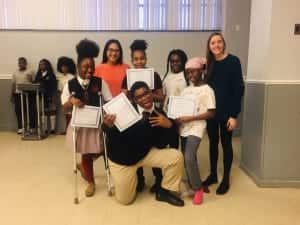
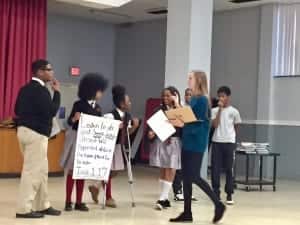
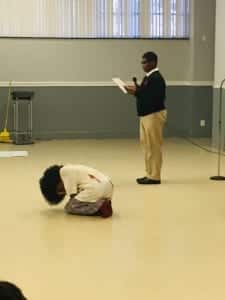
Global Storytelling Challenge: Likewise launched in fall 2018, the pilot Challenge engaged five middle school students at the Saint Thomas More Catholic Academy in DC’s Ward 8 in learning about international issues (e.g., climate change, war, poverty, gang violence, gender inequality) then creating and performing stories about issues the students chose. In December, the students, led by two George Washington University International Education Program graduate students, Nichole Hutchins and Rujjares Hans, performed their stories before their schoolmates and teachers in two competing teams of three and two students. Research on storytelling suggests that this art form can improve student engagement, visual memory, information recall and language skills as well as create a more welcoming and tolerant learning environment (more on this research in an upcoming Learning Life post). Hence, in 2019, following the food culture project, we aim to complete a second Global Storytelling Challenge involving more children in DC as well as abroad.
Mentoring: Informal mentoring Learning Life volunteers did with some of our youth in Washington DC in 2017 showed that those children exhibited more self-confidence, knowledge, and motivation to participate in our programming. Mentoring also helped forge more trusting, participatory relationships with participating families. Accordingly, in 2018, we launched a mentoring program to support CDI. Our mentoring connects DC area college and graduate students as well as professionals in mentoring our youth not only in DC but where we work abroad: in San Salvador, El Salvador, Dakar, Senegal, and Jerash, Jordan. Our mentors and mentees in DC meet at least once per month to visit foreign embassies, museums, cultural festivals, restaurants and more. Our mentors mentoring children abroad meet with their mentees live via Facebook or Skype at least twice per month to read articles, watch videos, and discuss their thoughts and experiences as well as the mentees’ ambitions and plans. For both the mentees in DC and abroad, the mentoring is intended to deepen their understanding of the world, and connect them to ideas, resources and educational opportunities that can improve their lives. Currently, we have 15 mentors mentoring 11 children in DC and 5 children and adults in El Salvador, Senegal and Jordan, with plans to up to double the number of mentor-mentee pairs in 2019.
As we move into 2019, here are three ways you can help:
1)Donate to support our work. Learning Life does a lot with little funding. The money you donate pays for food, printing, youth awards, and other items that help recruit and motivate our families and carry out our programs. When you donate, please consider becoming a Learning Life sustainer by giving $5, $10, $20 or whatever amount you are comfortable with per week or month through your credit card.
2) Volunteer with Learning Life: Volunteers do the bulk of Learning Life’s work. You can help with mentoring, international learning activities, language interpreting, document translation, planning, fundraising, recruitment, research, writing, graphic design, video marketing, and other tasks. To learn more, contact us at email@learninglife.info.
3) Shop through iGive.com, and help fund Learning Life free. Shop more than 1,400 stores (Amazon, Apple, Best Buy, Crate & Barrel, The Gap, KMart, Nordstrom, Sephora, Staples, Starbucks, Target, T-Mobile, Walgreens, and many more) through iGive, and if you make Learning Life your preferred charity, a percentage of your purchase will be donated to Learning Life at no cost to you.
On Monday this week, laughter and screams erupted from a school cafeteria in Washington DC as two student teams competed in telling stories about pressing international issues.
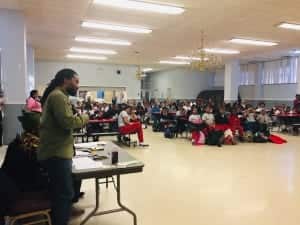
The students, 7th and 8th graders at Saint Thomas More Catholic Academy (STM) in southeast DC’s Ward 8, were participating in Learning Life’s pilot Global Storytelling Challenge in partnership with STM. “We live in one world, we all like stories, and stories can change the world,” Learning Life Director Paul Lachelier told the students assembled to view the students’ stories. Research on storytelling suggests that this art form can improve student engagement, visual memory, information recall and language skills as well as create a more welcoming and tolerant learning environment. This Challenge was a first experiment in storytelling for Learning Life and STM intended to encourage youth interest and learning about international affairs.
The students participating in the Challenge met for six weekly sessions in October-December at STM with two Learning Life teachers, Rujjares Hans and Nichole Hutchins, both Master’s students in the International Education Program at George Washington University. During the sessions, Ms. Hutchins and Ms. Hans first guided the students through videos and discussions to learn about various international issues that impact health, including climate change, poverty, violence against women, child labor, and human trafficking. They then formed two teams, and each team chose an issue that interested them most and crafted a story to help inform their fellow STM students about that issue.
One team presented a story about a young Cambodian girl compelled to work in a village brick factory rather than go to school to help support her family. The other team told a story of a young Sudanese girl whose mother is tricked into delivering her daughter into slavery as a domestic laborer in Brazil. Their stories were evaluated by three judges with substantial experience in storytelling: “The Moth” storyteller Nick Baskerville, Vera Oyé Yaa-Anna, founder of Oyé Palaver Hut, and John Johnson, founder and artistic director of Verbal Gymnastics Theater Company. The audience, composed of STM teachers, staff, and students in Grades 2-8, then had the opportunity to make some noise in support of the team they thought performed better. The story about the Sudanese girl won the judges’ critical acclaim and the audiences’ enthusiastic screams, but both teams were awarded certificates and small cash rewards for completing the pilot Challenge.
The student storytellers and STM staff enjoyed the Challenge. “The best part is that I had fun acting with my friends and learning new facts about the world,” said one of the student storytellers in a post-Challenge survey. “STM is thrilled to have participated in this first Global Storytelling Challenge, and we look forward to working with Learning Life on the next Challenge in 2019,” said STM Principal Gerald Smith.
In coming years, pending funding, Learning Life may expand the Challenge to involve more youth in Ward 8 and possibly other communities in the world with which we work in a more competitive international storytelling contest with bigger prizes. Stay tuned!
Intern Spotlight: Yaxeni Valero
This is the second of two spotlights on our fall semester 2018 student interns. Learning Life’s students this fall are assisting with curriculum development, research, and youth international learning activities as part of our Citizen Diplomacy Initiative (CDI). Yaxeni Valero, interviewed below, is helping with gathering educational content on mentoring, storytelling and health, assisting with health-learning youth activities, and more.
Where were you born and raised?
I was born and raised in Houston, Texas.
What school do you attend, and what is your year and major there?
I am currently a sophomore at Georgetown University pursuing a major in Global Health and a minor in Psychology.
What do you like to do in your free time?
In my free time, I enjoy volunteering in the community, including packing meals for the homeless, and teaching science to children. I also really enjoy trying new foods and finding new places to eat out. I’ve discovered and really enjoy sushi and Korean beef bowls.
Is there a life experience you have had that has particularly shaped you thus far? If so, what is it, and how has it shaped you?
When I was in middle school, I can remember helping my mother study for her citizenship test by testing her with index cards. At a young age, I did not understand the true magnitude of the situation and how impactful it was for my mother. As I got older, I began to hear about immigration issues and learn about politics. More recently, as I learned about Central American immigrant families being torn apart at the US border, my mind drifted to that memory. Something in me shifted. I learned to appreciate what I was once too young and uneducated to understand. This shaped me into a more open-minded, education-seeking individual. I always wanted to do good, but now, I want to truly learn as well — not just learning from a textbook, but learning that connects those textbooks to real life around me and helps me make a difference.
What are your career plans?
In the future, I wish to travel to poorer, undeveloped countries so that I can further understand the differences that are encountered in places where resources are scarce and poverty is high. I wish to look at health care and disease and understand how this shapes people’s lives and how it can be alleviated or prevented.
Why did you choose to intern with Learning Life?
I chose to intern with learning life because I value education. It’s a powerful tool that gives people more control over their own lives. I also value Learning Life’s work to help close educational gaps that exist because of the lack of resources in some communities. I believe educating youth is the definition of a better tomorrow, and that making them more curious and educated individuals will help bring change.
What is the most beautiful place you have seen on Earth, and why is it so beautiful?
The most beautiful place I have seen on earth is Aguascalientes, a city in central Mexico. My parents were born and raised there, and although I have not been there in in about seven years I have great memories of it. This is a place enriched with culture and community, including lots of celebrations like the Quinceañera. I love walking around when I am there and visiting all the animals, including horses, cows, pigs, goats and chickens, in the ranches nearby.
Globalization, Inequality & Opportunity
Thanks to Learning Life intern Thalia Navia for her assistance in the research for this post. Some data in this post was updated on May 13, 2020.
Globalization is increasing, and for good reason. Advances in transport and communication technologies are making it easier for people to travel and talk across national borders. This leads to greater trade and movement across borders, which in turn brings people more and cheaper goods and services as well as more opportunities to explore, learn, collaborate and prosper.
Globalization – simply defined, more connections and interdependence between countries – is driven to a great extent by businesses searching for profits. When businesses are able to sell their goods and services to more consumers abroad, they expand their potential for growth and profits. This helps explain why pay tends to be higher in international trade-directed than non-trade directed jobs (Griswold 2016), and why international jobs – like customer service representatives, market analysts, digital map-makers, language interpreters and translators, and airline and hospitality workers – are proliferating (Sentz 2016, Peltier 2018).
Given our world’s globalizing trend, persisting socio-economic inequities as to who participates in and leads foreign affairs threatens to further marginalize already disadvantaged groups, and undermine the representativeness of international business and policy-making. In the United States, this is especially true for African and Hispanic Americans, who comprise 14% and 17% of the U.S. population, respectively, yet who represent just:
5% and 7.5% of U.S. college students who study abroad (Carr 2014)
4% and 5.1% of U.S. Foreign Service officers (Miller 2015)
2% and 3% of executives of Fortune 500 companies (Jones 2017)
More recently, in 2020, the U.S. government’s Government Accountability Office reported that Hispanic Americans represent just 7% of the U.S. State Department’s full-time, permanent workforce, and minorities and women were most poorly represented at management and executive levels (GAO 2020).
Unfortunately, race and ethnicity dovetail closely with income and wealth, and Hispanic and African Americans have substantially less of both than European and Asian Americans on average (Peterson Foundation 2018). This makes it more difficult for blacks and Latinos to take advantage of travel abroad opportunities that help stimulate interest in the wider world.
While some individuals can overcome disadvantages to pursue successful international careers, it is much more difficult for marginalized groups to do so without government policies – like annual grants for travel, study and work abroad in high school and college, and consistent funding for effective international engagement programs at all ages – that widen opportunity on a large scale. Of course, there are a number of U.S. programs that fund international study, exchanges and travel abroad, such as the Kennedy-Lugar Youth Exchange & Study Abroad Program, the Critical Language Scholarship Program, and the Youth Ambassadors Program. However, the number of spots or grants offered are often quite limited, and those who take advantage of these programs – even programs meant exclusively to benefit ethnic and racial minorities, like the Thomas Pickering Fellowship and the Charles Rangel Summer Enrichment Program – tend to come from economically relatively privileged backgrounds.
Reformers who wish to open the world to marginalized peoples cannot create programs and expect the disadvantaged to throng to them. If they do, they will continue to disproportionately attract privileged applicants. Inequality segregates the disadvantaged and tends to narrow their geographic horizons, so they are much less inclined to take advantage of opportunities to engage with a world so foreign to them. Thus, reformers must go to the marginalized, opening opportunities in direct and sustained ways in their otherwise segregated communities.
It takes time and an accumulation of experiences – conversations, books, magazines, games, films, travel, classes, volunteering, internships, work — to understand, care about, and act effectively in the world. That’s an accumulation the advantaged are more likely to gather, little by little, as they grow up. Absent government policies to provide marginalized groups with such bridge-building opportunities in their own communities, nonprofits can do much to open the world to the disadvantaged. This includes mentorship, field trips, games, documentary discussions, volunteering, virtual exchanges, and other opportunities that can enrich marginalized neighborhoods, and connect the traveled and untraveled, with or without costly travel abroad.
Globalization holds much promise, but whether that promise is fulfilled for all rather than a few depends on clear-eyed purpose, sustained effort, and bridge-building to connect the marginalized to the world.

 Food Culture Project: Following on our successful 2017 community photo project, we moved our flagship program, the Citizen Diplomacy Initiative (CDI), forward with a new project intended to develop ten participating families’ understanding of nutrition and food culture through conversations and meals. This project marked the first time that Learning Life staff met face-to-face with some of our families and an organizational partner abroad. In March, my wife and I visited the Collectif pour la Promotion des Groupes Vulnérables, a partner association of men in Dakar, Senegal who provide free educational programming for families and youth in their lower-income neighborhood. We conducted research to compare the food culture of three of the Collective’s families with that of three of our lower-income families in DC to gain a better sense of the relative healthfulness of their food practices and beliefs (click here for the research results). This project was the concrete start of a long-term collaboration between Learning Life and Georgetown University Medical Center’s (GUMC) Community Health Division to improve the health of our families in DC and abroad. That collaboration led to further research and four conference poster presentations in 2018. We plan to complete the food culture project in spring 2019.
  Community Health Division. In September, six GUMC medical students, working in pairs, began meeting with several of our families in DC at their homes to cook and eat a meal together while learning about nutrition, cooking and foreign food culture. Each pair of medical students was charged with coming up with a meal that is foreign, tasty, inexpensive, easy to make and accessible (i.e., the families can buy the ingredients from their closest supermarket). The CELS are intended to deepen our families knowledge about nutrition and cooking with an eye to improving their health in the long-term. In 2019, we will continue the CELS with our families in DC, and possibly, depending on interest, develop virtual CELS between DC area students of health and medicine, and our foreign families.
 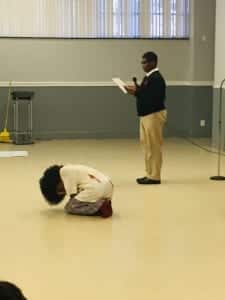 Global Storytelling Challenge: Likewise launched in fall 2018, the pilot Challenge engaged five middle school students at the Saint Thomas More Catholic Academy in DC’s Ward 8 in learning about international issues (e.g., climate change, war, poverty, gang violence, gender inequality) then creating and performing stories about issues the students chose. In December, the students, led by two George Washington University International Education Program graduate students, Nichole Hutchins and Rujjares Hans, performed their stories before their schoolmates and teachers in two competing teams of three and two students. Research on storytelling suggests that this art form can improve student engagement, visual memory, information recall and language skills as well as create a more welcoming and tolerant learning environment (more on this research in an upcoming Learning Life post). Hence, in 2019, following the food culture project, we aim to complete a second Global Storytelling Challenge involving more children in DC as well as abroad.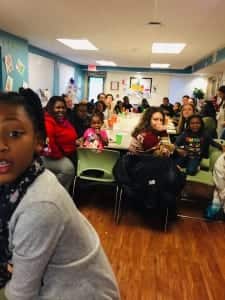
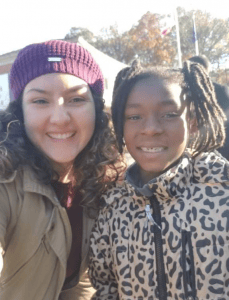 Dakar, Senegal, and Jerash, Jordan. Our mentors and mentees in DC meet at least once per month to visit foreign embassies, museums, cultural festivals, restaurants and more. Our mentors mentoring children abroad meet with their mentees live via Facebook or Skype at least twice per month to read articles, watch videos, and discuss their thoughts and experiences as well as the mentees’ ambitions and plans. For both the mentees in DC and abroad, the mentoring is intended to deepen their understanding of the world, and connect them to ideas, resources and educational opportunities that can improve their lives. Currently, we have 15 mentors mentoring 11 children in DC and 5 children and adults in El Salvador, Senegal and Jordan, with plans to up to double the number of mentor-mentee pairs in 2019.