Seeking International Dialogue Organizers in Amman, Jordan
Interested in education, children and families, and/or international affairs?
Want to volunteer for an innovative American organization promoting international peace and collaboration?
About Learning Life & Its Citizen Diplomacy Initiative
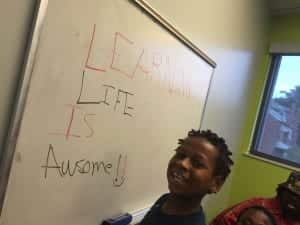
Based in metro Washington D.C., Learning Life is an educational nonprofit devoted to spreading learning beyond school walls. Learning Life’s Citizen Diplomacy Initiative engages lower-income American families, starting in the U.S. capital of Washington D.C., with families in other nations via “virtual exchange” (i.e., live, video-dialogue via the internet) and project collaborations in order to foster peace and family and youth development.
About the Volunteer Opportunity
Learning Life is now recruiting volunteers (university students, teachers, parents, community leaders) in Amman, Jordan to serve as dialogue organizers in their community. Dialogue organizers help find families, dialogue moderators, language interpreters (click here for more about each of these roles), and safe, quiet locations with high-speed (if families don’t have internet in their own home) in their communities to make the dialogues possible. If interested, dialogue organizers can also serve as discussion moderators or language interpreters during the live family-to-family dialogues, and collect survey data from the families during the dialogues.
Dialogue organizers work remotely, in their own countries, and meet as needed via Skype with Learning Life founder, Paul Lachelier, Ph.D. and/or other Learning Life staff in the United States, and otherwise communicate via email. Work hours will vary from week to week, but should average to about 3-5 hours/week.
Our dialogue organizers are not paid, but the work offers substantive, resume-building experience helping to build a new and innovative international exchange program. This volunteer opportunity is ideal for individuals interested in English language, education/teaching, youth and families, and/or international affairs, but others are welcome to apply.
No prior experience necessary, though dialogue organizers must enjoy working with people, be responsible, responsive, hard working, have routine and reliable internet access, and be strong in spoken and written English. It’s also a plus if you have social ties to many families in your community.
How to Apply
Email your resume in English to paul@learninglife.info. Dr. Lachelier will respond personally as soon as possible to schedule an interview with you via Skype, or another free internet phone service.
U.S. Families Connect with a New Family in Senegal
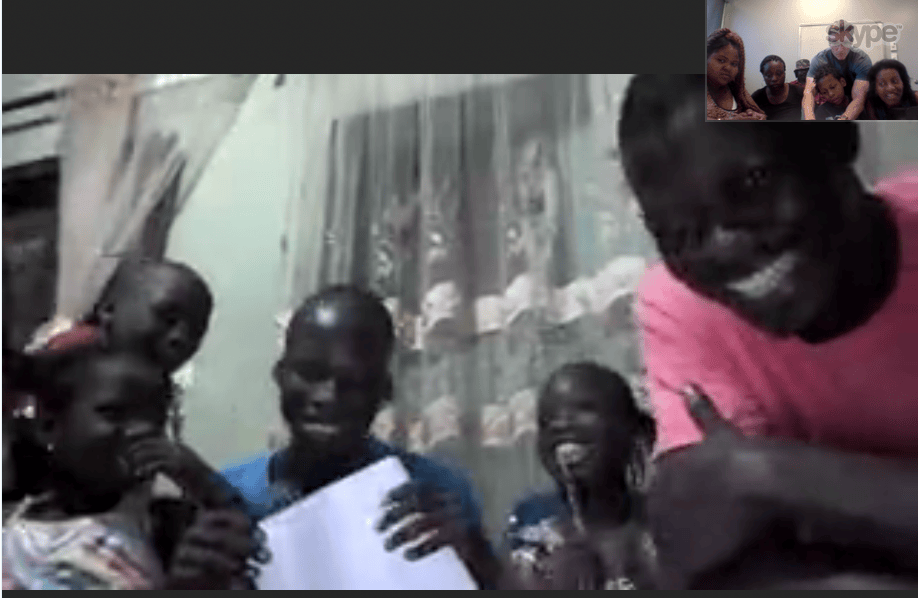
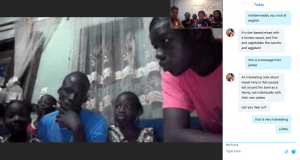
In Learning Life’s fourth live, international, family-to-family dialogue, we returned to Senegal to talk about food, education, politics, music and dance, and more with a new Senegalese family.
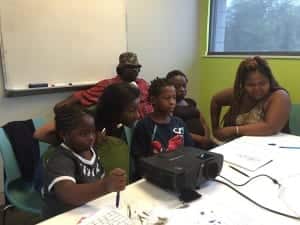
On Saturday, September 18, Learning Life volunteers gathered with members of two American families in Washington D.C.’s Anacostia Library to connect with the Gueyes, a family of eight living in a suburb of Senegal’s capital, Dakar. This was Learning Life’s fourth live dialogue, following our first with a different family in Dakar three weeks ago, and two dialogues with four families in El Salvador in the interim.
Following introductions, the Senegalese family siblings, ages 7 to 27, launched into questions they had written down. “What significant events are happening in your country right now?” Samba, 16, asked rhetorically with a smile. That question quickly led where Samba expected: to the fast-approaching U.S. presidential election. The families on both sides of the Atlantic expressed support for Barack Obama, but some ambivalence about Hillary Clinton, and above all, Donald Trump.
The questions then turned to education as the oldest Gueye sibling, Moukhamadou, a 27-year old English and French language teacher, asked Elsie, one of the Americans who is a literacy coach, why she teaches. “I teach because I know how much education has done for me,” Elsie responded. Elsie, at age 21, has a Master’s degree in public policy. Moukhamadou, in turn, is pursuing a Master’s degree.
The conversation moved to food and culture as the Americans in turn asked the Senegalese what significant events are occurring in Senegal. As the Gueyes explained, they recently celebrated Eid Al-Adha, a four-day Muslim holiday in which, following tradition, they slaughtered a sheep and shared its meat. The Gueyes explained that they often eat from a common bowl rather than on separate plates. The American participants, ages 7 to 42, considered the merit of eating from a common bowl — namely, the keener feelings of sharing and belonging — against hygienic concern about the handwashing practices of those eating from the same bowl.
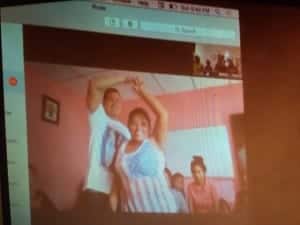
As with one of our recent dialogueswith Salvadoran families, this Senegalese-American dialogue finished with music and dancing as the participants shared songs and dances they like. With smiles and waves, the families resolved to dialogue again in mid-October.
Learning Life’s Citizen Diplomacy Initiative offers American families (and eventually all participating families across the world) that have few if any opportunities to travel the chance to dialogue and collaborate on projects with families in other nations for their mutual educational and cultural enrichment. In coming months, all participating families will begin a project that will gather their photos from across the world answering the same question: what is the past, the present, and the future of your community?
Stay tuned for more…
Special thanks to Learning Life volunteers, Emilie Mondon-Konan for her assistance with language interpreting on the American side, and Samantha Macfarlane and Moukhamadou Gueye for their help with interpreting and organizing this dialogue on the Senegalese side.
U.S.-El Salvador Live Dialogue Leads to Dance
On Sunday, September 4, in Learning Life’s second live, international, family-to-family dialogue, personal introductions quickly led to latin dance introductions.
In this first meeting between two American families and four Salvadoran families, all family participants were asked to introduce themselves not only with their names and occupations, and in the case of the children, their age and school grade, but with something interesting about themselves they wished to share with their foreign interlocutors. Eduardo, a tall, soft-spoken, fourteen-year old Salvadoran boy was the first to speak.
“Me gusta jugar el fútbol y bailar” (“I like to play soccer and to dance”), he said.
“Que tipo de baile?” (“What kind of dance?”) asked Paul, the American dialogue moderator.
“Bachata” — a type of latin dance which originated in the Dominican Republic — Eduardo responded.
“Puedes mostrarnos?” (“Can you show us?”) asked Paul with a smile.
Eduardo smiled in return. Literally less than a minute later the dozen or so assembled Salvadoran parents and children moved their seats to form a dance floor, selected and started playing music, identified Eduardo’s dancing partner — Delmi, a seventeen-year old girl from another of the Salvadoran families — and off they were both, smiling and dancing bachata in an office in El Puerto de la Libertad, El Salvador, before their American audience 3,200 miles away (by car) in Washington D.C.
This proved to be the first of three Salvadoran introductions that led to dance demonstrations — of a Salvadoran folk dance, and “reggaetón,” a music and dance of Puerto Rican origin that blends reggae, hip hop, and latin influences. The Americans, shy in the moment, nonetheless promised video demonstrations of their own passions — ballet in thirteen-year old Elyse’s case, and basketball in eleven-year old Kaniya’s case.
The American and Salvadoran families went on to discuss serious topics, including the problems their communities face. The Salvadorans reported problems with the privatization of water, and criminal gangs that threaten legal businesses and innocent bystanders. The Americans noted problems with youth gangs in school and police mistreatment of African Americans.
This second live, international dialogue — organized by Learning Life in partnership with CRIPDES, a grassroots organization working to empower Salvadorans in some 300 rural communities across El Salvador — followed the first dialogue between two American families in Washington D.C. and a Senegalese family in Dakar, the capital of Senegal. These dialogues are central to Learning Life’s Citizen Diplomacy Initiative, which works to nurture family and youth development through international dialogue and collaboration.
Through November 2016, Learning Life staff and volunteers plan to organize a series of pilot dialogues between families in Washington D.C., Puerto de la Libertad, El Salvador, Dakar, Senegal. Stay tuned for more!
We would like to thank CRIPDES and Learning Life volunteers Karen Tituana and Derrick Costa for their help in making this second dialogue possible. Thanks also to the nonprofit UNIFI for allowing us to use their cafe, Artdrenaline, in Washington D.C.’s Anacostia neighborhood, to conduct this live dialogue.
Internship: Help Organize Live International Dialogues
About Learning Life and Its Citizen Diplomacy Initiative
Learning Life is an educational nonprofit in Washington D.C. that seeks to spread learning in everyday life beyond school walls. Learning Life has recently begun a Citizen Diplomacy Initiative that engages lower-income American families in Washington D.C. in live internet video dialogues or “virtual exchanges” with similar foreign families in order to foster global citizenship and family and youth development.
About the Internship
Learning Life is now recruiting metro D.C. university students to serve as interns. Interns assist with finding and screening eligible families in D.C. and abroad, connecting and coordinating with nonprofit partners abroad, organizing and moderating the live international dialogues, research and drafting of documents, document translation and dialogue interpreting, and mentoring of D.C. youth involved in our Citizen Diplomacy Initiative.
Interns must be able to commit eight hours per week. Learning Life’s founder, Dr. Paul Lachelier usually holds weekly four-hour work meetings with interns as a group, then assigns each intern four hours of homework.
This opportunity is unpaid, but offers substantive, resume-building experience on an innovative international initiative, and a formal reference and/or recommendation letter given satisfactory performance.
The Interns We Are Looking For
Applicants should be interested in international affairs, languages, community organizing and/or social justice. Applicants should also be outgoing, organized, detail-oriented, motivated and responsible (e.g., complete work well and on deadline, and show up to meetings on time). Native or fluent speakers of Spanish, Arabic, French or Tagalog are especially encouraged to apply. People who have lived in or have family in Washington D.C.’s Wards 7 or 8 (D.C. east of the Anacostia River), and/or in Latin America, Africa, Asia or the Middle East are also encouraged to apply.
How to Apply
Email Dr. Lachelier directly at paul@learninglife.info with your resume and times you are available in the next seven days for a phone interview.