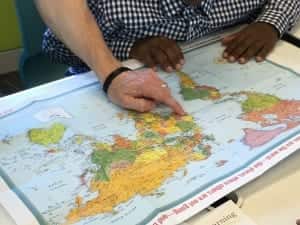
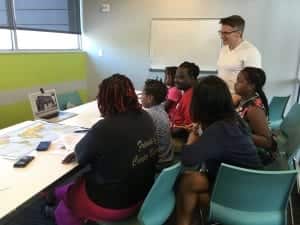
After seven months of organizing and preparation, we are happy to announce that our first live, international, family-to-family dialogue successfully took place today at the Anacostia Library in Washington D.C.
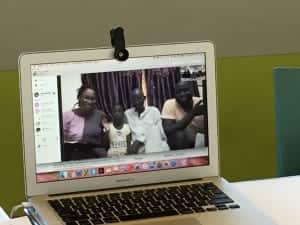
The dialogue connected members of two American families in D.C. — a grandmother and her grandson, and a father and his two daughters — with a nine-member family in Dakar, the capital of Senegal, located on the coast at the western-most tip of Africa. After introducing themselves, the families freely asked each other questions about their use of media (Facebook, Youtube, Snapchat, etc.), their food, music, modes of transportation, and cost of living, among other subjects. As the American families learned, residents of Dakar are not that different from residents of Washington D.C. as fellow major city dwellers connected to common media, music, food and other goods.
This dialogue was the first in a series of pilot dialogues Learning Life has planned over the next few months between American families in Washington D.C. and families in El Salvador, Senegal, and Jordan. Working with a resourceful team of volunteers and student interns, Learning Life began building this Citizen Diplomacy Initiative (CDI) from scratch in late January 2016, and has since found partners and families in Washington D.C. and these four nations across the world. In addition, to enable the families to communicate with each other in their respective languages, we have recruited volunteer interpreters and a set of common documents (surveys, dialogue guides, country info sheets, etc.) in the four different languages the families speak: English, Spanish, French, and Arabic.
Our purpose in building CDI is to tap into the power of the internet to nurture international peace and youth development. Our world is clearly globalizing (see our Five Ways World Affairs Affect Us All), but transnational travel is still too costly for many of the world’s people. Moreover, tourism is not necessarily educational, and the use of “virtual exchange” (dialogue via the internet) for educational and cultural enrichment is too often limited to universities. In pursuit of our mission to spread learning in everyday life beyond school walls, CDI connects families rather than schools as a way to make international affairs approachable to more people. We also focus on families that have less money and fewer educational and travel experiences in order to help address deepening inequalities and extent opportunity to more people. And, we do so free of charge to our participating families.
In the coming months, we will keep you posted as the dialogues progress, and we move toward a first international collaboration between the children involved in the dialogues. Stay tuned!
To support Learning Life’s Citizen Diplomacy Initiative, please make a donation here. To volunteer, please visit our CDI page to learn about the various ways you can get involved, then contact us at email@learninglife.info to set up a phone meeting.
Thank you for your interest and support!
Thanks to Learning Life volunteers Emilie Mondon-Konan, Derrick Costa and Samantha Macfarlane for respectively helping with French-English interpreting, photo and video recording, and organizing of the dialogue on the Senegalese side.
What are the ingredients of career success?
How can I be successful in my career? This is a question many people ask themselves. Of course, most workers across the world have jobs (i.e., work that offers no chance for advancement in pay, benefits, responsibility, skill, and/or else), not careers (i.e., work that offers a chance for advancement), so this question assumes one is lucky enough to pursue a career. For those lucky ones, the following answers from experts to this, the latest edition of Learning Life’s Big Question Series, may prove of some help.
Thanks to Learning Life interns Ian Ball and Omar Batterjee for their assistance in gathering the experts’s answers below.
Dr. James R. Bailey: There’s really only one ingredient to a successful career: Do something you really like doing. If you really like doing it, you’ll be intrinsically motivated, which means you want to do it. To be extrinsically motivated means you have to do it. We all find ourselves having to do something that is distasteful. That’s just part of life. But to be intrinsically motivated means your time and talent is willingly given and productively engaged. In fact, pay and prestige place well behind passion and purpose. This is the big part of life. During 50 employed years, you’ll spend one minute out of four working. Repeat: 25% of every minute you live for 50 years is on the job. Don’t spend that time on something you just have to do. Spend it pursuing endeavors that enrich, reward, and renew you. In doing so you’ll devoted and perform better. If the reward comes from within, you’ve found the only necessary and sufficient ingredient to a successful career.
Dr. da Mota Veiga:The ingredients for career success vary from person to person because everyone defines career success differently. But for many, career success is not defined so much by financial success as by happiness and challenges. Career success is often achieved by identifying and understanding one’s strengths. Work experience is one of the best ways to determine what your strengths are, and what drives you. For example, imagine you are searching for a job. You need to understand your strengths and passion to decide what you want to do. Additionally, you want to research industries, companies, especially what they will offer you that will motivate you to do more than just show up, that will make you want to go the extra mile (and offer a lot more!), achieve your goals and more, and challenge the status quo.
Dr. Sheetal Singh: While there can be several different paths and ingredients to success, I believe being open to new experiences is the key. When we choose a particular career, we are selecting certain set of experiences that will allow us to learn and grow in that career. However, we are also closing ourselves to possibilities that could contribute towards new experiences and potential opportunities. We have these perceived limitations that prevent us from exploring other interests that, in reality, can lead us to success and new opportunities. It is important to strive for your goals in a career path, however, it is equally important that you do not dismiss opportunities.
ABOUT THE RESPONDENTS
Dr. James R. Bailey is Professor and Hochberg Fellow of Leadership Development at the George Washington University School of Business, and a Fellow in the Centre for Management Development, London Business School. He has taught at University of Michigan, New York University, IMD, and Helsinki School of Economics, Dr. Bailey is the recipient of many teaching distinctions, including four GWSB Outstanding Faculty Awards. In 2006 he was named one of the world’s top ten executive educators by the International Council for Executive Leadership Development. He has published over 50 academic papers and case studies, and is the author of five books, including the award-winning, best-selling Organizational and Managerial Wisdom and the forthcoming Lessons on Leadership. He has designed and delivered hundreds of executive programs for firms like Nestle, UBS, Conoco-Phillips, and Goldman Sachs, as well as several major law firms and US Congressmen. Dr. Bailey is a frequent keynote speaker who has appeared on broadcast programs for the BBC, NPR, and Fox News Channel, and whose work has been cited in such outlets as the Wall Street Journal, Fortune, Forbes, and Business 2.0. He is a frequent contributor to TheHill, Washington Post, Washington Business Journal, and Harvard Business Review. He is the past Editor-in-Chief of the Academy of Management Learning and Education, as well as the founder and Editor-in-Chief of the online magazine Lessons on Leadership (www.lessonsonleadership.org.) Professor Bailey has served as a dean, department chair, and program director during his 25 year academic career.
Serge P. da Motta Veiga is an Assistant Professor in the Kogod School of Business at American University. Prior to coming to American University, Serge was an Assistant Professor of Management at Lehigh University. He earned his Ph.D. in Business Administration with an emphasis on Organizational Behavior and Human Resource Management from the University of Missouri, and his license in Economics from the Université Libre de Bruxelles in Belgium.
Serge’s research interests include job search, careers, recruitment, affect, motivation, and humor at work. Specifically, he is interested in examining various dynamic factors involved in pre-organizational entry processes (job search and recruitment), such as the role of affect and motivation regulation. He has published his work in the Journal of Applied Psychology, Personnel Psychology, Organizational Behavior and Human Decision Processes, and in the Journal of Organizational Behavior, and his research has been featured in public press outlets such as Time, Fast Company, and Psychological Science. Prior to pursuing his Ph.D., Serge worked for six years in the banking and consulting industries in London, Paris, and Brussels.
Sheetal Singh is a researcher, corporate trainer, coach and an adviser to several startups. She is assistant professor of management at George Washington University’s School of Business. Her research focuses on studying individual emotions in corporate and entrepreneurial settings. Through her research, she hopes to help individuals and organizations by creating a greater understanding of the role of emotions and how to harness the power of emotions to achieve better results.
Dr. Singh completed her PhD. in Organizational Behavior and Strategy from University of Maryland’s Robert H. Smith School of Business. She completed her undergraduate work in Commerce from Delhi University, and in Hotel Administration from the Institute of Hotel Management, Delhi, India. She also completed a Post Graduate Diploma in Hotel Management from The Oberoi Centre of Learning and Development.
Prior to her doctoral work Dr. Singh worked for over a decade in the Hotel Industry with the Oberoi Group of Hotels & Resorts and Carlson Group in various positions in Rooms and Food & Beverage before transitioning into Training & Development. Apart from designing and conducting training programs for Oberoi and Marriott hotels, she also delivered training for the broadcast and travel industry.
Intern Spotlight: Omar Batterjee
This is the third of a series of spotlights on our summer 2016 student volunteers. Learning Life’s student volunteers this summer are translating documents, conducting research and doing outreach locally and internationally for our new Citizen Diplomacy Initiative (CDI) established this year. CDI will connect American families in Washington D.C. with families in other parts of the world through live online video-dialogue starting this summer. Omar has been providing invaluable help in translating CDI documents into Arabic, developing a database of metro D.C. language teachers, and assisting with outreach in Jordan.
Where were you born and raised?
I was born and raised in Jeddah, the second largest city in Saudi Arabia, and the largest seaport on the Red Sea.
What school do you attend, and what is your year and major there?
I am a senior at George Mason University majoring in Communication and Public Relations.
What do you like to do in your free time?
Reading and writing are my pastimes when I’m feeling productive. I like to read about different theories, from Kantian Ethics to securitization views in military. But mostly I read opinion pieces and blogs on social and political issues. I try to learn the way writers present and express their thoughts, so I can improve my own writing. Most of what I write regards social issues, although I don’t publish, I just keep it to myself.
On my days off, I like to wake up and leave the news on for an hour or two while I get ready for my day. My idea of a good night is hanging out with a group of friends and maybe playing a very popular card game we have back home in Saudi Arabia.
What is the most beautiful place you have seen on Earth, and why is it so beautiful?
Eighty feet under the surface of the Red Sea, there is a spot called Cable Reck, where a ship carrying construction materials sunk in 1978. The Red Sea has a lot of marine life and good visibility down to 160 feet, so seeing the ship and the sea life in natural light was beautifully tranquil and intense. is covered with cables at the bottom. The tranquility came from the calm sounds of deep water diving, the intensity from having some of the most dangerous sea life swimming by, like a 4.5 foot barracuda, eels and sharks.
Is there a life experience you have had that has particularly shaped you as a person thus far? If so, what is it, and how has it shaped you?
I would say that my time in the United States has been one of the most effective experiences I have had. Unlike my home country where most people share a common way of thought, in the United States the diversity of opinions is eye opening. Although Saudis have a wide range of views on the religious spectrum, for instance, they are all regarding the same Muslim religion. In the United States, however, there are not only different liberal and conservative views, but also a mix of religious and non-religious views.
Why did you choose to intern with Learning Life?
Working with Learning Life is not only a chance to help myself, but to help others. I really believe in the power of both education and awareness programs. In some way Learning Life is a bit of both: it spreads learning in new ways, but it’s also an awareness campaign for the importance of education.
What are your career plans?
I plan to work in the corporate side of the public relations field. I hope to make the need for corporate social responsibility a wide spread view in Saudi Arabia. The idea that the community is one of the stakeholders of a company is still relativity new. I believe a lot of good can come about if companies are socially responsible. I want companies to realize that public support is the reason they make money, and that they should give back, not just take.
What’s Your Position in the World?
Given the United States’ outsized role in the world, and Clinton and Trump’s quite different positions on foreign relations, the time seems ripe for Americans to ponder their positions in the world.
A few years ago, as an assistant professor of sociology at Stetson University in Florida, I taught an introductory sociology class every semester. Early on each semester, when my students learned about the sociology of culture, I would ask them in class “are you a cultural relativist, or a cultural universalist?” I explained that a relativist chooses to respect people’s different cultural practices while a universalist (or absolutist) insists that there are certain universal values and practices that all nations should respect regardless of their particular cultures.
It may come as no surprise that when simply presented with that question and those definitions, my students tended to identify as relativists. Countries like the United States that lean individualistic on the continuum from individualism to collectivism are more likely to produce relativists since individualism inclines people to respect individual and group differences, at least in principle, if not in fact. However, I then posed the following issue-based questions, one after the other:
Question 1: Is it bad for people living in high-income nations to condemn the practice of child labor in poorer countries because we think youth belong in school?
Question 2: In 1997, two Iraqi brothers, aged 34 and 28, living in Nebraska were charged with statutory rape of their wives, aged 13 and 14, whom they married following Muslim law and the customs of their community in southern Iraq. Was it right for Nebraska to prosecute the two men, or should their culture have been respected?
Question 3: What about female “circumcision,” also known as “female genital mutilation”? Should nations intercede to stop this painful and sometimes deadly practice, or should nations respect cultural differences?
As you might expect, a lot of my students qualified their relativism as we moved from Question 1 to Question 3. Many defended child labor in poorer nations, but maintained that people should follow the laws of the country in which they reside, and grimaced to learn about female genital mutilation, but weren’t sure how to respond to its practice abroad.
This question of relativism vs. universalism seems all the more relevant now as the U.S. presidential contest spurs debate about how and how much the United States should engage with the world. Relativism, in principle, inclines people not to meddle in the affairs of other nations out of respect for their own sovereign ways of doing things, however much we may find these ways — like child labor, child marriages, and female genital mutilation — reprehensible. Universalism, in principle, inclines people to promote their values abroad, and for westerners that can mean banning child labor, early marriages and female genital mutilation, among other practices driven by religious tradition or economic hardship.
In the United States, how the majority of Americans feel about foreign relations depends substantially on domestic economic conditions. In economic downturns, Americans tend to lean isolationist or protectionist. Isolationists (as critics sometimes deprecatingly call them) generally believe the United States should focus its resources more on its own people’s needs, and not get involved in other nations’ often thorny issues. In contrast, internationalists believe the United States stands to gain in the short and long-term by engaging more with the world, culturally, economically and/or politically.
There are, of course, right and left-wing versions of these positions. Leftist isolationists call for worker-protecting trade barriers and greater domestic investment while right-wing isolationists are more likely to call for withdrawal from the United Nations and crackdowns on illegal immigration. In turn, left-wing internationalists call for advancing human rights and elevating living, work and environmental standards worldwide while right-wing internationalists are more likely to call for strengthening security, democracy and/or capitalism by economic sanction, or force if necessary.
If you lean toward relativism, how to engage abroad seems simple on its face: don’t interfere. If you lean toward universalism, however, should the United States only act when it can get other nations on board (multilateralism), or should the U.S. go it alone when it can’t find partners (unilateralism) so long as it’s doing the right thing? And, what courses of action are appropriate and effective? Should the U.S. government simply issue a public condemnation, try diplomatic dialogue, offer economic incentives, fund nonprofits fighting child labor, child marriages, female genital mutilation, and other practices we oppose, or threaten military action?
Underlying your answers to these questions are fundamental assumptions, conscious or not, about what motivates people and nations. So-called “realists” believe people and nations are motivated foremost by self-interest, and this accordingly drives nations to seek security, economic advantage, political prestige, and/or military glory, depending on their governments. Idealists, on the other hand, assert people and nations are or should be motivated by ideals, whether religious (e.g., Christianity or Islam), political (e.g., democracy or nationalism), economic (e.g., capitalism or socialism), or otherwise.
These varied and overlapping positions can help any citizens of the world think more deeply about how they and their government should engage with the world. But it’s especially important for people in the most internationally powerful nations — like the United States, the United Kingdom, France, Russia and China — to think about their positions and answers to these questions.
So, are you a universalist or relativist? An isolationist or internationalist? A multilateralist or unilateralist? A realist or idealist?


 After seven months of organizing and preparation, we are happy to announce that our first live, international, family-to-family dialogue successfully took place today at the Anacostia Library in Washington D.C.
 families in Washington D.C. and families in El Salvador, Senegal, and Jordan. Working with a resourceful team of volunteers and student interns, Learning Life began building this Citizen Diplomacy Initiative (CDI) from scratch in late January 2016, and has since found partners and families in Washington D.C. and these four nations across the world. In addition, to enable the families to communicate with each other in their respective languages, we have recruited volunteer interpreters and a set of common documents (surveys, dialogue guides, country info sheets, etc.) in the four different languages the families speak: English, Spanish, French, and Arabic.
 transnational travel is still too costly for many of the world’s people. Moreover, tourism is not necessarily educational, and the use of “virtual exchange” (dialogue via the internet) for educational and cultural enrichment is too often limited to universities. In pursuit of our mission to spread learning in everyday life beyond school walls, CDI connects families rather than schools as a way to make international affairs approachable to more people. We also focus on families that have less money and fewer educational and travel experiences in order to help address deepening inequalities and extent opportunity to more people. And, we do so free of charge to our participating families.