Special thanks to Learning Life intern Ehvyn McDaniels and volunteer Craig Gusmann for helping to draft Nick’s profile.
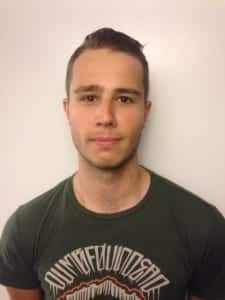
Virginia native Nick Burton enjoys a good challenge, especially if that challenge involves writing, sports, the internet, or business.
A graduate of W.T. Woodson High School in Fairfax, Virginia, and Potomac State College of West Virginia, Nick served as the editor of The Pasquino, Potomac State’s student newspaper. While the majority of the articles he wrote focused on-campus news, Nick also covered broader issues, like the future of Apple, and the potential for world war in Syria.
This past summer, Nick helped Learning Life with a variety of work including increasing our following on our social media pages, researching funding sources, and gathering facts on varied topics from financial literacy to Washington D.C history, to violence against women worldwide.
Nick recently took the time to answer some further questions about him.
Where were you born? Fairfax, Virginia
What’s your current occupation? I’m a student at Ohio University
What are your hobbies? I love sports. I love to root for all of the D.C. area sports teams – the Nationals, Redskins, and Capitals. I also like to play around with social media and website development in my spare time, honing my entrepreneur skills. I once created a website called “Rap Game Versace Flame” where I posted daily videos, links, and articles on hip hop culture.
Where would your dream vacation happen? Hawaii!
Are there talents or skills you wish you had, or hope to learn? I want to develop the ability to dunk a basketball.
What do you want to become in life? A business owner and millionaire. This fall, I’ve started as a freshman at Ohio University. I am majoring in business, and hope to use what I learn to become an entrepreneur. I am interested in anything from online marketplaces to restaurant chains. I find the idea of being my own boss and paving my own path extremely appealing.
Why did you choose to intern with Learning Life? I chose to intern with Learning Life because working with a developing nonprofit can be a very fun and exciting experience. I also really wanted to do something that had some meaning to it, rather than just sitting in a cubicle doing paperwork that has barely any impact. With Learning Life, I got to help teach people in a unique way.
We at Learning Life thank Nick for his help this past summer, and wish him the best in his pursuits at Ohio University and beyond!
To learn more about interning or volunteering with Learning Life, contact us at email@learninglife.info.
5 FACTS ON FOOD & GENETIC ENGINEERING
Human beings have used selective breeding techniques on plants and animals for thousands of years. Genetic engineering (GE, also known as GM or genetic modification), however, is a much more recent phenomenon, and has stirred considerable controversy over its use in the food supply.
Advocates argue that GE can boost food production for the world’s growing population, and improve the qualities of food, like hardiness, flavor, nutrition, appearance. Opponents charge that, among other things, GE plays with nature, is unsafe, and threatens the diversity of the world’s food supply as well as the livelihood of farmers worldwide who cannot afford to pay for GE crops.
In light of this controversy, Learning Life offers the following five facts about GE’s origins, forms, and use in the food supply.
1) 1973
The year the first genetically modified organism (GMO) was created. That GMO was a microbe. The next year, scientists produced the first GE animals: mice. Source
2) 1994
The year the first genetically modified organism (GMO) — a microbe used to make many cheeses — was introduced into the food supply. Source
3) 17 million farmers, 28 countries
The number of farmers and countries producing GE crops as of 2012. The 170 million hectares of land in use to produce these crops is more than 12 percent of the world’s arable land. Source
4) 88%
The percentage of corn planted in 2012 in the United States that was genetically engineered in some way, according to the U.S. Department of Agriculture. That same year, 94% of cotton and 93% of soybeans were genetically engineered in the USA. Source
5) Zero
The number of GM animals approved by the U.S. Food & Drug Administration (FDA) as meat for food. Currently, GM animals are used for research and medical purposes as well as to produce milk or other products. FDA guidelines state that “developers of GE animals of any species traditionally consumed as food must notify the agency that they are developing such animals, and cannot introduce them into the food supply without prior investigation from FDA.” Source
Live, or Do Business in the Washington D.C. Area?
As I noted in the blog post, “Toward a Local Learning Infrastructure,” last month, Learning Life is pleased to announce two local initiatives launching in the coming weeks: a Weekly Learn, and a Napkin Education Initiative. This post offers more details about these two new projects.
Learning Life’s mission is to inform and empower more people by spreading knowledge on everyday surfaces, like napkins, placemats and posters as well as phones, tables and computers. In pursuit of this mission and developing a local learning infrastructure, we are launching this September a free “Weekly Learn” where Learning Life is based in the Washington D.C. metro area. Once a week, subscribers will receive an email containing a brief, interesting fact or set of facts about the history, economy, politics, people and/or organizations that shape and define the D.C. metro area. It’s a new, free and easy way for D.C. area residents to learn more about their metro community.
The second developing project, the Napkin Education Initiative (NEI), will start spreading informative napkins in metro D.C. eateries in the coming months. The NEI builds on the pilot public education project Learning Life conducted last December with D.C.’s Newseum, a private museum devoted to learning about news and journalism. For last December’s project, Learning Life volunteers conducted street theater and distributed 10,000 interactive napkins (see the adjoining napkin graphic) in restaurants in several commercial centers of Washington D.C. The napkins invited readers to learn about President John F. Kennedy, in light of the 50th anniversary of his assassination in November 2013, by taking a JFK quiz at Learning Life, after which quiz takers could get a discount to the Newseum’s JFK exhibits. You can learn more about this JFK project by watching the short video we produced about the project and Learning Life’s approach.
Following on Learning Life’s JFK project, the NEI will offer selected nonprofits in metro D.C. the opportunity to promote their volunteer opportunities and low-cost or free services free on paper beverage napkins to be distributed in D.C. area restaurants, bars, cafes and other eateries. The NEI will be run through our soon-to-be-formed partner organization, Signia Surfaces LLC. Signia Surfaces will design, print and distribute the napkins on a monthly basis. Each napkin will feature the nonprofit information on one side, and advertising on the other. The advertising will provide companies, nonprofits and governments a new and innovative way to get their message out – on napkins in eateries – while simultaneously helping to promote local nonprofits and inform community residents.
If you live or do business in the D.C. metro area, you can sign up for our free Metro D.C. Weekly Learn, and find out more about the NEI here. Interested napkin advertisers and metro D.C. nonprofits seeking free promotion are encouraged to contact us at email@learninglife.info. Stay tuned for more information about these projects in our next monthly newsletter!
Paul Lachelier, Ph.D.
Founder, Learning Life
Intern Spotlight: Samantha Issa
Special thanks to Learning Life intern, Ehvyn McDaniels, for helping to draft Samantha’s profile.
Explore. Connect. Learn. These three verbs could describe what Learning Life is about, but they also define the passion of our intern, Samantha Issa.
Born in New Jersey of an American mother and a Lebanese father, you might say that Samantha was born to explore, connect and learn. “My desire to travel, explore, and learn informs most of my decisions. Traveling has fueled a passion for connecting with the people around me, and I have come to value human relationships over almost anything else.” These passions to explore, connect and learn help explain why Samantha has studied Spanish in Spain; taught children reading, writing and math; tutors English to immigrants in Washington D.C.; and serves as an admissions assistant fielding inquiries and applications from the diverse students applying to George Washington University.
As a senior at GWU, Samantha majors in Organizational Sciences and aims to work for an enterprise with a social conscience. “I would love to work for a social enterprise or other socially impactful business where I could use my communication skills and travel experience to make a difference.” To this end, she has volunteered with Serengetee, a fast-growing clothing company founded by college students that uses a portion of its proceeds to support local designers and causes around the world, with Lush, a cosmetics company that makes uses natural, ethically-sourced ingredients, and most recently with Learning Life.
This summer, Samantha interned with Learning Life from her home in New Jersey. Employing her developing research, design and social media skills, Samantha diligently carried out a variety of projects for Learning Life. She started by proposing ways for Learning Life to grow its audience via social media, then helped expand our audience on Facebook, and spurred us to create a Facebook group for volunteers, interns and supporters. Samantha also compiled a list of one hundred valuable informational resources online for our social media page readers; produced an initial list of placemat and poster makers that Learning Life might partner with; gathered facts about metro Washington D.C. for Learning Life’s (former) “Weekly Learn” launched in September; updated news media advertising rates in metro D.C. to compare with Learning Life pricing for our upcoming napkin education initiative; created a number of promotional posters and educational infographics (click on the example of her work to the right); and drafted a guide to search engine optimization (SEO) to improve Learning Life’s online search rankings. Importantly, this last project helped move Learning Life to first and second place in Google searches of the name “Learning Life.”
When asked why she decided to volunteer with Learning Life, Samantha responded, “I feel invested in the cause. The amount of information available to us is valuable but intimidating, and Learning Life can help make that information less unapproachable and more learnable.” Learning Life is happy and thankful for Samantha’s investment as we have benefited substantially from her careful and conscientious work this summer.
We congratulate Samantha in advance on her graduation from GWU, and wish her the best as she pursues her passions to explore the world, connect and learn.
To learn more about interning or volunteering with Learning Life, contact us at email@learninglife.info.

 This past summer, Nick helped Learning Life with a variety of work including increasing our following on our social media pages, researching funding sources, and gathering facts on varied topics from financial literacy to Washington D.C history, to violence against women worldwide.