Executive orders are directives from the U.S. President to the federal government to help carry out laws passed by Congress. They hold similar power to legislation passed by Congress, but do not have to be ratified by Congressional vote. This has caused controversy as opponents of executive orders often claim Presidents use them to expand their power into law-making, which Congress constitutionally controls. Learning Life offers the following five facts on the history and importance of executive orders to provide some perspective.
Thanks to Learning Life writer Craig Gusmann for helping to draft these five facts.
1) Not in the U.S. Constitution
The U.S. Constitution makes no mention of executive orders. However, Article II of the U.S. Constitution does require the President to “take Care that the Laws be faithfully executed.” Presidents have used this clause to argue that executive orders help the federal government “faithfully execute” the laws of Congress, though those may not be laws existing majorities of legislators in Congress support.
2) Franklin Delano Roosevelt
America’s longest-serving President, Franklin Delano Roosevelt, issued 3,721 executive orders — more than any U.S. President, by far — in his 12 years in office, between 1933 and 1945, during the Great Depression then World War II. Woodrow Wilson issued the second most executive orders — 1,803 — in his eight years in office, from 1913 to 1921.
FDR’s executive orders, among other things, established internment camps during World War II, used mostly to intern Japanese Americans and Japanese immigrants, and the Works Progress Administration, which employed millions of Americans during the Great Depression to construct roads, bridges, buildings and other public works.
3) The Golden Age of Executive Orders
The turbulent years between the presidencies of Teddy Roosevelt (1901-1909) and Harry Truman (1945-1953) could be called the “golden age of executive orders” in U.S. history because that period saw the greatest increase in the use of executive orders:
Teddy Roosevelt (1901-1909): 1,081
William H. Taft (1909-1913): 724
Woodrow Wilson (1913-1921): 1,803
Warren Harding (1921-1923): 522
Calvin Coolidge (1923-1929): 1,203
Herbert Hoover (1929-1933): 968
Franklin D. Roosevelt (1933-1945): 3,721
Harry Truman (1945-1953): 907
That period included World War I, the Great Depression, World War II and the Korean War, among other major events. Before Teddy Roosevelt, the number of executive orders a U.S. President issued never rose above 217 (Ulysses Grant), and since Truman it has never risen above 484 (Dwight Eisenhower).
4) Obama in Perspective
Despite the substantial publicity some of President Obama’s executive orders (e.g., on immigration, relations with Cuba) have received, Obama has exercised this power relatively little, issuing 203 thus far, less than his predecessor, George W. Bush (291), as well as Bill Clinton (364), Ronald Reagan (381), and Jimmy Carter (320), among other post-World War II Presidents. However, if one includes the presidential “memoranda” Obama has issued, which have the same legal power as executive orders, then Obama’s exercise of executive authority has been greater than any U.S. president since Harry Truman.
5) Famous Executive Orders
Arguably the most famous executive order was Abraham Lincoln’s Emancipation Proclamation, which he issued on January 1, 1863, during the Civil War, to claim the freedom of all slaves in rebel Confederate states. Other famous executive orders include Harry Truman’s order to racially integrate the U.S. armed forces, and Dwight Eisenhower’s order racially desegregating public schools.
Thanks to Learning Life researcher, Derrick Costa, for helping to draft these five facts.
1) Earth: 7.2 Billion, and Rising
The world’s population growth rate has been declining for decades, but the actual number of people on Earth is still rising rapidly. The Earth currently has over 7.2 billion people, up from 2.5 billion in 1950, and it is expected to rise to 9.7 by 2050.
2) Africa: 1.1 Billion, and Rising Fastest
Africa’s current population is more than 1.1 billion people, up from 229 million in 1950, and it is expected to more than double to 2.4 billion by 2050. With the total African population growing at more than 2% per year, Africa has the highest population growth rate of any continent on Earth.
3) One Quarter of the World’s Children
More than a quarter of the world’s people (2.2. billion) are children under 18 years of age. Nearly one quarter of the world’s children live in Africa.
4) 9 in 10 Children Born Poorer
Nine out of ten African children are born in low-income and lower-middle income countries, like the Democratic Republic of Congo, Zimbabwe, Liberia and Burundi. Three in ten African children are born in fragile and conflict-affected nations. According to the World Bank, 20 of the world’s 34 countries suffering conflict and fragile economies are African.
5) Majority Urban by late 2030s
Africa’s longstanding rural image is quickly disappearing. In 1950, 14% of Africans lived in urban areas. By 1980, 27% did. Today, 40% do. By the late 2030s, Africa is set to become majority urban for the first time in its history.
In addition, our partner in metro Washington D.C., Signia Surfaces:
Has established partnerships with four effective local nonprofits, and is working to promote them free on napkins in D.C. eateries. Learn about each of these nonprofits here.
Is developing an initiative that will put metro D.C. artists, writers and scientists on coasters at D.C. eateries and events. Learn more about this initiative here.
Learning Life and Signia Surfaces share the same purpose to use surfaces to spread knowledge. While Learning Life focuses on spreading knowledge on electronic surfaces, through its website and social media pages, Signia Surfaces is pursuing the above initiatives on ad-funded napkins and coasters locally in metro D.C. If you like what they are doing, here are three simple ways you can help:
Like Signia Surfaces’ Facebook page. This is both an easy way to show your support, and to keep up with the latest news. Please invite your Facebook friends in metro D.C. to like Signia Surfaces too, and if you’re on Linkedin, please connect with Signia Surfaces there.
Donate to Learning Life. Signia Surfaces is designed to bring in its own revenue through advertising, but Learning Life relies largely on individual donors. Your donation helps Learning Life produce and spread our free educational content. If you can donate, please consider becoming a sustainer: sustainers help us develop a more regular base of funding by giving a tax-deductible amount (e.g., $5, $10, $25, $50, $100) monthly that’s automatically deducted from your credit card or checking account.
Subscribe to our Metro D.C. Weekly Learn. If you live in the Washington D.C. metro area, subscribe to Learning Life’s free Metro D.C. Weekly Learn, which offers interesting facts on the politics, economics, history, people and organizations that shape metro D.C.
Learning Life is excited to be working with Signia Surfaces, and looks forward to growing together online and locally in D.C. in 2015!
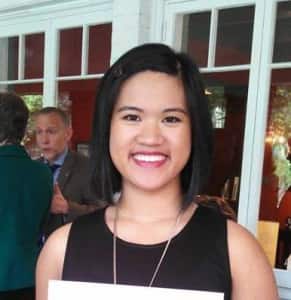
Michelle Vergara grew up in Florida, studied behavioral economics at Stetson University, then moved to Washington D.C., whereupon she began volunteering with Learning Life in the summer of 2014. Michelle and Learning Life founder, Paul Lachelier, overlapped at Stetson University over two years, but never met there. Nonetheless, Paul and the rest of the Learning Life team are very happy to have Michelle on board as she ably helps us with planning, analysis and marketing. Michelle kindly took a little time out of her schedule to answer the following questions about her.
Thanks to Learning Life writer, Craig Gusmann, for help with editing Michelle’s profile.
Where were you born?
Manila, Philippines
What did you want to be when you were a child?
I was an avid reader as a child, so I wanted to be a creative writer with the dreams of one day writing the novels that I loved reading. As I grew older (and more disenchanted) I realized I also wanted to make enough money to eat everyday and so I pivoted my ambitions to be a journalist.
What is your current occupation?
I’m a Sales and Marketing Associate at the Advisory Board Company.
What are your hobbies?
I like reading, museum-hopping, attending the finest and cheapest comedy shows and concerts that DC has to offer.
Do you have any secret talents?
In college, my main mode of transportation was via longboard. I used to be a huge longboard fan until I broke my wrist my freshman year. The longboard traffic also increased as frat boys also picked it up, and so I just avoided it altogether.
What talents or skills do you wish you had or hope to someday learn?
Bartending and making craft cocktails
What is your fondest childhood memory?
My favorite childhood memory was having sleepovers at my friend’s house. Her dad is an architect and her house was designed to have lofts and spiral staircases leading to multiple levels of the house. I was young, so I never really knew how big it was, but her house seemed like an endless adventure to me.
What is your dream vacation?
A jaunt across countries in Southeast Asia like Cambodia, Vietnam, and Thailand. And then a pit stop in Hawaii.
Are there any other interesting tidbits about yourself you would like to share?
I graduated from Stetson University (same university where Paul worked as a sociology prof), where I graduated magna cum laude with a BA in Behavioral Economics. I was the commencement speaker for the class of 2014, and while I can’t remember what I talked about to save my life, I’m sure there’s a video of me floating around somewhere. I currently live in Rosslyn, down the street from the Iwo Jima Memorial and the Netherlands Carilion. The first time I was in DC was a field trip my junior year in high school and I absolutely fell in love with the place. I loved the Metro system and how everyone was running all the time. I came back for a semester program at American University and I can proudly say that I now live and work in the DMV full-time.
What do you want to become in life?
I’m at the inevitable crossroads in my 20’s where I don’t really know what I want to be in life and I’m just trusting myself and the universe to know it when I see it. Right now, I work at the Advisory Board Company where I’m looking to work either as a business analyst or dedicated advisor in the higher education field. But in the long-term, I would like go back to school for an advanced degree in economics or business.
Why did you choose to volunteer with Learning Life?
I chose to work with Learning Life because it marries my two interests in start ups and education.


 2) Franklin Delano Roosevelt