Learning Life is pleased to announce the release of a new silent story video series to encourage conversation and learning about international issues. The four short videos, each linked below, feature Learning Life mentors and mentees, and signal the start of a longer-term project to develop a global silent story competition.
In line with Learning Life’s mission to spread learning and innovate education beyond school walls, Learning Life staff developed video silent short stories to creatively and collaboratively engage our youth and families in learning about international issues. The stories are silent for two reasons: to stimulate viewer conversation about the stories’ meanings, and to allow anyone worldwide, regardless of their spoken language(s), to understand the stories. This fall, Learning Life staff and volunteers produced four stories on issues of poverty, labor and consumption, gender inequality, and school work. These stories featured Learning Life Mentoring Program youth and adult volunteers in the metro Washington, DC, USA as the on-screen actors.
The silent stories follow on a pilot live Global Storytelling Challenge led by Learning Life staff and featuring 7th and 8th grade students at Saint Thomas More Catholic Academy (STM) in Washington DC in fall 2018. The students created and performed their own plays about child labor and human trafficking before an audience of fellow STM students and Learning Life volunteer storytelling judges.
“Learning Life’s silent stories offer a new, fun and interactive way to engage in learning. The kids involved really enjoyed being on camera. Our move this year from live to video storytelling also allows us to easily post, spread and reuse the stories to ignite conversation and learning,” said Learning Life’s founder and director, Paul Lachelier. “This was a successful test run, so we plan to create more stories next year, hopefully featuring Learning Life children in differing countries. As I said last year, we live in one world, we all like stories, and stories can change the world.”
In 2020 and beyond, Learning Life plans to produce more video stories, and collect them in a growing library of silent stories on international issues on Youtube to spur conversation and learning in families, groups and classrooms across the globe. The long-term vision is to develop an international silent storytelling competition that engages youth and families worldwide in making their own silent stories, or stories in collaboration with youth or families in other countries. To learn more, or get involved in future Learning Life silent stories, please contact us at email@learninglife.info.
Learning Life wishes to thank the following volunteers for helping to bring these first four silent stories to fruition:
Video and story production staff: Sumona Banerji, Desmond Jordan, Paul Lachelier, Maddy McFarlane, and Noah Watters.
Story actors: Desmond Jordan, Paul & Suzanne Lachelier, James Mayo, Aubrey & Deon Saunders, Javion & Baileigh Walker.
Learning Life Partners with DC International Student House
Learning Life is pleased to announce a new partnership with Washington DC’s International Student House (ISH) that will bring our mentors and mentees together with foreign visitors to share meals and cultures.
Learning Life’s international mentoring program connects kids ages 6 to 18 from lower-income families in Washington DC, San Salvador, El Salvador, and Dakar, Senegal with caring adult mentors. Our mentors, all in metro DC, help open the world to those mentees in San Salvador and Dakar through online conversations and messaging about their mentees’ lives, interests and goals, connecting these to relevant happenings and opportunities in the world. For instance, a mentor may connect a girl in San Salvador who likes singing to singers and music around the world through photos, videos and conversation. In turn, our mentors who mentor children in DC bring them to museums, embassies, libraries, cultural events, foreign restaurants and more in the metro DC area. With this new partnership, Learning Life’s mentors can now bring their DC mentees to ISH to connect with the world in a personal way.
Located in Washington DC’s Dupont Circle neighborhood, ISH each year welcomes graduate students, scholars and interns from countries around the world. In 2018, ISH had 194 residents who hailed from 48 nations. Through diverse programming and partnerships, ISH “promotes inter-cultural dialogue, encourages life-long connections, and fosters global citizenship,” as its website indicates. It is with such purpose that Learning Life mentors and mentees will have the opportunity to dine and discuss their lives and cultures with foreign students, interns and scholars on Sundays at 1pm over lunch, when many ISH residents eat communal meals at round tables.
“In keeping with ISH’s mission to promote inter-cultural dialogue, we are happy to welcome Learning Life mentors and mentees to give our residents a distinct perspective on Americans and American life. We think our residents will learn as much from the children of Washington DC as the children will learn from them,” said Jennifer Simpson, Resident Manager of the International Student House.
“This new partnership with ISH will give our DC kids an engaging opportunity not only to learn about foreign cultures through conversation with people from other countries, but to practice social skills vital to communication in our diverse and increasingly connected world,” said Learning Life’s Director, Paul Lachelier.
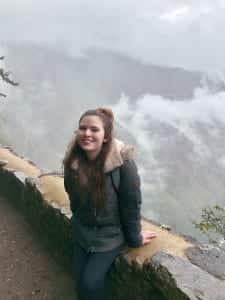
Intern Spotlight: Lexie Hill
Learning Life’s student interns this fall 2019 are, among other things, supporting our Family Diplomacy Initiative(FDI), Democracy Dinners, and world learning excursions with Learning Life children in Washington DC. Lexie Hill interviewed below, has thus far been helping with the excursions, and outreach for the FDI and Democracy Dinners.
Where were you born and raised?
I was born and raised in Pittsburgh, Pennsylvania.
What school do you attend, and what is your year and major there?
I attend George Mason University in Fairfax, Virginia, where I am a major in Public Administration with a minor in Human Development & Family Sciences.
What do you like to do in your free time?
In my free time I like to hang out with my friends. We watch movies (especially comedies, Marvel films), go to all kinds of restaurants, or go shopping for clothes.
What are your career plans?
I hope to work with a Department of Education either at the state or federal level to change and implement education policies that better our education system and country.
Why did you choose to intern with Learning Life?
My original career plans was to do foreign policy and work at the international level, however they have now shifted into educational policy at the domestic level. Even though my career plans do not involve the international level anymore, that is something that still interests me deeply. Learning Life combines the international with education as the organization’s goal is to educate people about the world.
What is the most beautiful place you have seen on Earth, and why is it so beautiful?
I think the most beautiful place I’ve seen is Cajón Del Maipo in Chile. It’s a canyon is southern Chile. Even when you are there it still looks like it’s fake because the river water is so blue and the Andes mountains are so vast. There were also wild horses roaming around, which just added to the breath-taking scene.
Open Letter to Learning Life Families
This letter from Leaning Life’s Director is meant for the lower-income parents and guardians we work with in Washington, DC, but is posted here at our website to help make clear why Learning Life engages lower-income families.
Dear parents and guardians,
I am writing to you to explain why Learning Life wants to engage your family in world learning. In explaining, I’m going to focus on four terms: globalization, segregation, global citizenship, and family diplomacy.
Some of you may wonder why we don’t instead focus on basics, like math, science or reading. We focus on world learning because schools focus more on math, science and reading, and because our world is globalizing. Globalization means that our world is getting smaller, that improvements in transportation and communication technologies are making it faster and easier for people, information, goods and services to move from one country to another. This is why the juice we drink may be made of fruit coming from Florida as well as Mexico, Brazil and India; why we eat Mexican burritos and Chinese fried rice, not just burgers and fries; why our cell phones are made from minerals mined in Canada, Turkey, Russia, Afghanistan and the Democratic Republic of Congo; and why cars made in the USA have parts coming from all over the world. Our lives are richer, and we have many more things to buy pretty cheaply because of globalization. At the same time, globalization means that issues like joblessness, climate change (extreme weather, including more frequent and powerful hurricanes, warmer winters, hotter summers, etc.), terrorism and disease increasingly affect more than one country.
While our world is globalizing, it is also deeply segregated by wealth and race. Segregation means that all around the Earth, rich and poor, and whiter and darker-skinned people often live in separate neighborhoods, even when they live in the same towns and cities. This is very much the case in Washington, DC. (For a stark look at the differences between the richest and poorest neighborhoods or wards of Washington, DC, click here.) Segregation is bad because it shuts poorer people out of many opportunities they would have if their neighborhoods had more of a mix of people of different races and wealth levels, and more of a common spirit of sharing rather than hoarding resources (money, jobs, good schools, decent homes, etc.). So, we live in a strange world because globalization is connecting people, but segregation keeps us apart, not just locally but also globally. We affect each other, but we usually don’t see how we affect each other, for better or worse.
That’s why learning about and connecting with the world is so important. The more we learn about the world, the better we understand how we are all connected, how we affect each other, and what we can do to improve our world, especially for those people that have less. The more we connect with people around the world, the more familiar and less strange they become, and the more we may come to trust and help each other. That’s where global citizenship comes in. We’re used to thinking of citizenship as “I am a citizen of the USA,” with all the rights (to vote, run for public office, religion, public schooling, etc.), and responsibilities (paying taxes, jury duty, military service in times of war, etc.) that comes with. But because of globalization we are also more and more citizens of the world. Being a global citizen means caring about people outside the USA not only because what people do outside the USA affects us as Americans, but because we are all human beings who think, feel, laugh, love and cry. Being a global citizen means not only enjoying the fruits of globalization — the cheaper and more varied food, cell phones, cars, and other goods we get from the world — but helping to make our world a better place for everyone by together tackling problems like climate change, poverty, disease, terrorism and war. Our world is a complicated place, so it can easily seem too difficult to understand, let alone address its problems. However, the problems aren’t going to go away if we just ignore them.
Moreover, there is such an exciting, beautiful world out there to explore, and so many different, interesting people to meet! That’s why Learning Life is developing family diplomacy. Diplomacy — the management of relationships between countries — has for most of human history been controlled by rich and powerful people, but globalization, especially the internet and cell phones, is allowing ordinary people like you and me to connect and cooperate with ordinary people in other countries. Family diplomacy in part means connecting families in different countries so that they can learn from each other about the world: about our families, cultures, communities and countries, about our joys, sorrows, fears and triumphs. Family diplomacy can help make the world seem less strange and complicated because most people have a family and value it. Family diplomacy may also help make the world a more caring place because families, at their best, are about loving and caring for each other.
So, if globalization connects us all in ways we often don’t see, and segregation pulls us apart by wealth and race, global citizenship can open our eyes, and family diplomacy can connect our hearts. Perhaps best of all, you don’t have to be rich to engage in global citizenship and family diplomacy. All you need is an internet-connected cell phone or laptop, and some caring volunteers to guide you. That’s where Learning Life comes in. We look forward to helping your family connect with the world!