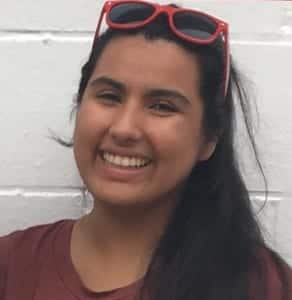
This is the third in a series of spotlights on our fall 2017 student interns. Learning Life’s students this fall are assisting with research, curriculum development, outreach, and family and youth learning activities for our Citizen Diplomacy Initiative (CDI). Sadia Kahn, interviewed below, is helping with our learning activities, grassroots fundraising, and technological and curriculum research, among other things.
Where were you born and raised?
I was born and raised in Pakistan, a country in South Asia, next to India.
What school do you attend, and what is your year and major there?
I am a senior majoring in human relations (a combination of sociology and psychology) at Trinity Washington University in Washington, DC.
What do you like to do in your free time?
I like to read Urdu poetry. (Urdu is one of the main languages spoken in Pakistan.) I also like to watch Youtube lectures of Muslims scholars and learn more about Islam.
Is there a life experience you have had that has particularly shaped you thus far? If so, what is it, and how has it shaped you?
When I was a child, I could not walk until I was three. At the time, my family lived in a small village in the mountains of Pakistan. Even when I could walk a little bit, I was unable to attend school because the mountain path to school was dangerous enough that I could fall off the mountain. By the time I was able to walk to school, I was eight years old. Family and my fellow students would always tell me that I was not capable of doing certain things, which made me doubt my abilities, and made me feel like I was too far behind to attend school.
I eventually overcame these obstacles, but I have a sister who is moderately autistic, so whenever someone tells her you cannot do this or that, I tell them to not to say this because I know how it can adversely impact one’s ability to learn necessary skills.
What are your career plans?
After graduation, I would like to work for a non-profit or other organization that helps people, whether children or else.
Why did you choose to intern with Learning Life?
I choose to intern with Learning Life because I want to improve my communication skills and gain experience that is not taught inside of a classroom.
What is the most beautiful place you have seen on Earth, and why is it so beautiful?
The most beautiful place I have seen on the earth is Virginia’s Shenandoah Valley. Seeing it made me feel like I was back home because I was surrounded by mountains, so many trees and greenery.
Support Learning Life: Host A Diplomacy Dessert
In our unequal, insecure world, Learning Life’s Citizen Diplomacy Initiative (CDI) engages lower-income American families in live dialogues and project collaborations with lower-income families in other nations to nurture more caring, capable global citizens. One of the funnest, most social ways to support CDI is by hosting what we call a “Diplomacy Dessert.”
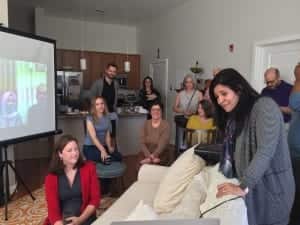
Diplomacy Dessert hosts volunteer to invite their friends, family and/or colleagues to their home on a weekend afternoon for 2-3 hours to learn about and discuss CDI. Diplomacy Dessert participants donate $25 minimum per person to Learning Life to attend the event. In exchange, participants get the opportunity to meet new people, learn about and discuss an innovative international education program, and enjoy sweets the host provides. In some cases, the event can include a live dialogue via Skype with one of CDI’s families abroad to experience first-hand the dialogues in which our CDI families engage.
You don’t have to live in or around Washington DC, where Learning Life is based, to host a Diplomacy Dessert. We can present to your group via Skype if you have a high-speed internet connection at your home.
Hosting a Diplomacy Dessert is pretty simple, and can be summarized in five steps:
Create a list of friends, family and/or colleagues you would like to invite to your Diplomacy Dessert. At least ten people should RSVP their plans to attend for the event to occur, so set your list size as you see fit to meet that minimum.
Consult with Learning Life staff to set a date and time for your Diplomacy Dessert.
Send out the event invitation at least two weeks in advance, with 1-2 reminders until the event. We can take care of this for you via Evite.
Buy whatever desserts or sweets you think your guests will enjoy.
Enjoy your Diplomacy Dessert! Learning Life’s founder, Paul Lachelier, will lead the presentation (including photos, video, and/or live dialogue) and discussion in person or via Skype depending on where you live, so you can focus on your guests.
Interested in hosting a Diplomacy Dessert? Contact us at email@learninglife.info.
Thank you for your support!
Intern Spotlight: Kelly Cruz
This is the second in a series of spotlights on our fall 2017 student interns. Learning Life’s students this fall are assisting with research, curriculum development, outreach, and family and youth learning activities for our Citizen Diplomacy Initiative (CDI). Kelly Cruz, interviewed below, is helping with our learning activities, grassroots fundraising, outreach and research, among other things.
Where were you born and raised?
I was born and raised in Washington, DC.
What school do you attend, and what is your year and major there?
I attend Trinity Washington University, where I am a senior majoring in international affairs.
What do you like to do in your free time?
As a vegetarian, I like to surf the internet for international vegetarian dishes that I can cook at home. Currently, I am interested in a lot of Indian dishes, like “vada pav,” which is a potato-stuffed sandwich! When I have time on my hands l also like to visit the art museums in Washington, DC.
Is there a life experience you have had that has particularly shaped you thus far? If so, what is it, and how has it shaped you?
One of the most life changing experiences I had was volunteering as an English teaching assistant at an adult charter school this last spring. The school’s students come from all over the world, including places that I hadn’t heard of before. Seeing diverse people trying to learn a new language encouraged me to learn more about the cultures and foods of the world!
What are your career plans?
My hope is that I can work for a non-governmental organization focusing on combating climate change. Earth is the only home that we have right now as human beings, and if we don’t take care of it then we won’t have a future.
Why did you choose to intern with Learning Life?
Learning Life focuses on lower-income communities that have fewer resources and ability to impact the world. However, as individuals and families they can provide insight into their values, traditions and culture to other people across the world. Our world is becoming smaller due to globalization, and everyone is affected by it. Learning Life is helping to ensure that nobody gets left behind. Plus, I am able to interact with new people locally and abroad that I might otherwise never meet.
What is the most beautiful place you have seen on Earth, and why is it so beautiful?
I think of the most beautiful place in the world is Fort Totten metro station in Washington DC. Alongside the station there is a park and a garden that intertwines with the station. For example, the fences and walls are covered in vegetation. There are also deer, bird, raccoons, and other wild animals. The calmness of the trees and animals next to rows of parked cars makes the scene unique.
yPIE Interviews Founder Paul Lachelier
Stephanie Blochinger with the Young Professionals in International Education (yPIE) in Washington DC recently interviewed Learning Life Founder and Director Paul Lachelier about the Citizen Diplomacy Initiative. The full interview is copied below, and can be found at yPIE of DC here.
The two promising events were live, internet video dialogues or “virtual exchanges” that I organized between students at Stetson University in Florida and university students in Paris and Cairo in 2009 and 2011, respectively, when I was then a professor of sociology at Stetson. (You can view short videos about those dialogues here and here.) Those single dialogues — respectively about the role of government in society in light of Obamacare legislation then being debated, and about social media and social change in light of the Arab Spring in Egypt — were well-received on all sides, and left me thinking that more such substantive, respectful, learning-focused, transnational dialogues are needed.
The tragic event was the series of coordinated terrorist attacks that happened in Paris on Friday, November 13, 2015 that killed 130 people. That event spurred me to conclude that it was time for Learning Life to turn our focus to combating the ignorance and disconnection that fuel extremism and xenophobia through virtual exchange and collaboration.
2. Why is this initiative different from other community-based initiatives?
Most international virtual exchange is currently student-to-student or classroom-to-classroom. As much as such exchange is praiseworthy and deserving of expansion to more schools (so long as it produces positive and sustainable outcomes), it is more likely to occur between relatively privileged students because schools in wealthier communities are more likely to be equipped and motivated to engage in such dialogues.
As far as we know, we are the only nonprofit in the international virtual exchange field that’s devoted to dialogue and collaboration between lower-income people, and specifically families, in different nations. Families are sometimes viewed as refuges from a dangerous world, but families are always vulnerable to all sorts of public dangers, some of them international, like terrorism, disease, cyber-piracy and evolutions in transnational trade. We envision and work to nurture families not as refuges but as vehicles for peace through a new kind of family-to-family citizen diplomacy.
Plus, for less educated families, talking about family and lifestyle can be a more comprehensible and appealing entry-point into citizen diplomacy than talking about trade agreements, terrorism or climate change.
It’s also an opportunity for families to bond and create memories together through international dialogue. As one of our family members in Dakar, Senegal, recently told us, his large family is usually busy, each at their own cell phones, hobbies or tasks, but when our dialogues happen, they come together as a family.
3. What challenges did you face and were there any lessons learned from the first year of implementation?
In our first year of the Citizen Diplomacy Initiative, we faced a number of challenges, including recruiting families here in DC and abroad, making sure everyone showed up to the dialogues as planned, arranging transportation for our DC families without cars, hoping the internet connection is strong enough, keeping the families engaged as we continue to develop and refine our curriculum, coordinating a volunteer-intensive operation, fundraising to pay for food, transport and communications for our dialogues and supportive learning activities (field trips, international potlucks, global learning “fundays,” etc.).
We’re still working on some of these challenges, but are happy to report that we successfully completed over twenty live, family-to-family dialogues, and an international photo project comparing various aspects of our families’ communities in DC, Dakar, Senegal, and Jerash, Jordan.
4. What can international education professionals learn from this program?
If there is anything our Citizen Diplomacy Initiative is intended to convey in the short and long-term it’s that:
a) Overcoming many of the world’s challenges will take widespread, participatory, public commitment,
b) Our current largely elite-controlled system of diplomacy doesn’t help spread that commitment,
c) we thus need to democratize diplomacy, that is, to widen the spectrum of people participating in tackling those challenges,
d) that technologies like the internet, cell phones and tablets — when properly used in carefully designed, research-based, international programs — can help democratize diplomacy.
5. Anything else you would like to share? This could also be a good opportunity to share information about the networking group you formed?
Also, if you’re interested in helping to advance the field of international virtual exchange, let us know and we’ll notify you of the bi-monthly face-to-face meetings in DC and online Slack of our Virtual Exchange Coalition, which brings together government, business and nonprofit professionals in the field.