Good health is vital. The less healthy one is, the less one is able to perform as a private individual in school, work and family, let alone as a public citizen in community and society. The vigor and happiness of individuals, families, communities, societies, indeed the entire world, thus depends on good health. In turn, human health is also impacted by a myriad of factors, from the local food supply to global climate change. These are two major reasons why Learning Life has begun orienting our programming toward health.
Countless pressing public issues are health issues, including bullying, child abuse, domestic violence, depression, loneliness, drug abuse, drunk driving, gun violence, hunger, obesity, diabetes, heart disease, homelessness, poverty, unemployment, income and wealth inequality, human trafficking, communicable diseases ranging from common cold viruses to deadly Ebola, terrorism, war, pollution, and climate change. As this long yet far from complete list demonstrates, health issues run from violence at home, or bullying in one’s school or neighborhood, to international phenomena like human trafficking, terrorism and climate change. Furthermore, many of these health issues are interconnected and happen in many localities yet they are shaped by big, complicated histories and institutional actors — religious faiths, multinational businesses, national governments, international governmental bodies — whose powerful actions are often invisible and incomprehensible to all but a few trained and paid specialists. Thus, human health is affected by so many issues local to global yet the connections and causes of those issues are dauntingly complex.
Faced with such complex health problems, it is tempting to ignore them. But ironically, the less one knows, the more one is at risk for avoidable health problems (e.g., those less educated are more likely to smoke, take drugs, overeat, etc.) while other health threats, like drunk driving, inequality, and climate change, one can ignore but cannot avoid entirely, if at all. Those who are resource-poor are the least able to avoid many public problems that have health impacts. So, we can either put our heads in the sand, or take action, and Learning Life aims to take action.
Accordingly, in fall 2017, Learning Life began collaborating with the Georgetown University School of Medicine’s (GUSM) Community Health Division. That collaboration helped propel Learning Life’s research this year comparing the health and food cultures of our CDI (Citizen Diplomacy Initiative) families in Washington DC, San Salvador, El Salvador, and Dakar, Senegal (click here for the first study, with further research results coming soon), and our larger family food culture project. Food clearly impacts health, and has the educational advantage of being a universal, daily preoccupation of interest to most people. Food culture — which we define as a group’s food shopping, cooking and eating habits and beliefs — also varies substantially cross-nationally, and can be shaped to advance health and learning about the world. Hence, food culture seems a fitting focus for our project work between CDI families in different countries.
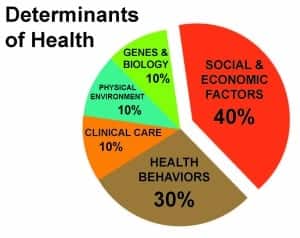
The GUSM Community Health Division, under the leadership of Dr. Kim Bullock, welcomes partnerships with community organizations to help improve community health education while giving Georgetown medical students experience in what the medical profession commonly calls “the social determinants of health” (SDHs). A pie chart (University of North Carolina-Charlotte 2018) often employed to provide U.S. medical students and health professionals with perspective on the determinants of health gives a sense of the importance of SDHs:
As the chart shows, SDHs have the largest impact on people’s health, surpassing individuals’ own actions (diet, exercise, smoking, drug-taking, etc.), and much surpassing a person’s genetics, environment, or medical care resources. The second chart below (Kaiser Family Foundation 2018) unpacks the SDH term, giving a sense of the wide range of SDHs, and hence why these factors, together, matter so much to human health:
The chart underscores that while good or bad health is experienced individually, it is shaped by a range of social factors, some of which, like literacy and language, too many people may not realize are linked to their health. As our world grows more interconnected economically, socially and politically, many of these SDHs are shaped more and more by international forces like trade, immigration and climate change. It thus behooves health educators to frame learning about health in local to global terms.
In the shorter term, the shared challenge of Learning Life and GUSM’s Community Health Division is to improve CDI families’ understanding of health, including nutrition and SDHs, and food culture, wherever they are in the world. In the longer term, we hope to improve the health outcomes of our families worldwide. Much that is good on this Earth takes time and patient work to happen. That is why we are in this for the long haul.
Kaiser Family Foundation. “Beyond Health Care: The Role of Social Determinants in Promoting Health and Health Equity.” Chart retrieved from https://www.kff.org/disparities-policy/issue-brief/beyond-health-care-the-role-of-social-determinants-in-promoting-health-and-health-equity/ on 9/7/18.
University of North Carolina-Charlotte. “ARCHES Mission & Goals.” Chart retrieved from https://arches.uncc.edu/mission-goals on 9/7/18.
CDI Is Two Years Old! Here’s Where We Are
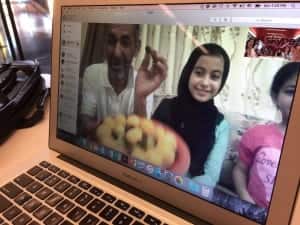
Today marks the second anniversary of Learning Life’s Citizen Diplomacy Initiative (CDI). On this day two years ago, we held our first live international family-to-family video dialogue between two American families in Washington DC and one Senegalese family in Dakar, the capital of Senegal.
Since then, we’ve conducted over thirty video dialogues between families in DC, Dakar, San Salvador, El Salvador, and Jerash, Jordan. We also completed our first cross-national, family-to-family project in 2018 in which our families from DC shared community photos with families in Dakar and Jerash, yielding an international photo album on five themes: public life, food culture, challenges, bright spots, and the future. More on that project here.
This year, we are conducting our second international project engaging families in DC, San Salvador, Dakar and Jerash in deeper learning about food culture through interviews with families abroad and projects guests. This second project signals our growing focus on advancing the health of the families and communities we work with in the long-term. Health is fundamental to everyone, and is affected by a wide array of local to global issues, from food security and water safety to climate change and terrorism. This makes our focus on health important not only to the vitality of CDI families but to their understanding of the world. More on this project here.
In March, my wife and I took our first visit to one of our CDI partners, the Collectif pour la Promotion des Groupes Vulnerables (Collective for the Advancement of Vulnerable Groups) or CPGV in Dakar, Senegal. That trip, in collaboration with the Community Health Division of the Georgetown University Medical Center, resulted in a comparative study of the food culture of CDI families in Washington DC and Dakar that was presented at three conferences. It also strengthened Learning Life’s relationship with the CPGV and the Senegalese families with which we work. More on that trip and food culture research presentation here and here.
This year we also started a mentoring program. In 2017, I began informally mentoring one of our CDI kids, James, who was present at that inaugural dialogue on August 27 two years ago. I noticed over time that James exhibited greater self-confidence, knowledge and interest in world affairs. Consequently, early this year, my wife began mentoring a teenage girl, Samya, who, after expressing initial enthusiasm about CDI, had gradually disengaged. Overnight, Samya’s engagement with CDI returned. These anecdotes, along with research on the benefits of mentoring, spurred the start of our mentoring program. With thirteen mentors now and growing, we are very pleased to see our mentors and mentees’ mutual enthusiasm as they explore the world together through visits to metro DC museums, embassies, cultural festivals, universities, restaurants and other sites as well as reading, documentary viewing, map learning and discussion. Next up: extending this one-on-one mentoring to our CDI youth abroad via monthly video dialogues with volunteer mentors in the USA. More on our mentoring program here.
I will have more to report at the end of this year as we complete our food culture project, and plan for the coming years. CDI remains purposefully small at this early developmental stage as we test-learn-adapt, slowly expand, and do our best to provide our families with a quality experience. Developing a novel, family-based, international model for citizen diplomacy is challenging, especially because we currently work exclusively with lower-income families. But it continues to be an exciting and rewarding calling.
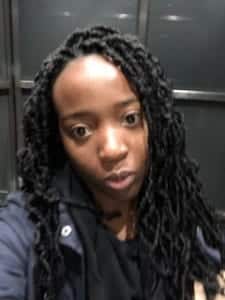
This is the seventh and final spotlight on our summer 2018 student interns. Learning Life’s students this summer are assisting with planning, fundraising, curriculum development, and international family-to-family projects focused on community photography and food culture as part of our Citizen Diplomacy Initiative (CDI). Onize Oniwon, interviewed below, is assisting with organizational planning.
Where were you born and raised?
I was born and raised in Nigeria, which is in West Africa. I left Nigeria after high school at age 18 to further my education here in the United States.
What school do you attend, and what is your year and major there?
Currently, I am entering my last year at Marymount University, located in Arlington, VA. I am completing a dual-degree graduate program in Health Care Management and Business Administration.
What do you like to do in your free time?
In my free time, I like to relax and watch movies, including dramas, comedies and action films. I also enjoy good times with friends, drinking wine, chatting and watching movies.
Is there a life experience you have had that has particularly shaped you thus far? If so, what is it, and how has it shaped you?
I grew up in a developing country, so I am aware of the inequalities that exist in the world, including patriarchy (child marriages, men dominating business, media, politics, etc.). This has fueled my passion to help the disadvantaged through volunteering and public health work.
What are your career plans?
In the near future, my plan is to get a job in health care administration. Ideally, it would be nice to have a job that engages my background in medical technology, public health and business. Long term, I would like to establish a clinical laboratory and a public health nonprofit back home in Nigeria.
Why did you choose to intern with Learning Life?
I chose to intern with Learning Life because it offered me a chance to get hands-on experience in program planning in the nonprofit sector. It gave me a chance to be involved in a collaborative effort to produce a program plan.
What is the most beautiful place you have seen on Earth, and why is it so beautiful?
I am not sure that I have seen the most beautiful place yet. I will say I have a bucket list of places that I would like to see due to their scenic richness. This includes Greece, the Maldives and southern France, to name a few.
Intern Spotlight: Zainab Mahdi
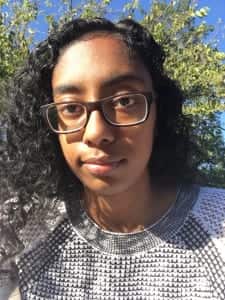
This is the sixth in a series of spotlights on our summer 2018 student interns. Learning Life’s students this summer are assisting with planning, fundraising, curriculum development, and international family-to-family projects focused on community photography and food culture as part of our Citizen Diplomacy Initiative (CDI). Zainab Mahdi, interviewed below, is, among other things, helping with fundraising, curriculum development, research, and live dialogues with families in El Salvador working on our food culture project.
Where were you born and raised?
I was born in Colombo, Sri Lanka and my family moved to the United States when I was 8 years old. I have lived in Northern Virginia ever since, along with my parents and younger brother and sister.
What school do you attend, and what is your year and major there?
I am a rising sophomore at Georgetown University’s School of Foreign Service. Currently, I plan to major in Global Business with a minor in Spanish.
What do you like to do in your free time?
In my free time, I enjoy reading books (especially historical fiction), drawing, and listening to true crime podcasts. I also love spending time outside biking and hiking at Algonkian Regional Park in northern Virginia, as well as hanging out with my family and exploring Washington D.C. with my friends.
Is there a life experience you have had that has particularly shaped you thus far? If so, what is it, and how has it shaped you?
I spent a summer working with a local environmental non-profit that used grassroots campaigning to promote legislative reform. Being a part of such a dedicated and passionate team was very inspiring for me, and I was able to push myself out of my comfort zone and learn a lot about environmental advocacy by engaging daily with people from all walks of life on the pressing issues of climate change, pollution, and politics.
What are your career plans?
Someday, I hope to have a career in international development. I would love to have a job that involves a lot of traveling and working directly with communities across the globe to improve living conditions and help solve major world issues like poverty, education, and scarcity.
Why did you choose to intern with Learning Life?
I am very interested in international affairs and studying the effects of intercultural connection and globalization. For me, Learning Life’s goal of fostering global citizenship through international family-to-family dialogue demonstrates that it is an organization committed to making a unique positive change in the world. Interning with Learning Life is a great opportunity for me to gain hands-on experience and practice my Spanish skills by contributing to the organization’s latest cultural project connecting families in D.C. and El Salvador.
What is the most beautiful place you have seen on Earth, and why is it so beautiful?
A few years ago, I visited Yala National Park in Sri Lanka with my family. It was an incredibly stunning and beautiful experience that I will never forget. In just a few days, I saw leopards, bears, crocodiles, monkeys, peacocks, and hundreds of elephants in the wild. We stayed in an open-air treehouse in the jungle, falling asleep below starry skies and waking up to the brilliant sunrise and sounds of animals gathering at a nearby watering hole. I have many wonderful memories of Sri Lanka, but this was one of the best experiences of my life and I hope to travel there again in the future.

 As the chart shows, SDHs have the largest impact on people’s health, surpassing individuals’ own actions (diet, exercise, smoking, drug-taking, etc.), and much surpassing a person’s genetics, environment, or medical care resources. The second chart below (Kaiser Family Foundation 2018) unpacks the SDH term, giving a sense of the wide range of SDHs, and hence why these factors, together, matter so much to human health: