This week, we are happy to report that the number of subscribers to Learning Life’s email newsletter surpassed 1,000 for the first time.
Learning Life’s e-news includes an announcement and photos sent at the beginning of the month about the past month’s events and events upcoming. We also send occasional breaking news about milestones achieved, new partnerships, issue articles, etc. Much of our e-news reports on our flagship Citizen Diplomacy Initiative (CDI), which engages lower-income American families in live dialogues and project collaborations with lower-income families in other nations.
Not a subscriber? You can subscribe free here. Think you subscribed, but are not getting our e-news? Check your spam/junk folder, or your promotions folder if you use gmail. If you find our e-news there, move it to your inbox or otherwise mark it as non-spam.
For our most current news as well as interesting facts, quizzes, and other eye-catching content, follow us on Facebook, Twitter, Instagram, and/or Linkedin.
New Fundays Get DC Kids Learning about the World
In June, Learning Life launched a new way to deepen DC children’s learning about the world.
Learning Life’s flagship Citizen Diplomacy Initiative engages lower-income DC families, starting in Ward 8 of Washington DC, in live internet dialogues and project collaborations with lower-income families in other nations. From January to August this year, eight families in Washington DC, Dakar, Senegal, and Jerash, Jordan, participated in the first project collaboration, a photo album comparing their photographic answers to the question “what is the nature of your community?” Stay tuned for a report on that project coming in December.
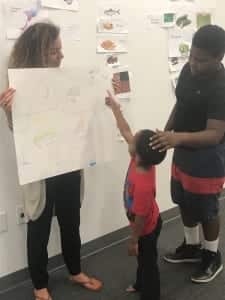
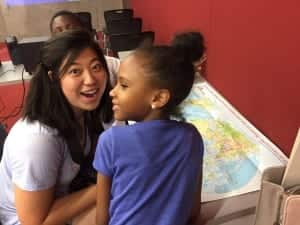
As we learned during the first project and in prior meetings with our DC families, participating DC children, who range in age from 5 to 14, come into CDI knowing very little about the world. Accordingly, we launched our first funday on Sunday June 11 with a focus on answering the question “why should we care about the wider world?”, and have carried out fundays on world geography and food. Fundays are typically broken into four parts:
Introduction: Children and volunteers get an orientation to the funday, including its structure, rules and learning focus.
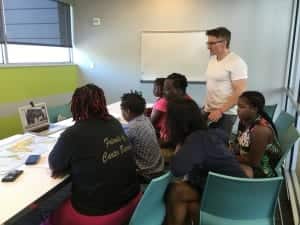
Learning session: In large and small groups kids and volunteers learn basic facts about a world topic (e.g., geography, globalization, food, religions, climate change) via online videos, infographics, photos, maps and/or printed Learning Life funday info.
Snack break: Kids and volunteers take a break and eat snacks provided free by Learning Life.
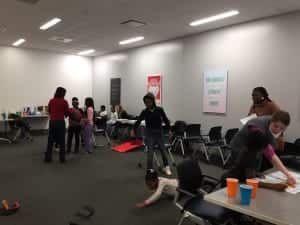
Game session: The children, divided into teams, are tested on what they learned from the learning session. The more questions the kids answer correctly, the more opportunities they have to score points in bowling, cornhole and horseshoe games. The team that scores the most points wins (no prizes, just the satisfaction of learning and winning).
“Fundays are a fun, interactive way for CDI kids to learn more about the wider world that affects us all. Happily, we’re already seeing improvements in participating children’s knowledge about the world,” says Paul Lachelier, Learning Life’s Founder and Director. “Knowing the facts is often denigrated in favor of knowing how to think, but everyone needs facts to think, and the more facts about a topic one knows, the better one understands, remembers, and problem-solves on that topic.” (For more on the importance of facts for learning, click here.)
Fundays, along with field trips and international potlucks, will be held occasionally on Saturday or Sunday afternoons at different locations in DC. To learn more or to volunteer for an upcoming funday, contact us at email@learninglife.info. Live in DC Ward 8 and interested in having your family participate free in CDI? Email us with a telephone number and best times to reach you. We will call you to determine if your family is eligible to participate.
Today is the First Anniversary of our Citizen Diplomacy Initiative!
One year ago today, we held our Citizen Diplomacy Initiative’s very first live, international, family-to-family dialogue. As we recounted back then in a blog post about the dialogue:
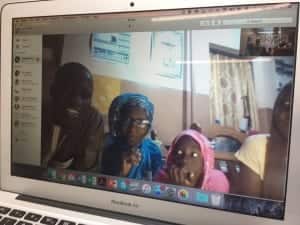
“The dialogue connected members of two American families in D.C. — a grandmother and her grandson, and a father and his two daughters — with a nine-member family in Dakar, the capital of Senegal, located on the coast at the western-most tip of Africa. After introducing themselves, the families freely asked each other questions about their use of media (Facebook, Youtube, Snapchat, etc.), their food, music, modes of transportation, and cost of living, among other subjects. As the American families learned, residents of Dakar are not that different from residents of Washington D.C. as fellow major city dwellers connected to common media, music, food and other goods.”
Fast-forward exactly one year and we have:
Carried out twenty-two live international dialogues between families in (a) Washington DC, (b) Porto de la Libertad, El Salvador, (c) Dakar, Senegal, and (d) Jerash, Jordan.
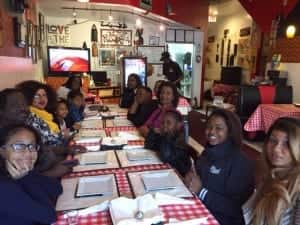
Conducted more than thirty youth and family learning activities in Washington DC, including international potlucks, documentary discussions, game-based fundays, and field trips to embassies, museums, and other locations with a focus on local and international learning.
Nearly completed our first cross-national, family-to-family, collaborative project.
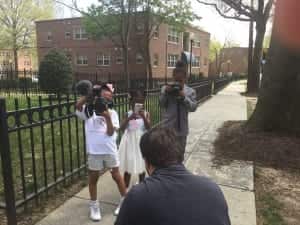
Our collaborative photovoice project engaged eight lower-income families in Washington DC, Dakar, Senegal, and Jerash, Jordan in taking photos in answer to the question “what is the nature of your community?” The album that we are now putting together selects 75 of the nearly 500 photos our families took from their different vantage points in three communities on three continents. The photo album — organized into street scenes, food culture, social challenges, bright spots, and visions of the future — will be finalized along with a project report in September and released for public presentation online as well as in Washington DC and abroad in September and beyond.
Later this year, we will begin our second international project, and double the number of participating families in DC and abroad to about 16. This second project will engage our families in practicing how to ask questions and interview people locally and internationally to learn. Being able to ask questions might seem elemental, but asking thoughtful questions is not easy, takes some degree of self-confidence, and is absolutely essential to learning. All of our projects are intended to develop what we call “civic skills,” or one’s ability to act effectively at local to global levels to solve collective problems.
Lastly, I need to note: we run a money-efficient, volunteer-rich operation, but it still takes money to pay for food, communication technology, and transportation for our lower-income families that don’t have cars. Your donations are really vital to our ability to pay for these costs. Please give $25, $50, or $100 here now to help sustain our work.
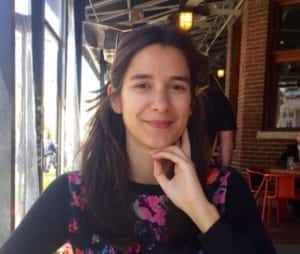
This is the fourth in a series of spotlights on our summer 2017 student interns. Learning Life’s students this summer assisted with research, curriculum development, outreach, and family and youth events for our Citizen Diplomacy Initiative (CDI). Lorna Strachan, interviewed below, helped with academic literature research, curriculum development, international learning activities with our youth, and more.
Where were you born and raised?
I was born and raised in the Silicon Valley of California, south of San Francisco. My hometown is Santa Clara.
What school do you attend, and what is your year and major there?
I go to George Washington University in Washington, DC. I am a rising senior double majoring in Dance and International Affairs with a concentration in Europe and Eurasia.
What do you like to do in your free time?
I have been a dancer for most of my life, so in my free time I dance and choreograph for my student ballet group Balance as well as for the Dance Department at George Washington University.
Is there a life experience you have had that has particularly shaped you thus far? If so, what is it, and how has it shaped you?
The experience that has shaped me the most in my life so far was the experience of auditioning for and being rejected by college dance programs my senior year of high school. While it was incredibly disheartening, it taught me how to move on from rejection and find new paths that I may not have thought of before. I was able to come to GW and learn about styles of dance I did not know about before and probably would not have been exposed to had I attended a university with a very rigorous dance program.
What are your career plans?
I hope to work somewhere with interest in the European Union, whether it is a consulting firm, a non-profit, a European agency, or some part of the US government.
Why did you choose to intern with Learning Life?
I am passionate about the importance of global knowledge and access to information about international issues, so I was drawn to Learning Life because we get to teach kids and families tools that lead to important values like tolerance and curiosity about the outside world.
What is the most beautiful place you have seen on Earth, and why is it so beautiful?
I have seen lots of beautiful places but probably my favorite is the island of Kauai in Hawaii. Kauai is lush and green, with tall mountains and steep cliffs that lead to soft sandy beaches.

 Learning Life’s e-news includes an announcement and photos sent at the beginning of the month about the past month’s events and events upcoming. We also send occasional breaking news about milestones achieved, new partnerships, issue articles, etc. Much of our e-news reports on our flagship Citizen Diplomacy Initiative (CDI), which engages lower-income American families in live dialogues and project collaborations with lower-income families in other nations.