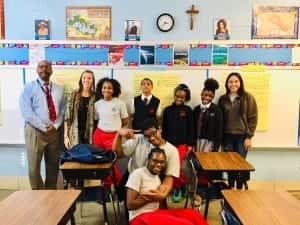
Today, six DC middle school students and two Learning Life teachers met for the first time to launch an experiment in Washington DC: a global storytelling challenge.
Since Learning Life started its Citizen Diplomacy Initiative (CDI) a little more than two years ago, in August 2016, we have recruited some of our CDI families from schools in Washington DC, but we have not established a working relationship with any school, until now. Starting today, two volunteer Learning Life teachers, Nichole Hutchins and Rujjares Hans, both Master’s students in the International Education Program at George Washington University, are leading six students at the Saint Thomas More Catholic Academy (STM), with the assistance of STM Social Studies teacher, Randall Carter, in a challenge focused on telling stories about health from an international perspective.
“Countless pressing public issues are health issues, including bullying, depression, loneliness, drug abuse, crime, hunger, obesity, diabetes, homelessness, unemployment, income and wealth inequality, human trafficking, communicable diseases, terrorism, war, pollution, and climate change. Good health is fundamentally important, yet research indicates that lower-income families suffer disproportionately from health problems. Storytelling is a widely useful, resume-building skill any person can develop, regardless of their material resources, and an effective way to learn about any topic, including health. However, there are relatively few opportunities for lower-income youth, including many STM students, to develop their storytelling skill, especially in an international context,” explained Learning Life’s Founder and Director, Paul Lachelier.
Thus, from October 22 to December 10, 2018, Nichole and Rujjares will meet with their elementary school students for 1.5 hours weekly to learn, plan and ultimately perform before a live audience two compelling stories about an international issue that affects health. The group will form two teams, each composed of three students and one teacher. Each team will develop its own engaging health story, choosing their international issue and story form (dance, song, poetry, miming, painting, writing, etc., or some combination thereof). Each story, told in 5-10 minutes, must connect the local with the global, either by comparing or connecting two stories in different parts of the world, or by connecting a local story to a global phenomenon or trend. In their last meeting on December 10, the two student teams will perform their stories and be judged by a panel of storytelling experts in front of a live audience of students, teachers and staff.
When all is said and done, the challenge should give the student storytellers valuable experience in developing and performing a story, and a deeper understanding of world health issues. Learning Life will survey the students at the start and end of the challenge to gauge its impact on the students’ attitudes and knowledge about the world. If this pilot storytelling challenge proves successful, we aim to do a second challenge in the spring with more STM students with an eye toward expanding the competition to more schools in Washington DC and in other cities where Learning Life works abroad in the coming years.
Introducing “Cook, Eat & Learn Sessions” (CELS)
This fall and winter, six Georgetown University medical students will meet with lower-income Washington DC families participating in Learning Life’s Citizen Diplomacy Initiative (CDI) to conduct what we call “cook, eat and learn sessions” or CELS. The CELS will support the American families engaged in our CDI food culture project in learning about nutrition and differences in shopping, cooking and eating practices internationally.
Each year, first-year Georgetown University medical students are required to complete a community-based learning (CBL) course. Through the course, students gain community-based experience about the “social determinants of health” — socio-economic factors like employment, housing, transportation, education, and access to supermarkets — as they assist community organizations by educating and/or conducting basic health exams with lower-income DC residents. This fall is the first time students in the CBL course will be volunteering with Learning Life.
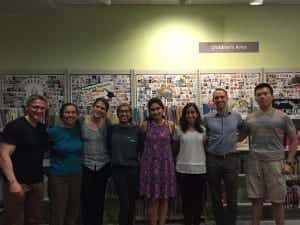
If all goes according to plan, the medical students, working in pairs — Claire and Matt, Nikita and George, Dahlia and Amna — will meet with five CDI families, one at a time, at their respective homes to (1) cook a meal that is healthy, cheap, tasty, foreign and easy to make, and (2) during the meal make a Powerpoint presentation about their experience of foreign food cultures while traveling or living abroad. The students (featured in the above photo along with their faculty lead, Dr. Kim Bullock, and Learning Life Director, Paul Lachelier) all elected into conducting the CELS given their interest in food, nutrition and/or travel.
“DC, like so many cities worldwide, is highly segregated by class and race. People of different socio-economic status may cross paths as strangers or at best polite acquaintances on the street, in stores, or at work, but rarely do they interact meaningfully, let alone cook and eat together. CELS are intended to bridge that socio-economic divide via something all humans do — food — while giving lower-income families the opportunity to learn a little about nutrition, healthy cooking, and food cultures in other countries,” explains Learning Life Director, Paul Lachelier.
“Our students are excited to participate in the CELS. I anticipate they will learn just as much from the experience as the families will,” said Dr. Bullock, who is also a practicing doctor, professor, and Director of the Community Health Division at the Georgetown University School of Medicine.
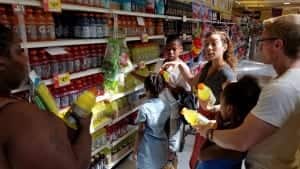
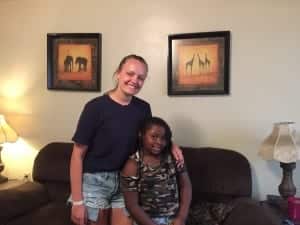
CELS follow on several supermarket nutrition tours Learning Life volunteers conducted with some of our American families this summer to teach them about nutrition labeling and healthier food shopping, and to try new fruits, like kiwi, mango, pomegranates and dragon fruit (see the above photo).
Toward Good Health, Local to Global
Good health is vital. The less healthy one is, the less one is able to perform as a private individual in school, work and family, let alone as a public citizen in community and society. The vigor and happiness of individuals, families, communities, societies, indeed the entire world, thus depends on good health. In turn, human health is also impacted by a myriad of factors, from the local food supply to global climate change. These are two major reasons why Learning Life has begun orienting our programming toward health.
Countless pressing public issues are health issues, including bullying, child abuse, domestic violence, depression, loneliness, drug abuse, drunk driving, gun violence, hunger, obesity, diabetes, heart disease, homelessness, poverty, unemployment, income and wealth inequality, human trafficking, communicable diseases ranging from common cold viruses to deadly Ebola, terrorism, war, pollution, and climate change. As this long yet far from complete list demonstrates, health issues run from violence at home, or bullying in one’s school or neighborhood, to international phenomena like human trafficking, terrorism and climate change. Furthermore, many of these health issues are interconnected and happen in many localities yet they are shaped by big, complicated histories and institutional actors — religious faiths, multinational businesses, national governments, international governmental bodies — whose powerful actions are often invisible and incomprehensible to all but a few trained and paid specialists. Thus, human health is affected by so many issues local to global yet the connections and causes of those issues are dauntingly complex.
Faced with such complex health problems, it is tempting to ignore them. But ironically, the less one knows, the more one is at risk for avoidable health problems (e.g., those less educated are more likely to smoke, take drugs, overeat, etc.) while other health threats, like drunk driving, inequality, and climate change, one can ignore but cannot avoid entirely, if at all. Those who are resource-poor are the least able to avoid many public problems that have health impacts. So, we can either put our heads in the sand, or take action, and Learning Life aims to take action.
Accordingly, in fall 2017, Learning Life began collaborating with the Georgetown University School of Medicine’s (GUSM) Community Health Division. That collaboration helped propel Learning Life’s research this year comparing the health and food cultures of our CDI (Citizen Diplomacy Initiative) families in Washington DC, San Salvador, El Salvador, and Dakar, Senegal (click here for the first study, with further research results coming soon), and our larger family food culture project. Food clearly impacts health, and has the educational advantage of being a universal, daily preoccupation of interest to most people. Food culture — which we define as a group’s food shopping, cooking and eating habits and beliefs — also varies substantially cross-nationally, and can be shaped to advance health and learning about the world. Hence, food culture seems a fitting focus for our project work between CDI families in different countries.
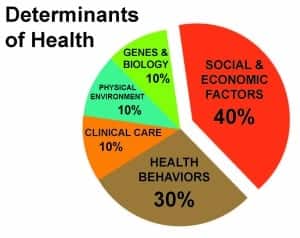
The GUSM Community Health Division, under the leadership of Dr. Kim Bullock, welcomes partnerships with community organizations to help improve community health education while giving Georgetown medical students experience in what the medical profession commonly calls “the social determinants of health” (SDHs). A pie chart (University of North Carolina-Charlotte 2018) often employed to provide U.S. medical students and health professionals with perspective on the determinants of health gives a sense of the importance of SDHs:
As the chart shows, SDHs have the largest impact on people’s health, surpassing individuals’ own actions (diet, exercise, smoking, drug-taking, etc.), and much surpassing a person’s genetics, environment, or medical care resources. The second chart below (Kaiser Family Foundation 2018) unpacks the SDH term, giving a sense of the wide range of SDHs, and hence why these factors, together, matter so much to human health:
The chart underscores that while good or bad health is experienced individually, it is shaped by a range of social factors, some of which, like literacy and language, too many people may not realize are linked to their health. As our world grows more interconnected economically, socially and politically, many of these SDHs are shaped more and more by international forces like trade, immigration and climate change. It thus behooves health educators to frame learning about health in local to global terms.
In the shorter term, the shared challenge of Learning Life and GUSM’s Community Health Division is to improve CDI families’ understanding of health, including nutrition and SDHs, and food culture, wherever they are in the world. In the longer term, we hope to improve the health outcomes of our families worldwide. Much that is good on this Earth takes time and patient work to happen. That is why we are in this for the long haul.
Kaiser Family Foundation. “Beyond Health Care: The Role of Social Determinants in Promoting Health and Health Equity.” Chart retrieved from https://www.kff.org/disparities-policy/issue-brief/beyond-health-care-the-role-of-social-determinants-in-promoting-health-and-health-equity/ on 9/7/18.
University of North Carolina-Charlotte. “ARCHES Mission & Goals.” Chart retrieved from https://arches.uncc.edu/mission-goals on 9/7/18.
CDI Is Two Years Old! Here’s Where We Are
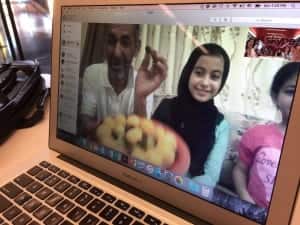
Today marks the second anniversary of Learning Life’s Citizen Diplomacy Initiative (CDI). On this day two years ago, we held our first live international family-to-family video dialogue between two American families in Washington DC and one Senegalese family in Dakar, the capital of Senegal.
Since then, we’ve conducted over thirty video dialogues between families in DC, Dakar, San Salvador, El Salvador, and Jerash, Jordan. We also completed our first cross-national, family-to-family project in 2018 in which our families from DC shared community photos with families in Dakar and Jerash, yielding an international photo album on five themes: public life, food culture, challenges, bright spots, and the future. More on that project here.
This year, we are conducting our second international project engaging families in DC, San Salvador, Dakar and Jerash in deeper learning about food culture through interviews with families abroad and projects guests. This second project signals our growing focus on advancing the health of the families and communities we work with in the long-term. Health is fundamental to everyone, and is affected by a wide array of local to global issues, from food security and water safety to climate change and terrorism. This makes our focus on health important not only to the vitality of CDI families but to their understanding of the world. More on this project here.
In March, my wife and I took our first visit to one of our CDI partners, the Collectif pour la Promotion des Groupes Vulnerables (Collective for the Advancement of Vulnerable Groups) or CPGV in Dakar, Senegal. That trip, in collaboration with the Community Health Division of the Georgetown University Medical Center, resulted in a comparative study of the food culture of CDI families in Washington DC and Dakar that was presented at three conferences. It also strengthened Learning Life’s relationship with the CPGV and the Senegalese families with which we work. More on that trip and food culture research presentation here and here.
This year we also started a mentoring program. In 2017, I began informally mentoring one of our CDI kids, James, who was present at that inaugural dialogue on August 27 two years ago. I noticed over time that James exhibited greater self-confidence, knowledge and interest in world affairs. Consequently, early this year, my wife began mentoring a teenage girl, Samya, who, after expressing initial enthusiasm about CDI, had gradually disengaged. Overnight, Samya’s engagement with CDI returned. These anecdotes, along with research on the benefits of mentoring, spurred the start of our mentoring program. With thirteen mentors now and growing, we are very pleased to see our mentors and mentees’ mutual enthusiasm as they explore the world together through visits to metro DC museums, embassies, cultural festivals, universities, restaurants and other sites as well as reading, documentary viewing, map learning and discussion. Next up: extending this one-on-one mentoring to our CDI youth abroad via monthly video dialogues with volunteer mentors in the USA. More on our mentoring program here.
I will have more to report at the end of this year as we complete our food culture project, and plan for the coming years. CDI remains purposefully small at this early developmental stage as we test-learn-adapt, slowly expand, and do our best to provide our families with a quality experience. Developing a novel, family-based, international model for citizen diplomacy is challenging, especially because we currently work exclusively with lower-income families. But it continues to be an exciting and rewarding calling.

 Since Learning Life started its Citizen Diplomacy Initiative (CDI) a little more than two years ago, in August 2016, we have recruited some of our CDI families from schools in Washington DC, but we have not established a working relationship with any school, until now. Starting today, two volunteer Learning Life teachers, Nichole Hutchins and Rujjares Hans, both Master’s students in the International Education Program at George Washington University, are leading six students at the Saint Thomas More Catholic Academy (STM), with the assistance of STM Social Studies teacher, Randall Carter, in a challenge focused on telling stories about health from an international perspective.