This is the second of two spotlights on our fall semester 2018 student interns. Learning Life’s students this fall are assisting with curriculum development, research, and youth international learning activities as part of our Citizen Diplomacy Initiative (CDI). Yaxeni Valero, interviewed below, is helping with gathering educational content on mentoring, storytelling and health, assisting with health-learning youth activities, and more.
Where were you born and raised?
I was born and raised in Houston, Texas.
What school do you attend, and what is your year and major there?
I am currently a sophomore at Georgetown University pursuing a major in Global Health and a minor in Psychology.
What do you like to do in your free time?
In my free time, I enjoy volunteering in the community, including packing meals for the homeless, and teaching science to children. I also really enjoy trying new foods and finding new places to eat out. I’ve discovered and really enjoy sushi and Korean beef bowls.
Is there a life experience you have had that has particularly shaped you thus far? If so, what is it, and how has it shaped you?
When I was in middle school, I can remember helping my mother study for her citizenship test by testing her with index cards. At a young age, I did not understand the true magnitude of the situation and how impactful it was for my mother. As I got older, I began to hear about immigration issues and learn about politics. More recently, as I learned about Central American immigrant families being torn apart at the US border, my mind drifted to that memory. Something in me shifted. I learned to appreciate what I was once too young and uneducated to understand. This shaped me into a more open-minded, education-seeking individual. I always wanted to do good, but now, I want to truly learn as well — not just learning from a textbook, but learning that connects those textbooks to real life around me and helps me make a difference.
What are your career plans?
In the future, I wish to travel to poorer, undeveloped countries so that I can further understand the differences that are encountered in places where resources are scarce and poverty is high. I wish to look at health care and disease and understand how this shapes people’s lives and how it can be alleviated or prevented.
Why did you choose to intern with Learning Life?
I chose to intern with learning life because I value education. It’s a powerful tool that gives people more control over their own lives. I also value Learning Life’s work to help close educational gaps that exist because of the lack of resources in some communities. I believe educating youth is the definition of a better tomorrow, and that making them more curious and educated individuals will help bring change.
What is the most beautiful place you have seen on Earth, and why is it so beautiful?
The most beautiful place I have seen on earth is Aguascalientes, a city in central Mexico. My parents were born and raised there, and although I have not been there in in about seven years I have great memories of it. This is a place enriched with culture and community, including lots of celebrations like the Quinceañera. I love walking around when I am there and visiting all the animals, including horses, cows, pigs, goats and chickens, in the ranches nearby.
Globalization, Inequality & Opportunity
Thanks to Learning Life intern Thalia Navia for her assistance in the research for this post. Some data in this post was updated on May 13, 2020.
Globalization is increasing, and for good reason. Advances in transport and communication technologies are making it easier for people to travel and talk across national borders. This leads to greater trade and movement across borders, which in turn brings people more and cheaper goods and services as well as more opportunities to explore, learn, collaborate and prosper.
Globalization – simply defined, more connections and interdependence between countries – is driven to a great extent by businesses searching for profits. When businesses are able to sell their goods and services to more consumers abroad, they expand their potential for growth and profits. This helps explain why pay tends to be higher in international trade-directed than non-trade directed jobs (Griswold 2016), and why international jobs – like customer service representatives, market analysts, digital map-makers, language interpreters and translators, and airline and hospitality workers – are proliferating (Sentz 2016, Peltier 2018).
Given our world’s globalizing trend, persisting socio-economic inequities as to who participates in and leads foreign affairs threatens to further marginalize already disadvantaged groups, and undermine the representativeness of international business and policy-making. In the United States, this is especially true for African and Hispanic Americans, who comprise 14% and 17% of the U.S. population, respectively, yet who represent just:
5% and 7.5% of U.S. college students who study abroad (Carr 2014)
4% and 5.1% of U.S. Foreign Service officers (Miller 2015)
2% and 3% of executives of Fortune 500 companies (Jones 2017)
More recently, in 2020, the U.S. government’s Government Accountability Office reported that Hispanic Americans represent just 7% of the U.S. State Department’s full-time, permanent workforce, and minorities and women were most poorly represented at management and executive levels (GAO 2020).
Unfortunately, race and ethnicity dovetail closely with income and wealth, and Hispanic and African Americans have substantially less of both than European and Asian Americans on average (Peterson Foundation 2018). This makes it more difficult for blacks and Latinos to take advantage of travel abroad opportunities that help stimulate interest in the wider world.
While some individuals can overcome disadvantages to pursue successful international careers, it is much more difficult for marginalized groups to do so without government policies – like annual grants for travel, study and work abroad in high school and college, and consistent funding for effective international engagement programs at all ages – that widen opportunity on a large scale. Of course, there are a number of U.S. programs that fund international study, exchanges and travel abroad, such as the Kennedy-Lugar Youth Exchange & Study Abroad Program, the Critical Language Scholarship Program, and the Youth Ambassadors Program. However, the number of spots or grants offered are often quite limited, and those who take advantage of these programs – even programs meant exclusively to benefit ethnic and racial minorities, like the Thomas Pickering Fellowship and the Charles Rangel Summer Enrichment Program – tend to come from economically relatively privileged backgrounds.
Reformers who wish to open the world to marginalized peoples cannot create programs and expect the disadvantaged to throng to them. If they do, they will continue to disproportionately attract privileged applicants. Inequality segregates the disadvantaged and tends to narrow their geographic horizons, so they are much less inclined to take advantage of opportunities to engage with a world so foreign to them. Thus, reformers must go to the marginalized, opening opportunities in direct and sustained ways in their otherwise segregated communities.
It takes time and an accumulation of experiences – conversations, books, magazines, games, films, travel, classes, volunteering, internships, work — to understand, care about, and act effectively in the world. That’s an accumulation the advantaged are more likely to gather, little by little, as they grow up. Absent government policies to provide marginalized groups with such bridge-building opportunities in their own communities, nonprofits can do much to open the world to the disadvantaged. This includes mentorship, field trips, games, documentary discussions, volunteering, virtual exchanges, and other opportunities that can enrich marginalized neighborhoods, and connect the traveled and untraveled, with or without costly travel abroad.
Globalization holds much promise, but whether that promise is fulfilled for all rather than a few depends on clear-eyed purpose, sustained effort, and bridge-building to connect the marginalized to the world.
This is the first of two spotlights on our fall 2018 student interns. Learning Life’s students this fall are assisting with curriculum development, research, and youth international learning activities as part of our Citizen Diplomacy Initiative (CDI). Lynnette Lomoki Kitcher, interviewed below, is helping with youth activities, gathering readings for mentors, researching storytelling’s impact, and more.
Where were you born and raised?
I was born in Washington, DC but raised in Woodbridge, Virginia. My parents were both born and raised in Ghana, located in West Africa. My mother came to the United States 27 years ago before my older brother was born. My father has worked for the United Nations overseas his entire life so he comes to visit us 1-2 times every year if he is given the opportunity. I am blessed to say that being born and raised in the United States and growing up in a Ghanaian household has exposed me to two different cultures that I can eventually pass on to future generations.
What school do you attend, and what is your year and major there?
I am a graduating senior at Howard University pursuing a bachelor’s degree in political science with a minor in business administration. When I started back in August 2013, I had absolutely no clue what I wanted to do. As time progressed though, I developed an interest in both business and political science, and thought to myself, “why not do both?”
What do you like to do in your free time?
In my free time, I love to travel. I believe that there is so much out there in the world to explore and learn. In the United States, I’ve been to Florida, California, New York, Texas, Michigan, Nevada, New Jersey and North and South Carolina. Outside the USA, I’ve been to Ghana, Jamaica, St. Maarten, and the Cayman Islands. Also, I am big on family, so I tend to spend a lot of time with my mother, brother, and my father when he’s home.
Is there a life experience you have had that has particularly shaped you thus far? If so, what is it, and how has it shaped you?
A life experience that has shaped me was when I visited Ghana for the very first time at 8 years old. I watched how kids my age (at the time) and younger were walking around with no shoes, clothes, and/or food, seeking help in the village areas. It made me appreciate life and everything that I have been given. My parents had to work extremely hard to get to where they are today and without their strength and courage, I would not be the person that I am today. This motivated me to work hard in school so that I can develop a great career and be able to take care of my parents one day.
What are your career plans?
Upon graduation this December, I plan to go to law school for international law in the fall of next year. With that, I want to establish my own law firm and develop different strategies to help protect the safety and human rights of individuals across the world.
Why did you choose to intern with Learning Life?
I chose to intern with Learning Life because I see it as an opportunity to learn and grow. Learning Life focuses on connecting families and teaching them about different cultures across the globe, so it correlates with my career plans.
What is the most beautiful place you have seen on Earth, and why is it so beautiful?
The most beautiful place that I have seen on Earth is the small country of St. Maarten in the Caribbean Sea. This island country is filled with warm, welcoming and beautiful people. That welcoming atmosphere gave me that sense of home. The beaches were amazing: the water was clear as day, the sand was white with lots of seashells, and the breeze was light and warm. The food and music were amazing. I loved the spiciness of their food as well as their fried plantains and sweet potato fries. It was a great experience that I would do again!
Follow-Up Study Compares Family Food Culture in Three Countries
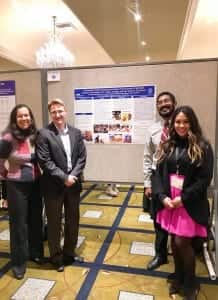
Learning Life’s Director, Paul Lachelier, plus medical student Anudeep Alberts, Dr. Melissa See and Dr. Kim Bullock of the Georgetown University School of Medicine (GUSM) co-presented a joint study of the food culture of lower-income families in three countries on Monday this week at the Health Literacy Annual Research Conference (HARC) in Bethesda, Maryland.
The cross-national study is a follow-up to research conducted by Drs. Lachelier and See earlier this year. The two studies are intended to better understand the food culture (i.e., shopping, cooking and eating practices, and the meanings attached to those practices) of selected families participating in Learning Life’s Family Diplomacy Initiative (FDI) in Washington DC, San Salvador, El Salvador, and Dakar, Senegal, with an eye to improving their health outcomes in the long-term.
Since Fall 2017, Learning Life has been collaborating with GUSM’s Community Health Division on international research and programming, including our food culture project, and more recently our project-supporting family “cook, eat and learn sessions” or CELS. Starting with that food culture project launched this year, Learning Life is grounding its FDI family-to-family projects in health. As Lachelier explains, “the vigor and happiness of individuals, families, communities, societies, indeed the entire world depends on good health. In turn, human health is also impacted by a myriad of factors, from the local food supply to global climate change. This makes health a vital, rich and flexible way for our families to learn about the wider world.” (Click here for more about FDI’s turn to health.)
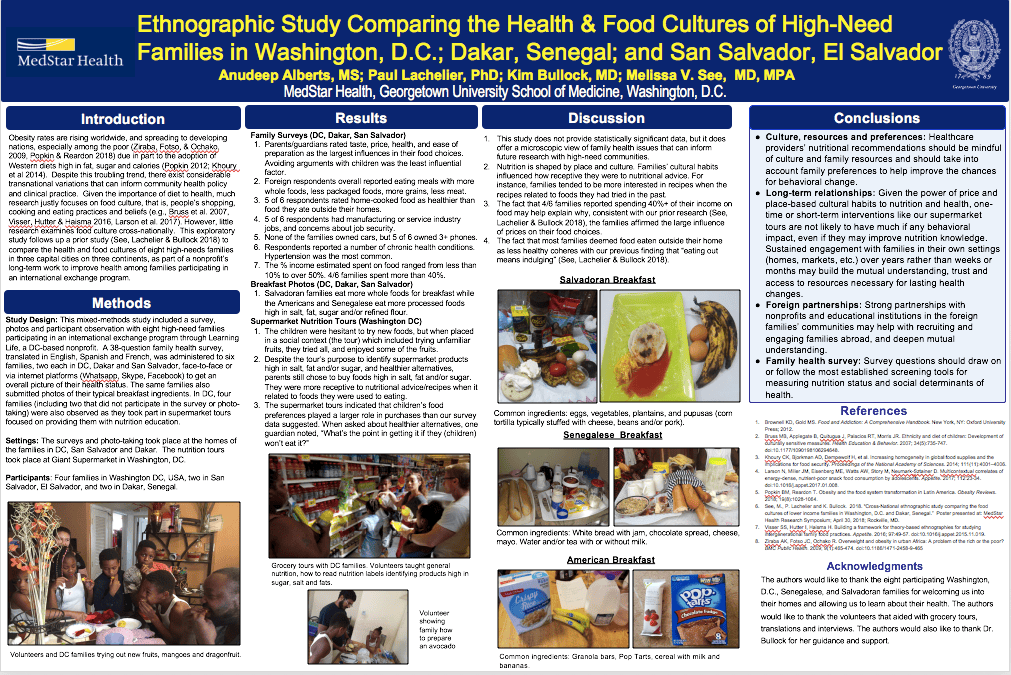
Since May, GUSM medical student, Anudeep Alberts, among other things worked diligently with Lachelier on the data collection then writing for this research poster. “We look forward to more collaboration with Learning Life on its innovative Citizen Diplomacy Initiative,” said Bullock, who directs GUSM’s Community Health Division. The poster is featured here, and below is the poster’s full text in larger print for readability. For a PDF copy of the poster, contact us at email@learninglife.info.
Ethnographic Study Comparing the Health & Food Cultures of High-Need Families in Three Countries
Introduction
Obesity rates are rising worldwide, and spreading to developing nations, especially among the poor (Ziraba, Fotso, & Ochako, 2009, Popkin & Reardon 2018) due in part to the adoption of Western diets high in fat, sugar and calories (Popkin 2012; Khoury et al 2014). Despite this troubling trend, there exist considerable transnational variations that can inform community health policy and clinical practice. Given the importance of diet to health, much research justly focuses on food culture, that is, people’s shopping, cooking and eating practices and beliefs (e.g., Bruss et al. 2007, Visser, Hutter & Haisma 2016, Larson et al. 2017). However, little research examines food culture cross-nationally. This exploratory study follows up a prior study (See, Lachelier & Bullock 2018) to compare the health and food cultures of eight high-needs families in three capital cities on three continents, as part of a nonprofit’s long-term work to improve health among families participating in an international exchange program.
Methods
Study Design: This mixed-methods study included a survey, photos and participant observation with eight high-need families participating in an international exchange program through Learning Life, a DC-based nonprofit. A 38-question family health survey, translated in English, Spanish and French, was administered to six families, two each in DC, Dakar and San Salvador, face-to-face or via internet platforms (Whatsapp, Skype, Facebook) to get an overall picture of their health status. The same families also submitted photos of their typical breakfast ingredients. In DC, four families (including two that did not participate in the survey or photo-taking) were also observed as they took part in supermarket tours focused on providing them with nutrition education.
Settings: The surveys and photo-taking took place at the homes of the families in DC, San Salvador and Dakar. The nutrition tours took place at Giant Supermarket in Washington, DC.
Participants: Four families in Washington DC, USA, two in San Salvador, El Salvador, and two in Dakar, Senegal.
Results
Family Surveys (DC, Dakar, San Salvador)
1.Parents/guardians rated taste, price, health, and ease of preparation as the largest influences in their food choices. Avoiding arguments with children was the least influential factor.
2.Foreign respondents overall reported eating meals with more whole foods, less packaged foods, more grains, less meat.
3.5 of 6 respondents rated home-cooked food as healthier than food they ate outside their homes.
4.5 of 6 respondents had manufacturing or service industry jobs, and concerns about job security.
5.None of the families owned cars, but 5 of 6 owned 3+ phones.
6.Respondents reported a number of chronic health conditions. Hypertension was the most common.
7.The % income estimated spent on food ranged from less than 10% to over 50%. 4/6 families spent more than 40%.
Breakfast Photos (DC, Dakar, San Salvador)
1.Salvadoran families eat more whole foods for breakfast while the Americans and Senegalese eat more processed foods high in salt, fat, sugar and/or refined flour.
Supermarket Nutrition Tours (Washington DC)
1.The children were hesitant to try new foods, but when placed in a social context (the tour) which included trying unfamiliar fruits, they tried all, and enjoyed some of the fruits.
2.Despite the tour’s purpose to identify supermarket products high in salt, fat and/or sugar, and healthier alternatives, parents still chose to buy foods high in salt, fat and/or sugar. They were more receptive to nutritional advice/recipes when it related to foods they were used to eating.
3.The supermarket tours indicated that children’s food preferences played a larger role in purchases than our survey data suggested. When asked about healthier alternatives, one guardian noted, “What’s the point in getting it if they (children) won’t eat it?”
Discussion
1.This study does not provide statistically significant data, but it does offer a microscopic view of family health issues that can inform future research with high-need communities.
2.Nutrition is shaped by place and culture. Families’ cultural habits influenced how receptive they were to nutritional advice. For instance, families tended to be more interested in recipes when the recipes related to foods they had tried in the past.
3.The fact that 4/6 families reported spending 40%+ of their income on food may help explain why, consistent with our prior research (See, Lachelier & Bullock 2018), the families affirmed the large influence of prices on their food choices.
4.The fact that most families deemed food eaten outside their home as less healthy coheres with our previous finding that “eating out means indulging” (See, Lachelier & Bullock 2018).
Conclusions
Culture, resources and preferences: Healthcare providers’ nutritional recommendations should be mindful of culture and family resources and should take into account family preferences to help improve the chances for behavioral change.
Long-term relationships: Given the power of price and place-based cultural habits to nutrition and health, one-time or short-term interventions like our supermarket tours are not likely to have much if any behavioral impact, even if they may improve nutrition knowledge. Sustained engagement with families in their own settings (homes, markets, etc.) over years rather than weeks or months may build the mutual understanding, trust and access to resources necessary for lasting health changes.
Foreign partnerships: Strong partnerships with nonprofits and educational institutions in the foreign families’ communities may help with recruiting and engaging families abroad, and deepen mutual understanding.
Family health survey: Survey questions should draw on or follow the most established screening tools for measuring nutrition status and social determinants of health.
References
1.Brownell KD, Gold MS. Food and Addiction: A Comprehensive Handbook. New York, NY: Oxford University Press; 2012.
2.Bruss MB, Applegate B, Quitugua J, Palacios RT, Morris JR. Ethnicity and diet of children: Development of culturally sensitive measures. Health Education & Behavior. 2007; 34(5):735-747. doi:10.1177/1090198106294648.
3.Khoury CK, Bjorkman AD, Dempewolf H, et al. Increasing homogeneity in global food supplies and the implications for food security. Proceedings of the National Academy of Sciences. 2014; 111(11):4001–4006.
4.Larson N, Miller JM, Eisenberg ME, Watts AW, Story M, Neumark-Sztainer D. Multicontextual correlates of energy-dense, nutrient-poor snack food consumption by adolescents. Appetite. 2017; 112:23-34. doi:10.1016/j.appet.2017.01.008.
5.Popkin BM, Reardon T. Obesity and the food system transformation in Latin America. Obesity Reviews. 2018; 19(8):1028-1064.
6.See, M., P. Lachelier and K. Bullock. 2018. “Cross-National ethnographic study comparing the food cultures of lower income families in Washington, D.C. and Dakar, Senegal.” Poster presented at: MedStar Health Research Symposium; April 30, 2018; Rockville, MD.
7.Visser SS, Hutter I, Haisma H. Building a framework for theory-based ethnographies for studying intergenerational family food practices. Appetite. 2016; 97:49-57. doi:10.1016/j.appet.2015.11.019.
8.Ziraba AK, Fotso JC, Ochako R. Overweight and obesity in urban Africa: A problem of the rich or the poor? BMC Public Health. 2009; 9(1):465-474. doi:10.1186/1471-2458-9-465.
Acknowledgments
The authors would like to thank the eight participating Washington, D.C., Senegalese, and Salvadoran families for welcoming us into their homes and allowing us to learn about their health. The authors would like to thank the volunteers that aided with grocery tours, translations and interviews. The authors would also like to thank Dr. Bullock for her guidance and support.


 Where were you born and raised?