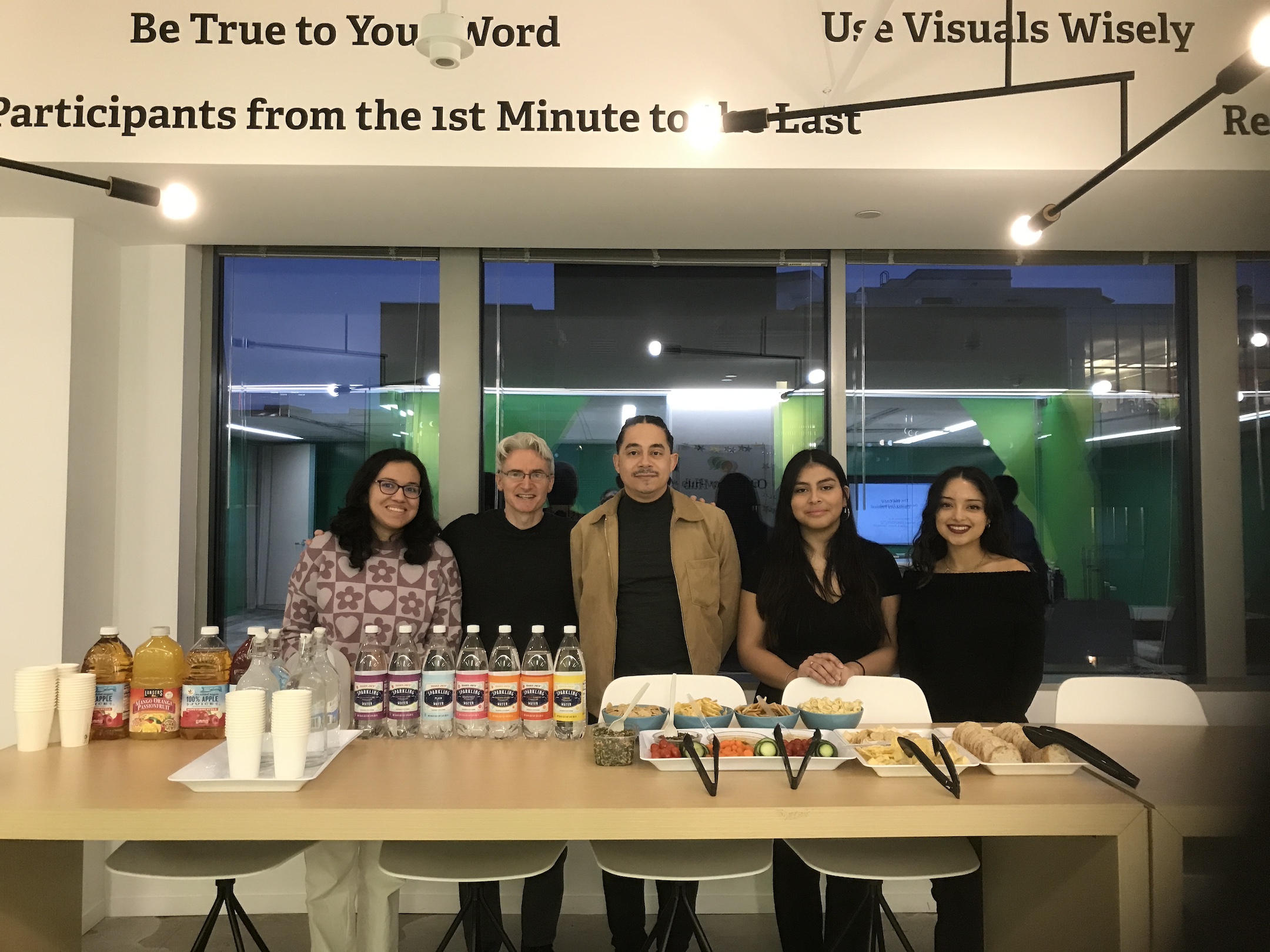
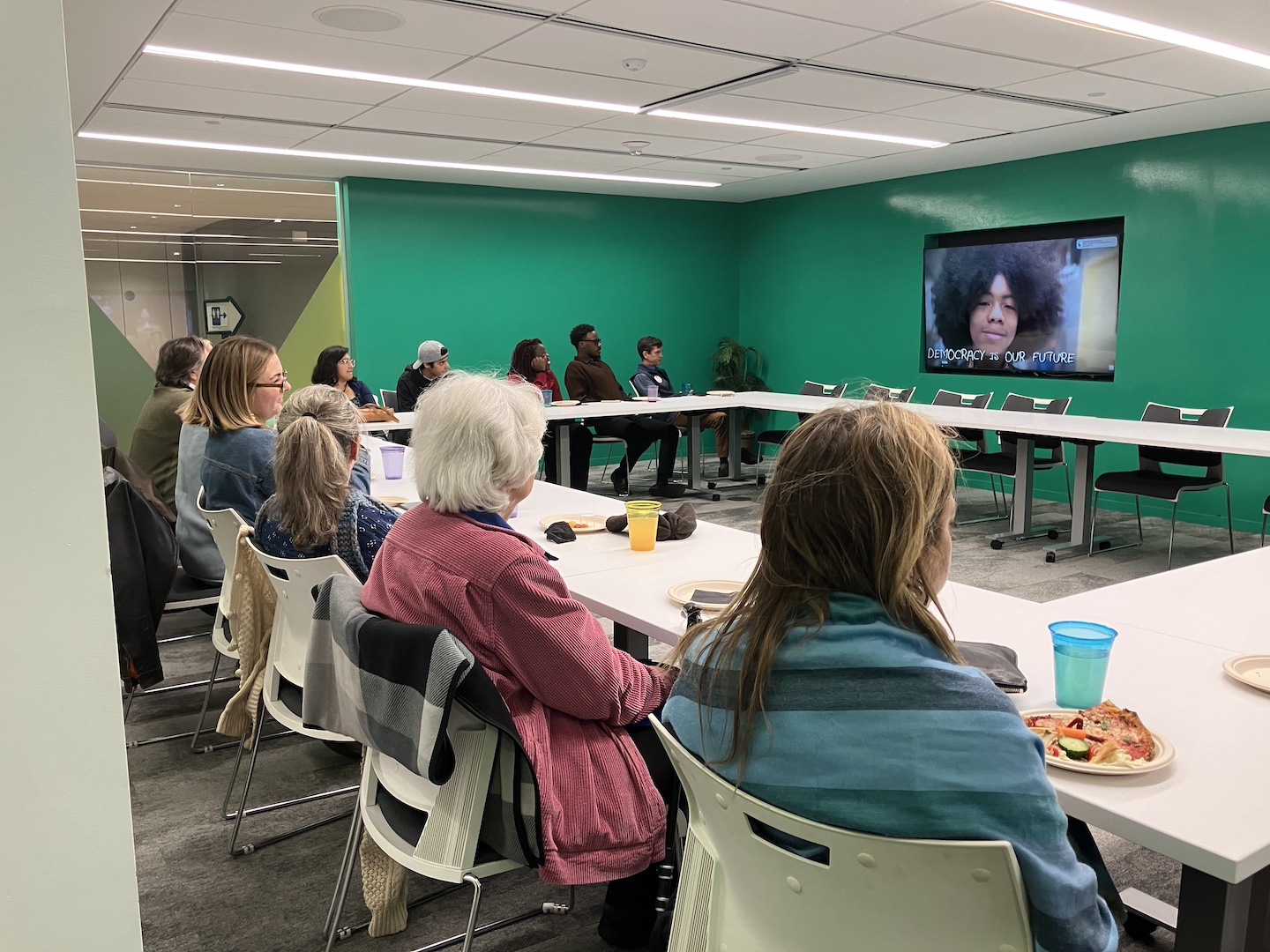
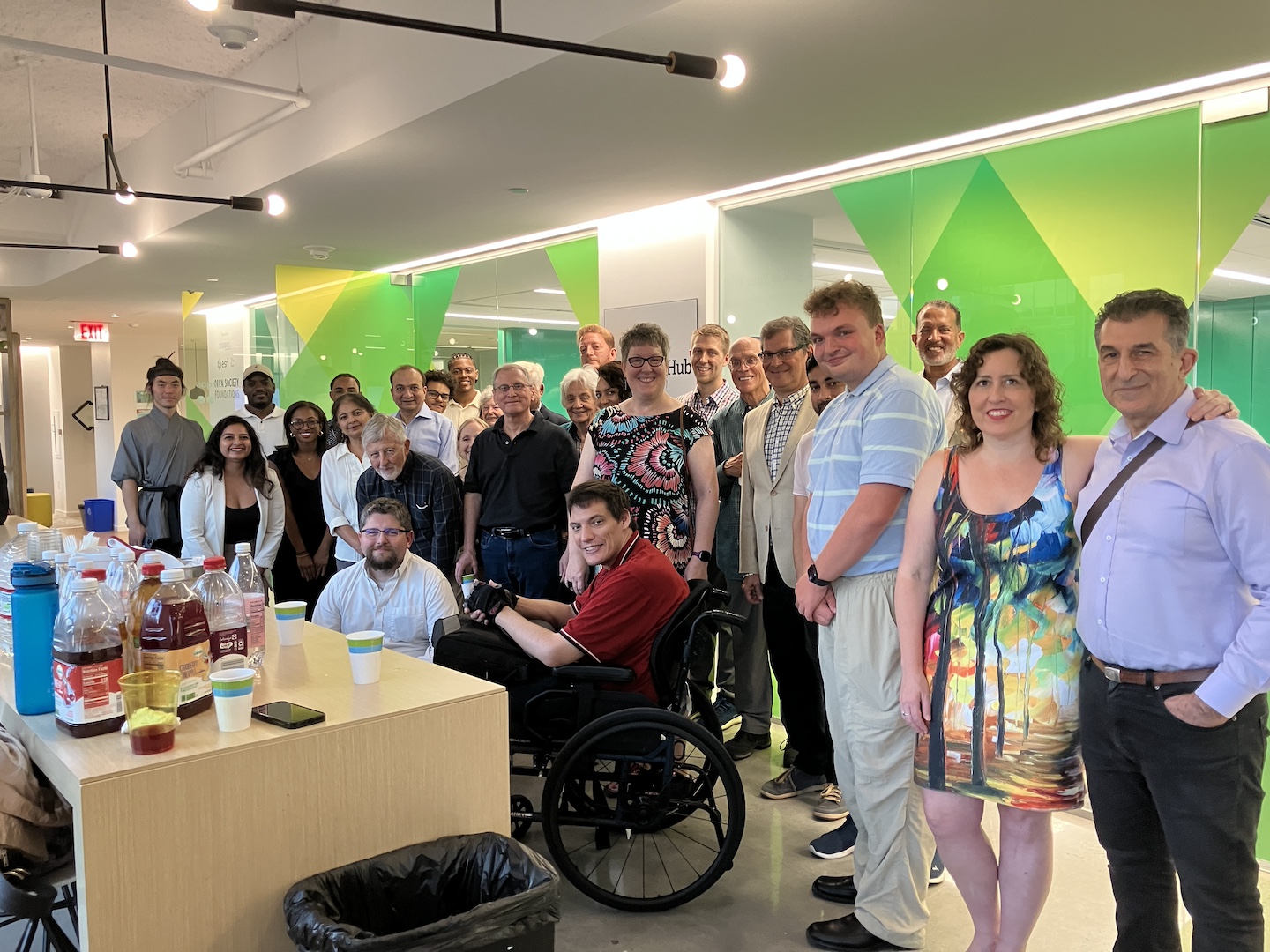
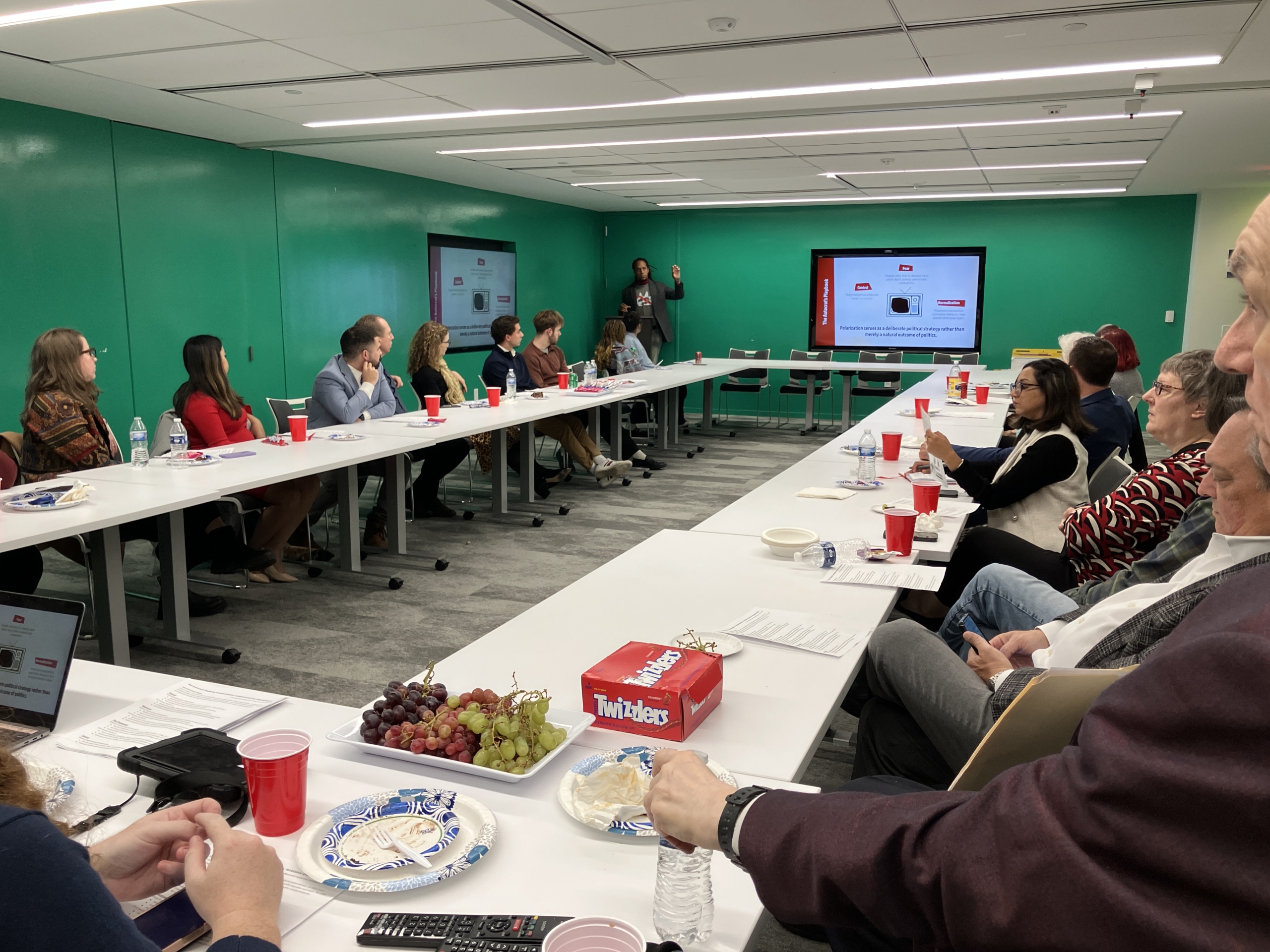
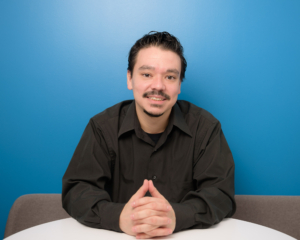
The “Stakeholder Spotlight” is an occasional series of posts highlighting people who are helping to advance Learning Life’s work. Our latest post in this series features Tony Rodriguez, Director of the Open Gov Hub, a Washington-DC located “dedicated work and event space supporting organizations in the open governance and transparency sector.” With Tony’s leadership, Open Gov Hub has kindly been hosting most of Learning Life’s Democracy Dinners since November 2023. See photos at bottom taken from some our Democracy Dinners at The Hub.
First, please tell us about you, Tony.
I’m originally from New York City, and despite living in DC, I continue to proudly—and sometimes painfully—follow the New York Mets.
My first foray into the nonprofit sector came through an internship in high school in the Hell’s Kitchen Neighborhood of Manhattan. I learned a lot about giving back to the community, information sharing, and resource scarcity. That internship had a lasting impact as it led to a college scholarship, and eventually my bachelor’s degree in business management.
I have an extensive background in operations and facilities management, which really shapes how I approach creating spaces where people can do their best work. In this field, you’re forced to wear a lot of hats and support a lot of teams. Because of this, I’ve picked up a lot of experience in network building, sales, marketing, and people management. This broad skillset helps me in my current role as the Director of a nonprofit co-working community and event space.
Lastly, a fun fact: I’m a bit of a Disney nerd. I love the storytelling, the world-building, and yes, especially theme-park operations and logistics.
Please tell us about the Open Gov Hub, and the benefits of joining the Hub.
The Open Gov Hub (OGH) is a dynamic co-working community and event space in Washington, DC, home to organizations advancing transparency, accountability, open government, and civic participation around the world. We bring together nonprofits, social enterprises, and changemakers who believe governance works best when it’s open, inclusive, and accountable.
As a member of OGH, you benefit from:
A collaborative community of mission-aligned organizations
Regular events, workshops, and networking that spark new partnerships
A flexible, well-designed workspace built for connection and productivity
Access to shared resources, from meeting rooms to event space to community programming
A culture of learning, innovation, and collective impact
We’re more than just a workspace—we’re a hub where ideas, people, and projects come together to strengthen open government movements globally.
Organizations that are members with the Open Gov Hub include:
Why does the Hub support Learning Life’s Democracy Dinners?
OGH supports Learning Life’s Democracy Dinners because they align perfectly with our mission to foster open, participatory, and informed communities. Democracy Dinners create intimate, thoughtful spaces for people to engage across differences, deepen their understanding of civic issues, and strengthen the social fabric that healthy democracies rely on.
We believe that democracy isn’t just shaped in formal institutions—it’s shaped in conversations, relationships, and shared learning. Supporting Democracy Dinners is one way we help cultivate a more connected, informed, and engaged citizenry, locally and nationally.
New Video about the Family Diplomacy Initiative!
Learning Life is excited to release a new video showcasing our growing Family Diplomacy Initiative (FDI)! The video features many screenshots and video clips from FDI’s international family diplomacy dialogues and trainings. Thanks to UC-San Diego student (now graduate!) and Learning Life intern Zhuo Kong for skillfully putting together this video!
Report on the first Youth Summit on Youth Policymaking
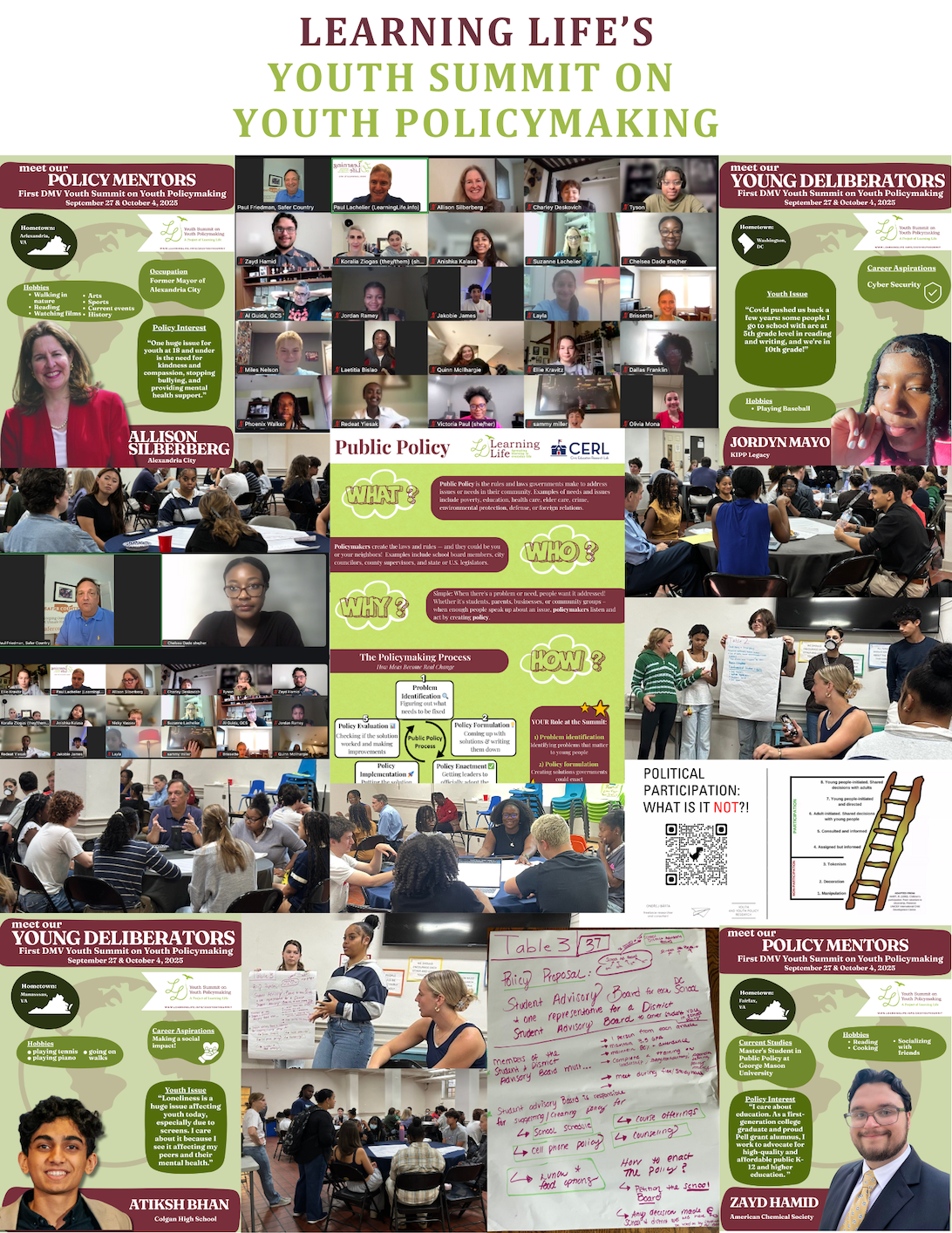
Learning Life is pleased to share the content and impact of the first Youth Summit on Youth Policymaking (YSYP) this fall in the Washington, DC capital region.
Summit Content & Context
Over the afternoons of Saturday, September 27 and October 4 this year, 34 diverse 8th-12th graders in the region engaged in online then in-person learning, deliberating, and proposing of policies at school, city, county and/or state government levels that would give voice to youth 18 and under in policies that affect them.
In so doing annually in the fall, with public advocacy in between, the Summit’s long-term goals are to bridge two consequential divides between (1) education and power / policymaking, and (2) private, public and charter school students in the highly unequal, segregated Washington DC region.
Below are highlights from the impact evaluation, the youth policies the Summit’s young deliberators proposed, and the votes they gave to each policy, plus acknowledgements of all those involved in this first Summit. Click here for the full impact evaluation, completed by Georgetown University’s Civic Education Research Lab.
Participant Demographics
Gender: 24 female, 10 male
Race: 14 black, 12 white, 6 Asian, 2 mixed
School type: 22 private, 8 public, 4 charter
Residence: 29 Washington DC, 3 Maryland, 2 Virginia
Twenty-five of the 34 students completed a pre-survey and post-survey comparing their civic knowledge, interest and self-efficacy (i.e., feeling effective or capable) before and after the Summit. Twenty-four of the 25 attended both Summit sessions on September 27 and October 4, while one attended October 4 only. Sixteen of the 25 completed the pre-survey before the first Summit meeting on September 27, and nine completed it after September 27 but before October 4. In order to best measure impact of the Youth Summit (September 27 + October 4), the highlights below focus on the sixteen young deliberators who attended on both dates, and completed the pre-survey prior to those dates.
Civic Knowledge
Got definition of public policy right: Pre-survey: 75% Post-survey: 71%
Got stages of policymaking right: Pre: 46% Post: 69%
Civic Interest
Strongly agree “I am interested in government and policymaking”: Pre: 31% Post: 73%
Strongly agree “I like interacting with people who are different from me”: Pre: 75% Post: 80%
Civic Self-Efficacy
Strongly agree “I am comfortable speaking in front of group of people I don’t know well”: Pre: 38% Post: 53%
Strongly agree “I am confident in my ability to work with others to solve problems in our community”: Pre: 69% Post: 73%
The Policies the Youth Proposed & Their Votes on Those Policies
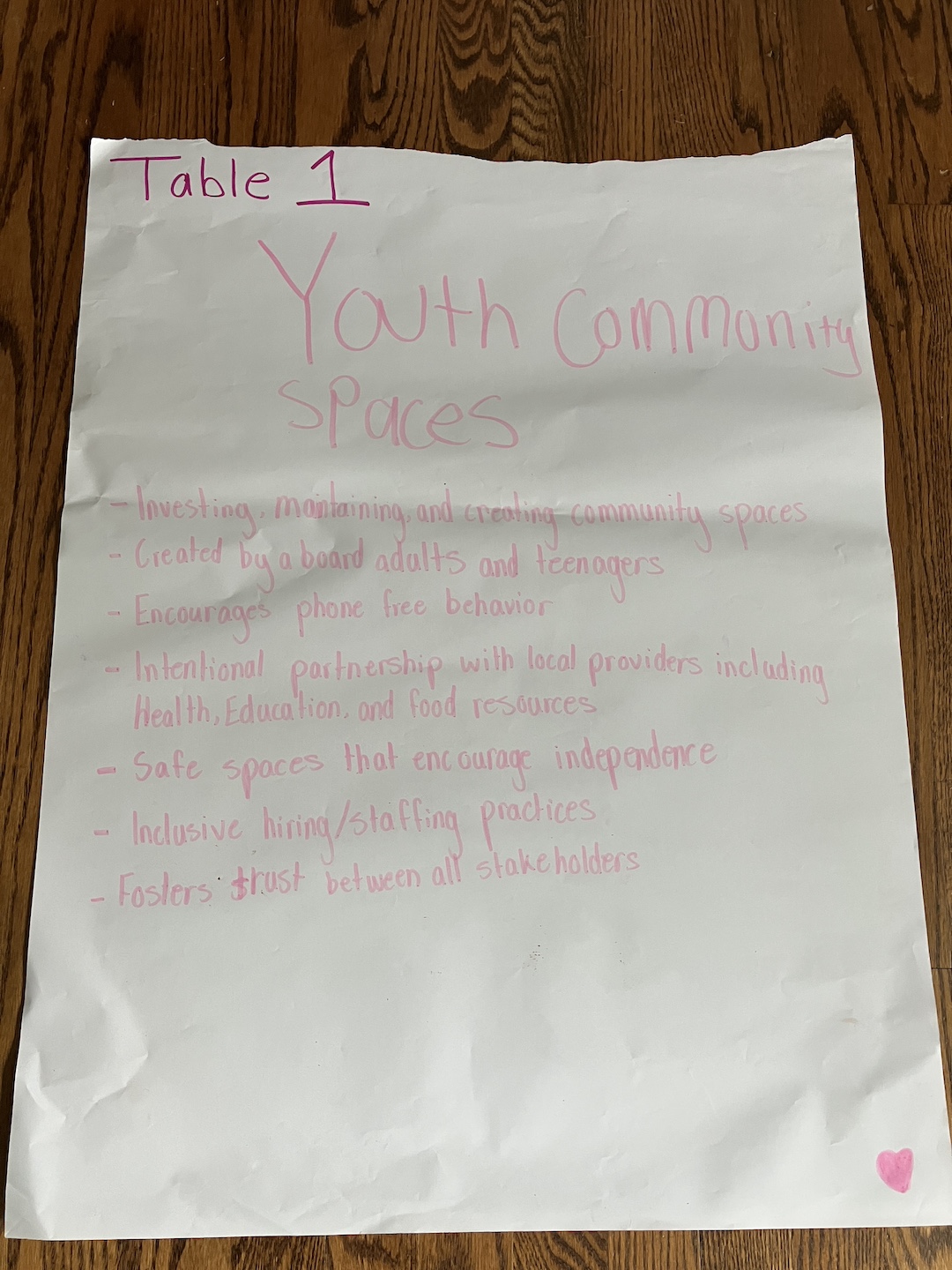
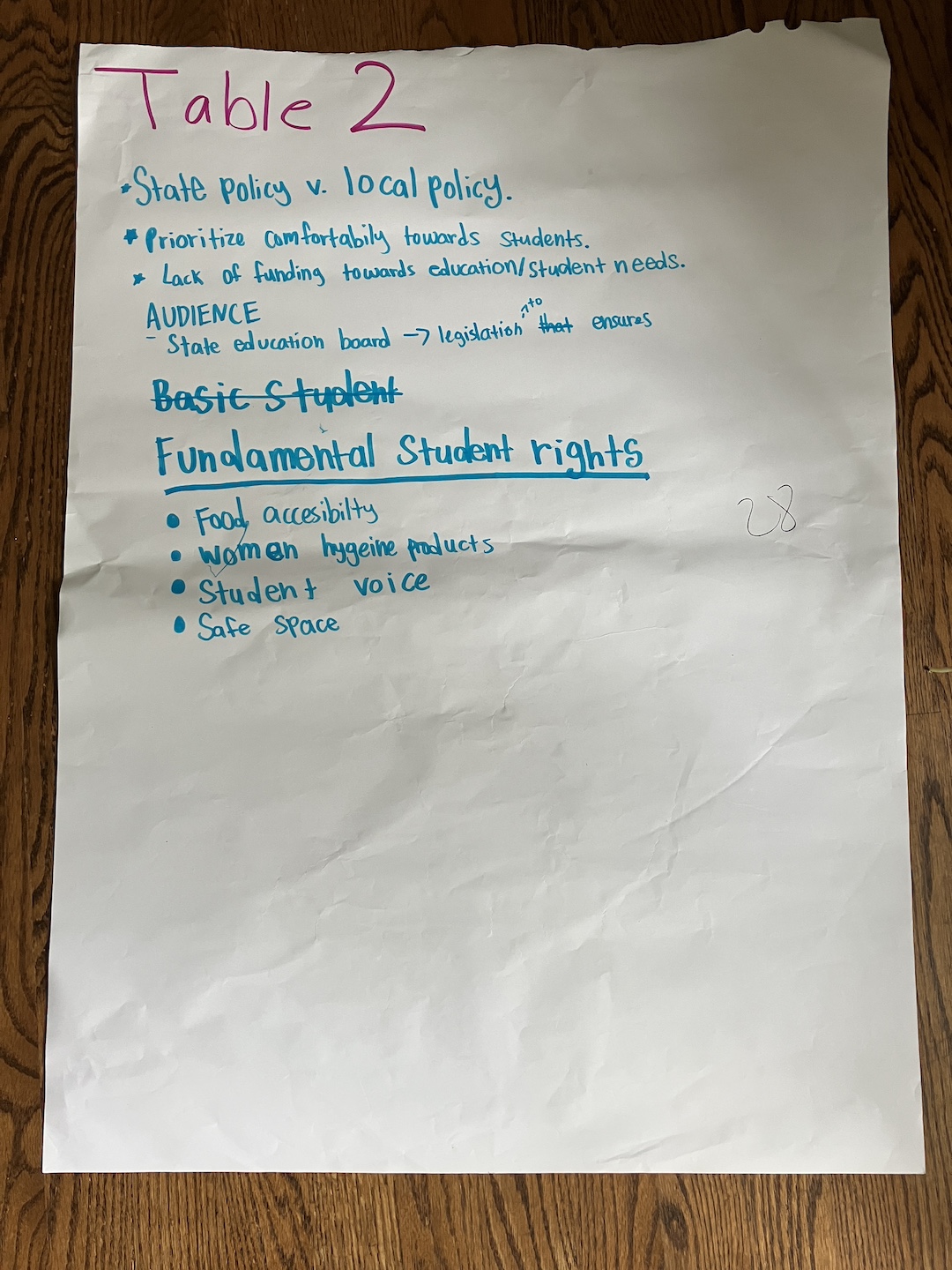
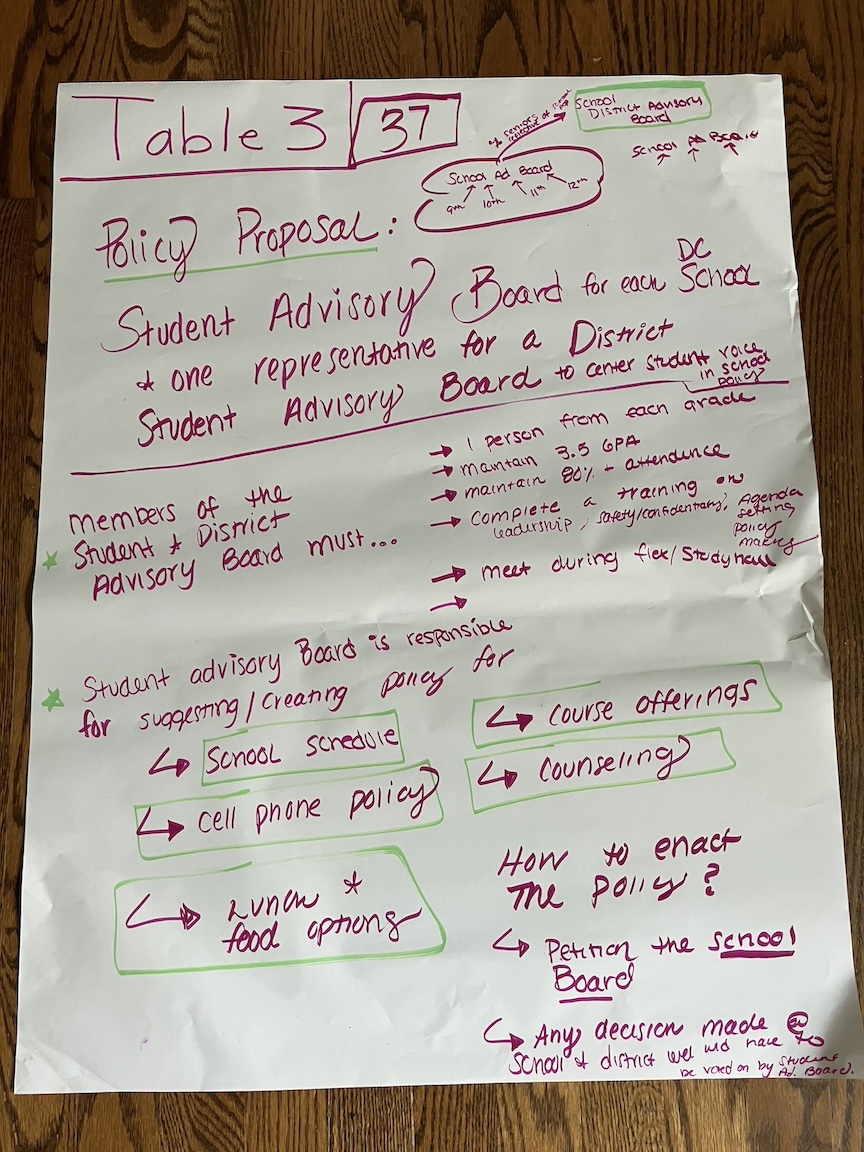
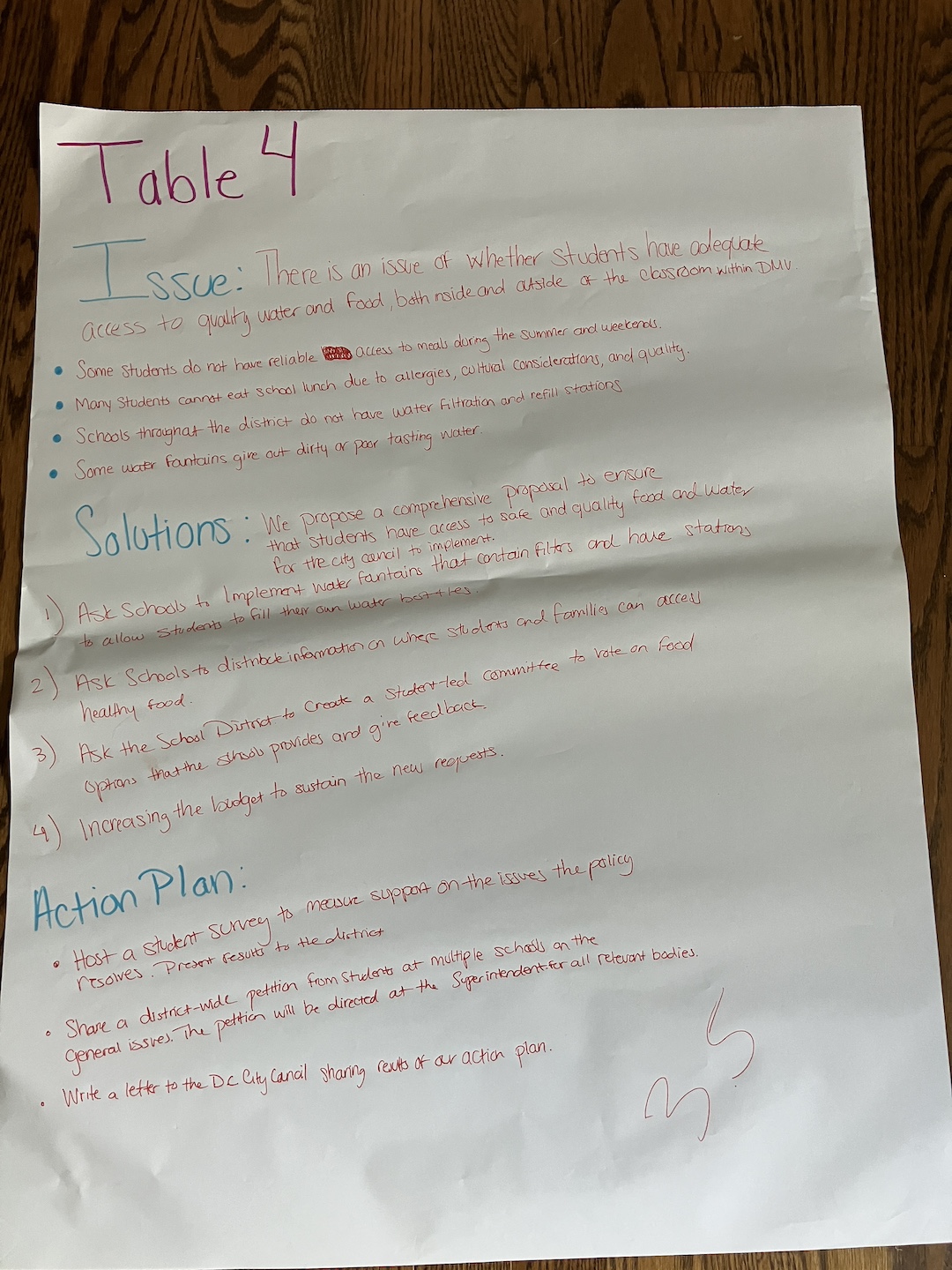
On the Summit’s second Saturday, in person, after preparatory remarks, the Summit’s young deliberators convened in six small groups or teams at six roundtables to each develop one policy to meet the needs of and/or give voice to young people in the DC region. The deliberators were assigned to tables to maximize diversity by school as much as possible.
YSYP youth then convened in one large group to explain their respective team’s proposed policy, one at a time, and answer any questions. The students then voted on all six proposals, each student receiving an equal number of token or votes to distribute among the six proposals as they each saw fit. Each team’s policy got the following vote totals:
Team 1: 51
Team 2: 28
Team 3: 37
Team 4: 35
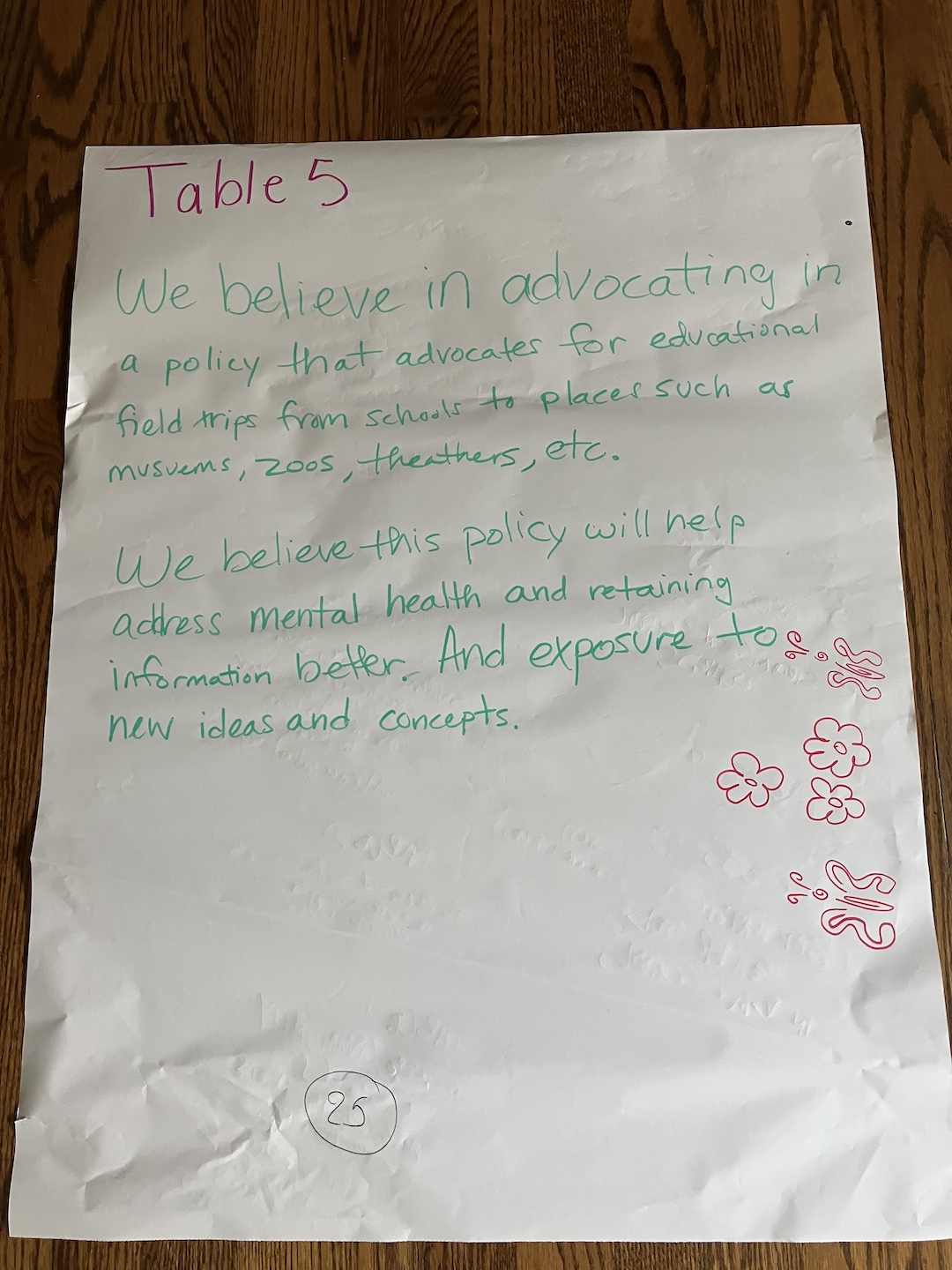
Team 5: 25
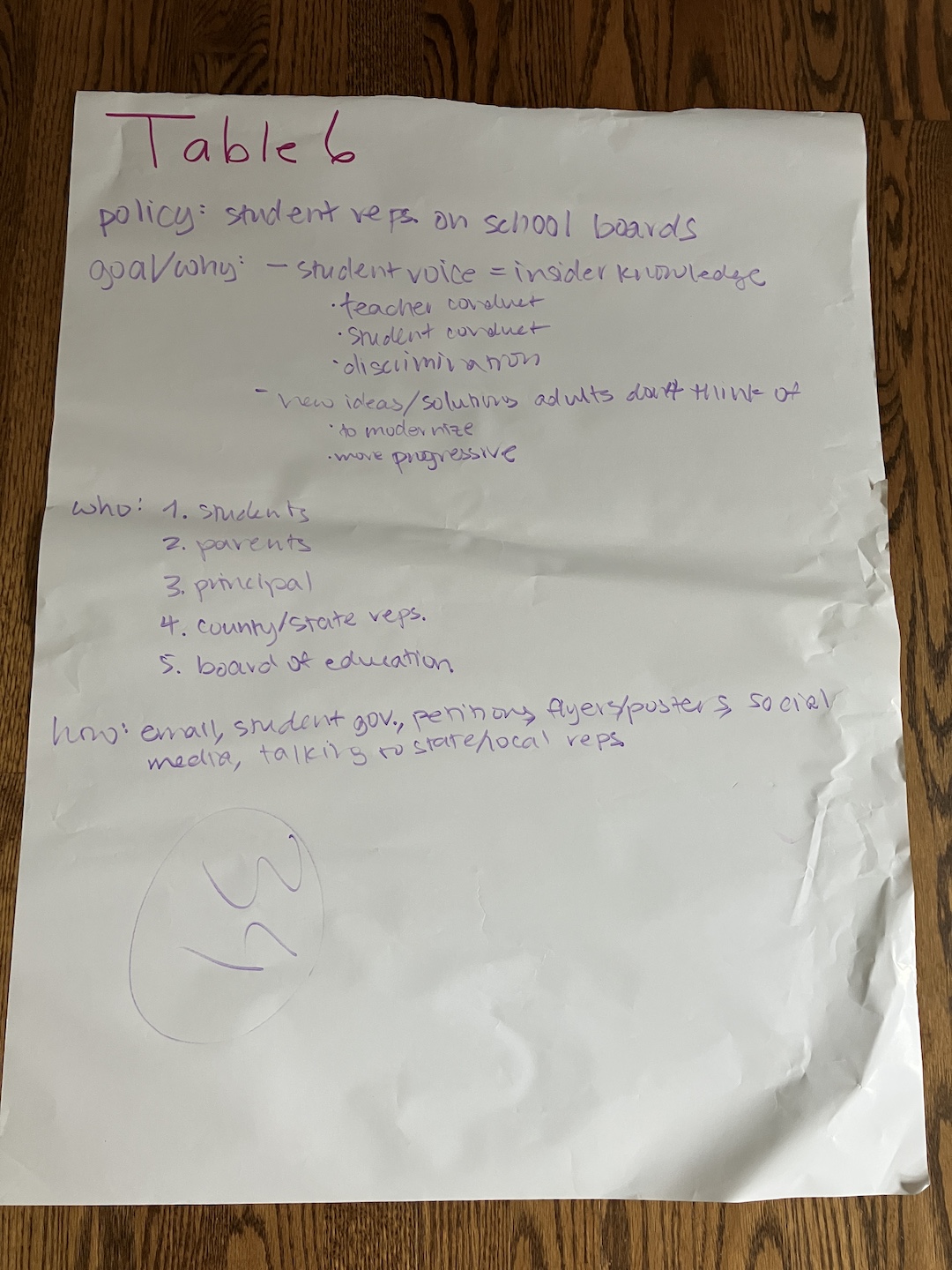
Team 6: 34
You can read each team’s proposal in the photo collage above, and a second photo collage highlighting the Summit’s meetings and participants below.
What Participants Liked about the Summit
The post-survey asked “What did you like most about the Summit?” The student respondents liked most the social aspect (networking, interacting with diverse people) and being heard as youth. Here were some of the young deliberators’ answers:
“I liked connecting with people of all ages around DC.”
“I liked what we did – brainstorming ideas, narrowing them down then coming up with a policy. It was very productive and made me think more about what policy making might take and what it involves (including different levels of government).”
“I enjoyed that we had experienced policy makers and those in the position to make policies because they taught us quite a bit about what goes into making policies. Coming up with our policies was every fun and informative because I learned that I enjoy policy making, as well as the thinking that went into making the policies.”
“I like the fact that people were passionate about their ideas. Everyone was engaged and enthusiastic about there policies and i was able to learn a lot about what is going on in different schools.”
“Engaging with people of different backgrounds to talk about real issues and learn new things.”
What Comes Next & Three Ways to Help
Between the Summits planned for each fall, Learning Life is organizing meetings with DC area middle and high schools and classes, civic, community and parent-teacher associations, relevant university groups, school and government boards, and others to (a) share the YSYP program, (b) recruit new student participants, and (c) make the case for involving youth 18 and under in policymaking that affects them to strengthen democracy’s future in our nation’s capital region.
YSYP alumni have the opportunity to volunteer as Youth Policy Advocates, recruiting new Summit participants, and advocating for youth by, among other things, speaking at the above-mentioned public meetings about their Summit experience, the youth policies the young deliberators proposed, and the need for youth engagement in school, city, county and/or state government policies affecting youth.
Any one in the DC region can help advance YSYP in three ways:
Schedule a Summit presentation to your class or group by emailing email@learninglife.info with your group’s name, city and state, contact person (name, title, telephone and email), at least three proposed meeting dates and times, and details to meet online preferably, and in person only in some cases depending on location. Presentations can be 5 to 30 minutes long, depending on your class or group’s meeting needs.
Copy and share via your social media the following call for student deliberators: “8th-12th grade students in the Washington DC area: Want to make new friends, deepen your understanding of youth issues, learn about policymaking, and/or exercise leadership in amplifying youth voices? Then RSVP now to request your seat at the DMV Youth Summit on Youth Policymaking this fall.”
Sponsor an 8th-12th grade young deliberator starting at $100. The full fee in 2026 will be $200 per student. Your sponsorship covers all or part of the fee for one or more students whose families cannot afford the full fee. When you contribute, please add “Youth Summit sponsor” in the Note box.
Acknowledgements
Learning Life thanks Georgetown University’s Civic Education Research Lab, including its Director & Principal Investigator, Diana Owen (who is also one of Learning Life founder Paul Lachelier’s former professors!), and Research Specialist, Jamie Joseph, for the Youth Summit evaluation. Working with Paul on the evaluation design, Jamie carried out the bulk of the data collection, and all the literature review, data analysis and writing.
Learning Life also thanks all of the policy professionals and graduate students who volunteered as senior and junior policy mentors to the Summit’s young deliberators: Ryann Alonso, Chelsea Dade, Paul Friedman, Alana Hackshaw, Zayd Hamid, Suzanne Lachelier, Andy McLeod, Victoria Paul, Destiny Sharpe, Allison Silberberg, and Rob Young. Special thanks to junior mentors Chelsea, Victoria and Zayd for preparing and presenting an effective “Policymaking 101” presentation, and to senior mentors Allison and Paul for offering their perspectives on policy to the Summit students at the September 27 online meeting in prep for the October 4 Summit in person.
Learning Life thanks the DC area school staff and teachers who shared the Summit opportunity with their students, and two DC social studies teachers in particular — Lynn Darby of MacArthur High School, and Brian Cunningham of The Lab School — for taking the time and effort to accompany their students to the Summit, and staying with them throughout the Summit, on a day these teachers would otherwise have off.
Last but certainly not least, we thank our sponsors who made it possible for youth whose families could not afford the full Summit fee to take part in YSYP: Marcia Anglarill, Matt Clausen, Patrick Cole, Mark Dreiling, Gretchen Ehle, Amy Fischer Bruey, Chip Hauss, Joe & Teresa Krettek, Cindy Mah, Chris McShane, David Meskill, Liudmila Mikhailova, Sherry Lee Mueller, Mark Nelson, Tony Perez, Isaiah Poole, Seth Radwell, Bill Schneider, Joe Toles, John & Carmen Vaughan, Nancy Walker, Emily Wasek, Margaret Willingham, and Ben and Sarah Yavitz.
Learning Life Wraps Up Nine Family Diplomacy Dialogues
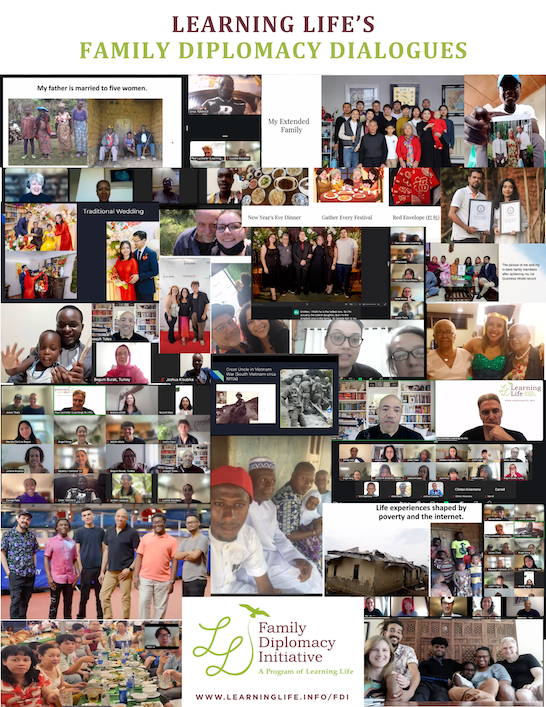
On Sunday, November 2, Learning Life held its last of nine consecutive monthly, live, international family diplomacy dialogues. The dialogues gathered via Zoom people from around the world to hear and discuss presentations on families from diverse countries, including Brazil, the USA, Canada, Uganda, Cameroon, Ghana, Vietnam and China. The dialogues are a simple, accessible way for ordinary people across the world to practice family diplomacy, fostering mutual understand and connection focused on family life and the challenges that families face.
You can view each of the nine 2025 family diplomacy dialogues at Learning Life’s Youtube Channel. You can also see photos from each dialogue at Learning Life’s “Families Connecting to Build a Caring World” Facebook Group. See below for a collage of selected photos from our 2026 dialogues. Learning Life plans to hold a new series of nine family diplomacy dialogues in 2026. Stay tuned for more information!
The dialogues are part of the Family Diplomacy Initiative. FDI connects people worldwide across lines of country, class, race and religion via the internet to share and learn together about families and citizen diplomacy with an eye to developing a corps of trained family diplomats to advocate for a more caring world via media, businesses, nonprofits and governments. Learn more and find out how you can get involved at the FDI link above.

 First, please tell us about you, Tony.