
DMV Youth Summit on Youth Policymaking
Note to supporting adults: If you wish to observe the Summit, or volunteer as a policy mentor or policy advisor, please complete the RSVP. If you can sponsor a Summit youth, please contribute here and type “Summit sponsor” in the donation page’s note field. Sponsorship is $200 per student, but you can co-sponsor at $100.
Are you a Washington DC-area resident and in 8th-12th grade, or of that age?
Want to develop your own voice, get community service hours, get youth heard in government policymaking, learn from adult policy mentors, and connect with diverse DC area 8th-12th graders about issues affecting youth?
Then RSVP to take part in the DMV Youth Summit on Youth Policymaking (YS)!
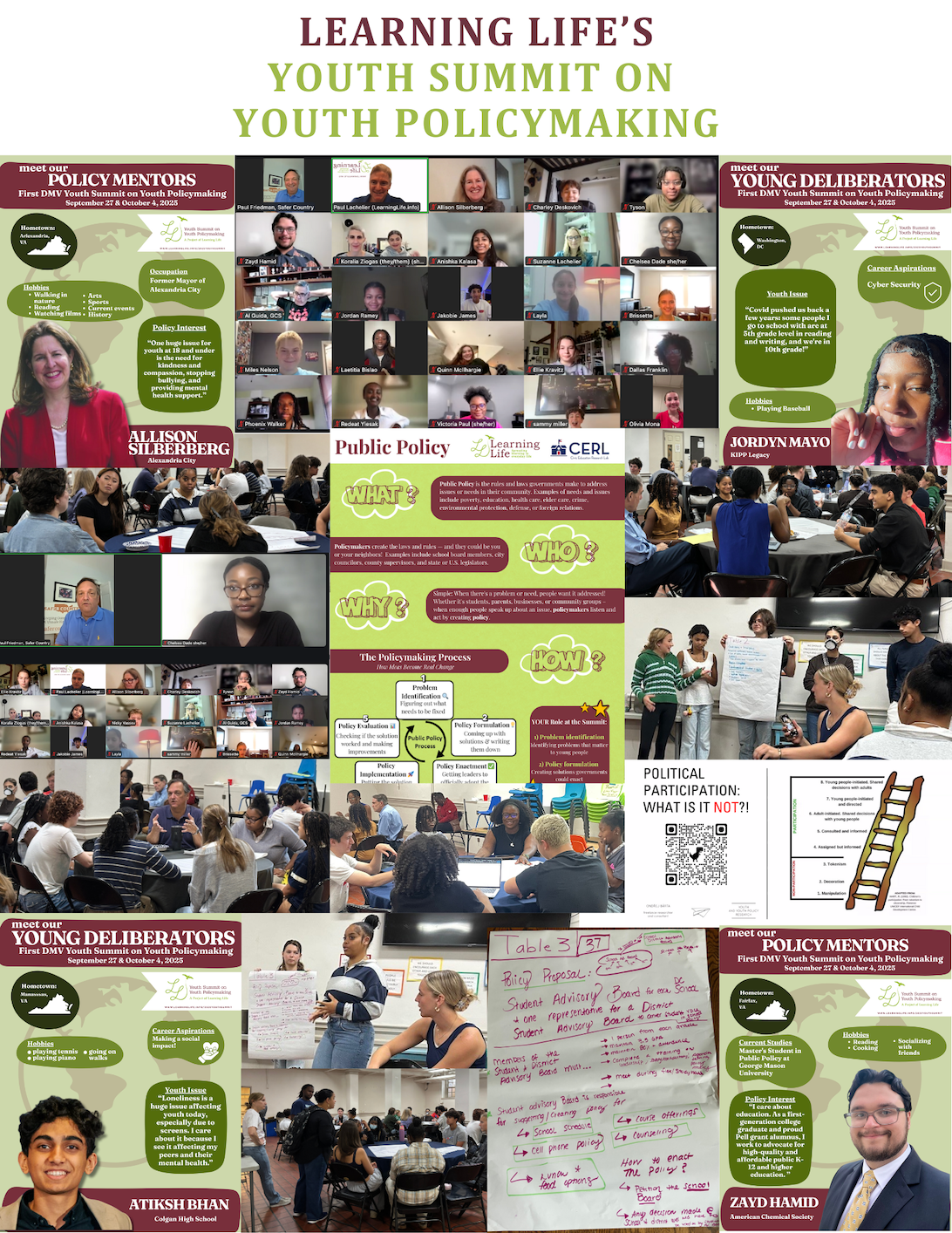
Check out our report on the first Youth Summit, which took place on Saturdays, September 27 and October 4, 2025. The second Summit will take place in fall 2026. Details below.
Context
By several measures, the United States is undergoing a democracy crisis, including rising polarization, proliferating disinformation, lack of public civic knowledge, longstanding inequality in civic participation, and declining trust in government, media and other institutions, among other problems. In many cases, these problems are acute among American youth.
American youth have always grown up in unequal communities, but those inequalities are getting worse, leading to vastly different family, health, safety, education and work experiences and outcomes. For instance, average life expectancy varies by as many 27 years in different DMV neighborhoods. Further, in schools, learning is typically divorced from participation in power. School tests, papers, and projects tend to be strictly academic exercises, intended foremost to move youth along toward the next grade level and graduation, rather than to connect and engage students as citizens in wider learning communities where youth can participate with adults in government policy-making.
For these reasons, Learning Life, a Washington DC-based educational nonprofit, is developing a Youth Summit on Youth Policymaking (hereafter, “the Summit” or “YSYP”) for diverse DC area youth in 8th-12th grade to be able to come together across lines of difference, learn, deliberate, and propose policies that could help give young people in the region more voice in government policymaking that affects them.
In formal school settings, research indicates that access to dedicated civics courses and participatory programs significantly enhances civic knowledge and political efficacy (Galston 2001, Ballard et al. 2016, Blevins et al 2016, Campbell 2019, Owen & Groth 2020). Students who attend civic workshops outside school, where they have the opportunity to meet with legislators and attend legislative hearings, experience significant gains in civic knowledge and political efficacy (Padilla et al 2020). Students’ commitment to civic participation also deepens when they are engaged in civics learning, afterschool activities, and live in civically responsive neighborhoods (Kahne & Sporte 2008, Blevins et al 2016). Student involvement in civic clubs and extracurricular activities also nurtures future civic behavior as an adult, including voting and community engagement (Youniss et al 1997, Kirlin 2002, Kahne & Sporte 2008). Overall, students demonstrate the most growth when their civic learning is student-driven, action-oriented and integrates skill-building and reflection (Morgan & Streb 2001, Kirlin 2002, Kahne & Sports 2008, Ballard et al 2016, Blevins et al 2016).
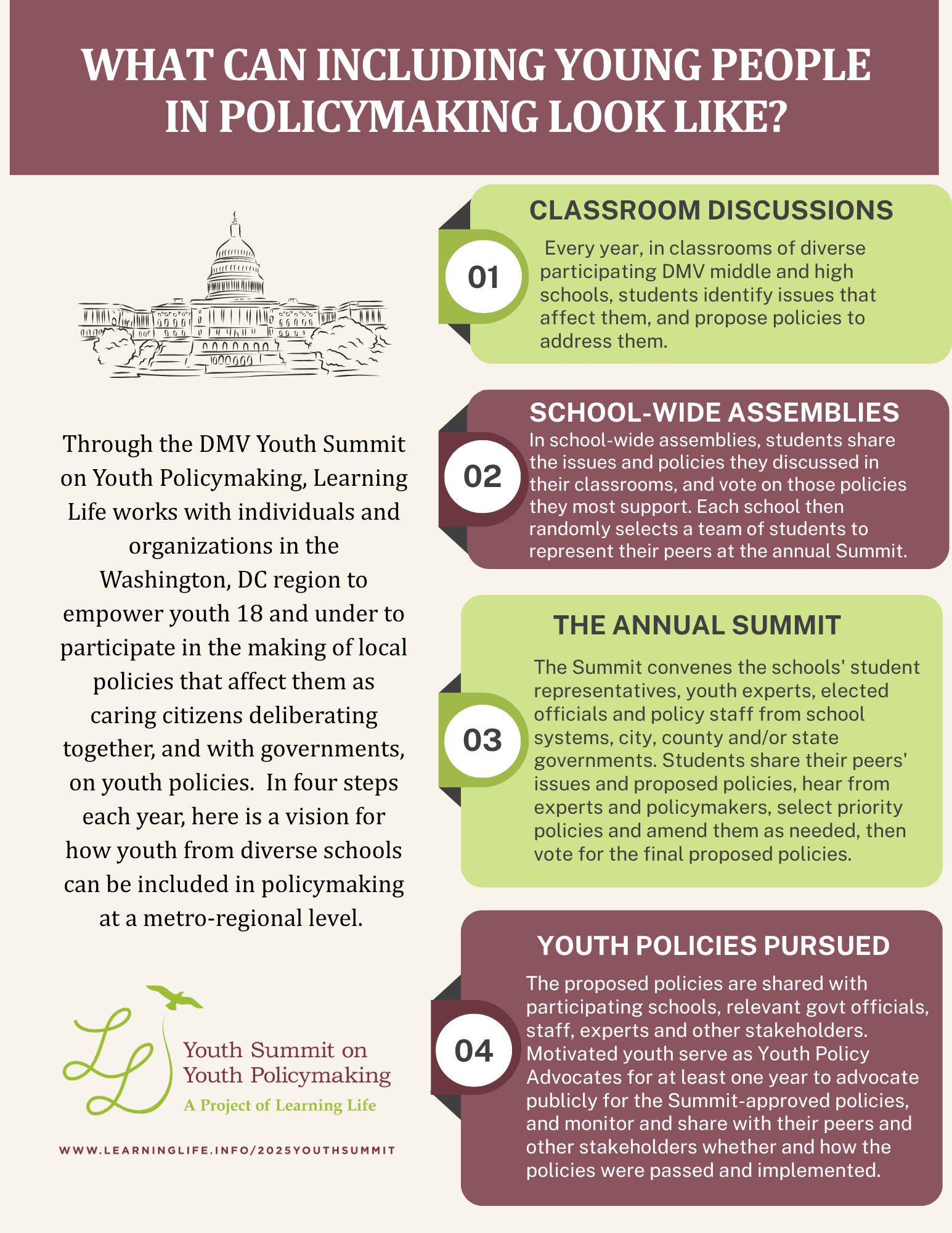
Longer term, Learning Life thus envisions an annual summit bringing young people together from throughout the DC region, across lines of class, race, religion and other divides, to connect, learn and propose policies on issues that affect them. Preparation would start in relevant school classes, proceed to school-wide deliberations, then the regional Summit, with follow-up opportunities for youth to participate in government policy deliberations, implementation and evaluation that affect young people 18 and under, with the support of foundations, schools, nonprofits, businesses and governments. Such a regular, community-supported, youth deliberative process should help (a) bridge social divides among DC area kids, and between kids and governments in the DC region, (b) engage more diverse young people in the DMV as connected, capable and caring citizens, (c) increase their influence on policymaking, thus improving government accountability to youth, (d) cultivate greater public trust in government, and (e) strengthen regional employment pipelines for the benefit of youth and employers.
Summit Schedule
- Saturday, September 26, 1:00-3:00pm: online, in interactive discussion, DC area policy professionals explain policy making at school and city levels.
- Saturday, October 3, 1:00-3:00pm: online, in interactive discussion, DC area policy professionals explain policy making at county and state levels.
- Saturday, October 10, 2-5pm, in person: Summit Day: student deliberators develop youth policy proposals in small groups, present them in the large group, then vote on all proposals, guided throughout as needed by their policy mentors.
- Following the Summit, participating students have the opportunity to serve as youth policy advocates advocating for youth engagement in government policymaking before classes, community groups and governments.
The October 10 Summit in person will tentatively proceed as follows:
2:00-2:20pm: Orienting remarks, then move into small groups of up to ten young deliberators, each with at least one adult policy mentor.
2:20-3:20: In small groups, student deliberators each develop one school, city, county or state policy proposal that would increase youth voice in policymaking that affects them, then together discuss and agree upon one policy proposal to present to the wider group.
3:20-4:15: Deliberators reconvene as one large group to present their proposals, and ask questions of other proposals.
4:15-4:30: Each deliberator votes on all the policies proposed.
4:30-5:00: Concluding remarks, then participants complete post-survey, get any community service forms signed, and receive raffle tickets (see benefits section below for more about the tickets).
The October 10 Summit will take place at DemFest 2026. DemFest 2026 culminates with a party at 5-6pm, including mingling, free sweets, and raffle prizes.
Following the Summit, Learning Life will produce a report, including all the YS small group policy recommendations, their votes gained, and the impact of the Summit. The report will be shared with all participants, elected officials and government staff, plus interested civic organizations in the DC region.
YS is a project of Learning Life’s DMV Democracy Learning Community (DLC), an association of DC area individuals and organizations working to make democracy more fun and inclusive by developing social events, products, services and spaces that entertain and nurture learning, networking, collaboration and wider, deeper citizen participation.
Benefits & Requirements
Benefits: For 8th-12th graders, benefits of participating in the Summit include:
- Three DemFest raffle tickets for a variety of prizes, including $100 cash. Raffle winners will be announced and prizes awarded at DemFest’s party at 5-6pm on Saturday, October 10. You must be in attendance at the party with your raffle tickets to be eligible for the raffle prizes.
- Up to 7 hours of YS community service credit for participation in all three days. Bring your service sheet with you to have it signed at the end of the Summit on October 10.
- Resume-building experience in policymaking.
- Connections to diverse DC area student peers, and policymaking professionals.
- Promoting youth voice in government policymaking in the DC area.
Requirements: To take part in the Summit, you must:
- Be in 8th to 12th grade, or of that age in fall 2026.
- Live within one hour’s drive from Washington, DC.
- Complete the RSVP by midnight, Wednesday, September 23, 2026. Summit students, mentors and advisors who opt in on the RSVP form may be highlighted in their own digital poster online to introduce the public to the YS participants.
- Pay the Summit fee by midnight, Wednesday, September 23:
$200/student for families with total gross household income over $150,000 in 2025.$100/student for families with total gross household income $75,000-$150,000 in 2025.$50/student for families with total gross household income under $75,000 in 2025.Schools: $200/student, for up to ten 8th-12th graders. Schools with restricted budgets can get a fee reduction pending funding from YS sponsors. At the payment page, make sure to note “Youth Summit fee” in the Note field. Learning Life trusts its Youth Summit families to pay honestly according to their household income, so no need to provide evidence of income. Note: the Summit fee is non-refundable.
-
Students complete a short consent or assent form, depending on their age, to participate in the YS impact evaluation. Parents of students 17 and under complete a consent form. The assent/consent forms are voluntary, but strongly encouraged to help us evaluate the impact of the Summit. The assent/consent form will be emailed to those who RSVP.
- Complete the YS pre-survey online. Those who complete the RSVP will receive the pre-survey. The pre-survey is voluntary, but strongly encouraged to help us evaluate the impact of the Summit.
- Optional, but encouraged: All those interested in the Summit are encouraged to join the DMV Democracy Learning Community (DLC) Linkedin Group. Through the Group, you can connect with Summit participants (students, policy mentors, advisors and sponsors), get updates about the Summit, and get a sense of the Summit community before the Summit activities commence. Note: Linkedin does not allow youth younger than 16 to have their own Linkedin account, but if you are under 16 you can take part in the community through a parent or legal guardian who can join the Linkedin community via their own adult Linkedin profile.
Adults who wish to observe the Summit, or volunteer as policy mentors or policy advisors, should complete the RSVP. If you can sponsor a Summit youth, please contribute here and type “Summit sponsor” in the donation page’s note field. Sponsorship is $200 per student, but you can co-sponsor at $100.
Contact us at email@learninglife.info with any questions.
References
Ballard, Parissa J., Alison K. Cohen, and Joshua Littenberg-Tobias. 2016. “Action Civics for Promoting Civic Development: Main Effects of Program Participation and Differences by Project Characteristics.” American Journal of Community Psychology 58: 377–390. https://doi.org/10.1002/ajcp.12103
Blevins, Brooke, Karon LeCompte, and Sunny Wells. 2016. “Innovations in Civic Education: Developing Civic Agency Through Action Civics.” Theory & Research in Social Education 44 (3): 344–384. https://doi.org/10.1080/00933104.2016.1203853
Campbell, David E. 2019. “What Social Scientists Have Learned About Civic Education: A Review of the Literature.” Peabody Journal of Education 94 (1): 32–47. https://doi.org/10.1080/0161956X.2019.1553601
Galston, William. 2001. “Political Knowledge, Political Engagement, and Civic Education.” Annual Review of Political Science 9: 217–234. https://doi.org/10.1146/ANNUREV.POLISCI.4.1.217
Kahne, Joseph E., and Susan E. Sporte. 2008. “Developing Citizens: The Impact of Civic Learning Opportunities on Students’ Commitment to Civic Participation.” American Educational Research Journal 45 (3): 738–766. https://doi.org/10.3102/0002831208316951
Kirlin, Mary. 2002. “Civic Skill Building: The Missing Component in Service Programs?” PS: Political Science & Politics 35 (3): 571–575. https://doi.org/10.1017/S1049096502000872
Morgan, William, and Matthew Streb. 2001. “Building Citizenship: How Student Voice in Service-Learning Develops Civic Values.” Social Science Quarterly 82: 154–169. https://doi.org/10.1111/0038-4941.00014
Owen, Diana, and Alissa Irion-Groth. 2020. “Civic Education for Youth Empowerment: The Impact of We the People and Project Citizen.” Journal of Higher Education Theory and Practice 20 (3). https://doi.org/10.33423/jhetp.v20i3.2977
Padilla, Yesenia Alvarez, Mary E. Hylton, and Jennifer Lau Sims. 2020. “Promoting Civic Knowledge and Political Efficacy Among Low-Income Youth Through Applied Political Participation.” Journal of Community Engagement and Scholarship (2020): n. pag.
Woolf, Steven, et al. 2018. “Uneven Opportunities: How Conditions for Wellness Vary across the Metropolitan Washington Region.” VCU Center on Society and Health.
Youniss, James, Jeffrey McLellan, and Miranda Yates. 1997. “What We Know About Engendering Civic Identity.” American Behavioral Scientist 40: 619–630. https://doi.org/10.1177/0002764297040005008